

How Ashtabula’s 1876 Train Disaster Changed American Railroads
On Dec. 29, 1876, a passenger train plunged into the Ashtabula River, leaving tragedy, unanswered questions and lasting reforms in its aftermath.

The Lake Shore & Michigan Southern Railway’s Pacific Express was within sight of the Ashtabula railroad station on the night of Dec. 29, 1876. Or it would have been, under normal circumstances.
The train, with a route from Buffalo to Chicago, had been running behind all day due to a massive snowstorm. A second locomotive had even been added after the train left Buffalo to help power it through snow drifts as high as 6 feet and winds with gusts up to 50 mph.
It was estimated that around 160 people were on the 11-car train. In addition to the standard crew, there were men hawking the day’s newspapers. Among the passengers were Philip Bliss, a composer and singer of gospel music, and Mary Birchard, a cousin of Gov. Rutherford B. Hayes. The former Civil War general was readying to take office in March as the 19th President of the United States. She was headed to his hometown of Fremont to receive an inheritance after the death of her and Hayes’ uncle, Sardis Birchard.
One of the enduring lessons of the Civil War was the importance of railroads, which had already become not only the dominant mode of transportation in the United States but also a lucrative business.
Nowhere were the railroads more important than in Ohio. By 1860, the state had more than 3,000 miles of track, the most of any state.
During that time, many railroad bridges used what was called a Howe Truss. Patented in 1840 by William Howe, the bridge used wood and metal. The design lent sturdiness while being relatively simple to assemble. Two years after it was patented, Howe’s brother-in-law Amasa Stone bought the rights to make Howe trusses, building hundreds as he became one of the nation’s leading railroad magnates.
When building a new span across the Ashtabula River in 1865, Stone replaced the Howe truss with one made entirely of iron. Although iron had more tensile strength than wood, it was also heavier, and the bridge initially sagged under its own weight. Twice, the bridge had to be rebuilt before being put into service.
Charles Collins, who did maintenance and engineering for the railroad, was one of many unnerved by the bridge, saying, “If it goes down, I trust it will be with a freight and not a passenger train.”
It was around 7:30 p.m. when the Pacific Express crossed the 154-foot bridge over the Ashtabula River, just 1,000 feet from the station. Socrates, the leading locomotive, had just cleared the bridge and was slowing to pull up to the station. Engineer Daniel McGuire felt the bridge shake and had the good sense to open the throttle, just as he started to hear a cracking sound.
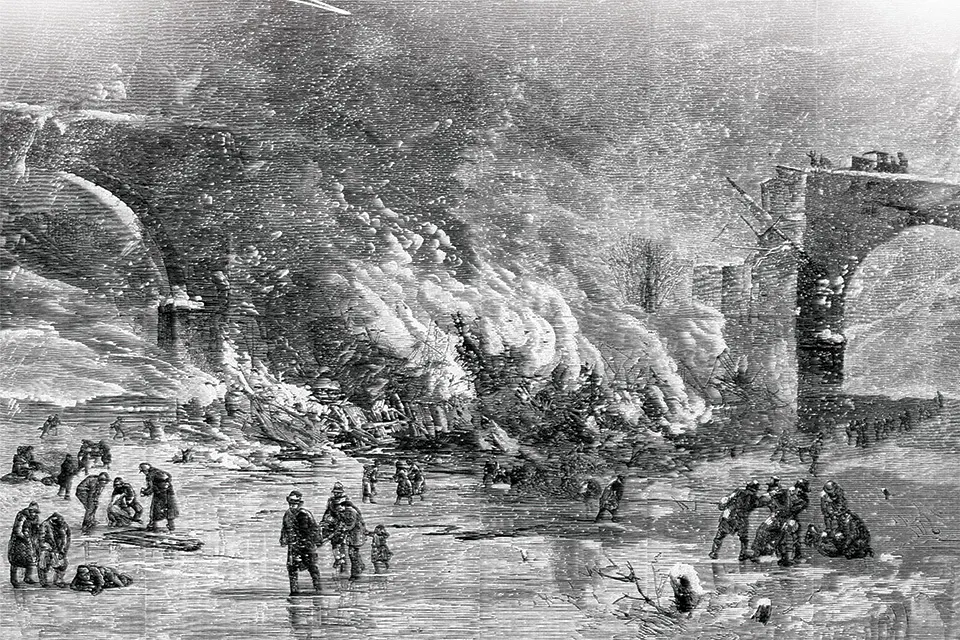
Socrates made it across the bridge. The rest of the train didn’t. As the span started to collapse, the coupling between the two engines broke under the strain, and Columbia, the other engine, and all 11 passenger cars fell more than 70 feet into the ice-covered river.
“The first thought that came into my mind was that I was dead,” recalled passenger Henry Wright of Weathersfield, Connecticut, in the book The Ashtabula Disaster, published just one year after the crash.
He lived to tell the story though. Dozens more didn’t in what has come to be called locally the “Titanic of the 19th century.”
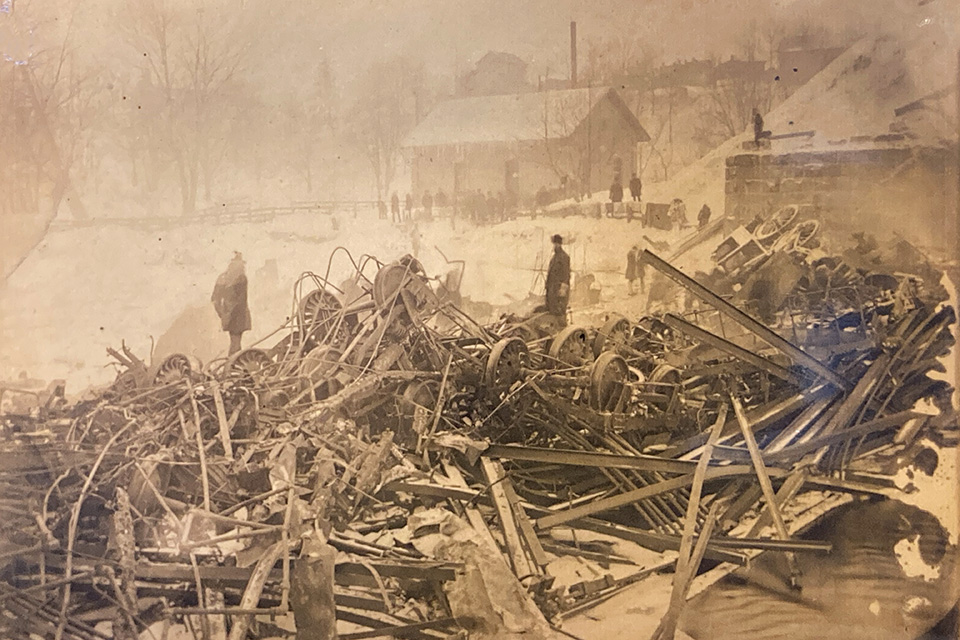
Wreckage from the Ashtabula train disaster (photo courtesy of the Ashtabula Maritime and Surface Transportation Museum)
Daniel McGuire, the engineer of the first locomotive, was the only person to make it across in the bridge collapse. He sprinted to the station as best he could in the snow, yelling, “Great God, the train is over the bridge, all but us!”
For the people below, what would become known as “The Ashtabula Horror” was just beginning. Those who survived the fall, amid a twisted mass of iron, wood and glass, faced myriad other dangers. Train cars were heated by iron stoves and lit by gas lamps, and soon, fire broke out, melting the ice covering the freezing cold river, making drowning or hypothermia real risks. “Danger threatened from all the elements,” wrote the Rev. Stephen D. Peet in The Ashtabula Disaster.
Witnesses reported seeing fires overtake entire train cars, being unable to aid people who were still trapped. In his book, Peet recalled hearing a woman asking her husband to slit her throat so she wouldn’t die in the fire. (They both safely escaped.) Among the dead were Mary Birchard and Phillip Bliss. The composer was able to extricate himself from the wreckage, but died trying to save his wife, who also perished.
Birchard and the Blisses were three of many people who were unidentifiable in death. It was estimated more than 90 people perished in the disaster. “No one could suspect they had ever been human beings,” The Stark County Democrat wrote of the dozens of bodies pulled from the wreckage.
One of the reasons so many people were burnt beyond recognition was that the fire raged until midnight. Firefighters took no action to douse the flames. At the time, the fire department was more of a social club than a public safety unit. Chief G.A. Knapp never gave a command to fight the fire. (He was relieved of his command following it.)
The crash led to accounts of great heroism. Nearby residents ran to the station and the fire scene, even forming a bucket brigade in the face of the fire department’s inaction. Telegraph operators John Manning and Charles B. Leek — the latter being the first Black telegraph operator in the United States — stayed at their post for more than two days straight, managing communications in the crash’s aftermath.
Families in Ashtabula opened their homes to people injured in the crash, giving them a place to recover. Marion Shepard, a passenger on the train who was on her way back to her native Wisconsin, became a heroine, dragging people to safety and breaking windows to free trapped passengers.
“She was one of the bravest and best women I ever met,” said George Wright, another passenger who survived.
And yet there were examples of humanity at its worst. The train was regarded as a luxury form of transportation, with many well-heeled passengers. Robbers descended upon the wreckage, taking hundreds, if not thousands of dollars in cash and jewelry from the dead and dying.
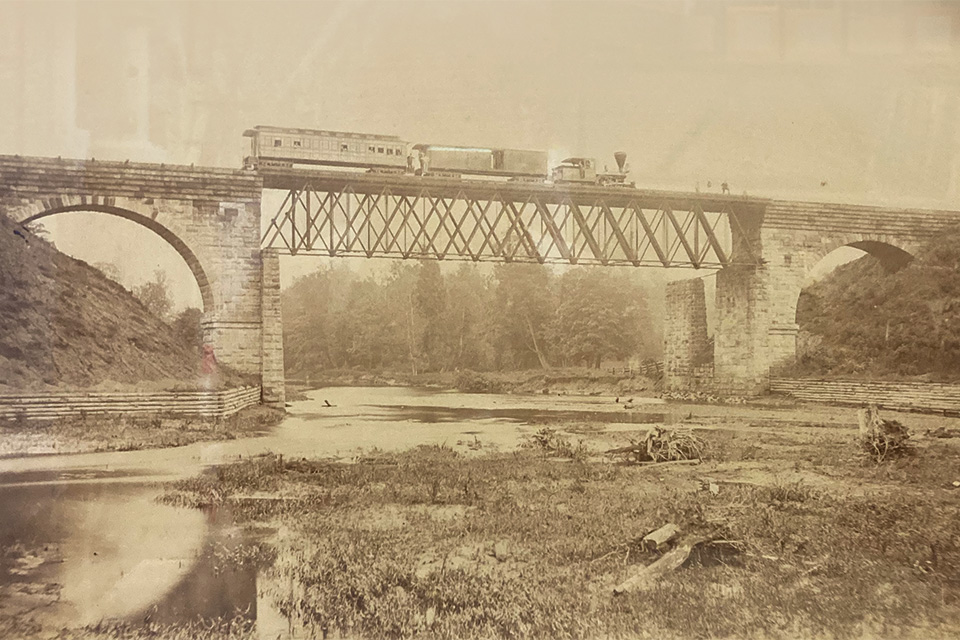
A train crossing the iron, double-truss railroad bridge over the Ashtabula River prior to the span’s failure (photo courtesy of the Ashtabula Maritime & Surface Transportation Museum)
Almost immediately, investigations started into the bridge collapse, both by the state legislature and by an Ashtabula County coroner’s jury. Stone theorized that something caused the second engine to derail, leading to the massive crash. He said that the bridge was the strongest one he had designed and that it had shown no signs of weakness.
Charles Collins testified Jan. 17, 1877, at the state hearing, held in Cleveland. Two days earlier, he had submitted his resignation, which wasn’t accepted. After his testimony, he missed both an inspection of the replacement bridge and the ceremony for the mass burial of 48 unidentified victims of the crash at Chestnut Grove Cemetery in Ashtabula. On Jan. 20, 1877, he was found dead of a gunshot wound. It was officially declared a suicide, but further investigation theorized he was murdered.
Amasa Stone met a similar fate. On May 11, 1883, Stone locked himself in his bathroom and shot himself in the chest. It was also ruled a suicide. He had been plagued by further personal financial losses and health issues, including chronic insomnia. Although he denied his own culpability, in the eyes of the law, he bore blame for the Ashtabula bridge collapse.
A county coroner’s jury and an investigation convened by the state legislature both held the railroad liable for the collapse. The coroner’s jury verdict stated that the bridge was flawed and improperly inspected and that the railroad failed to keep up with current law with stoves that would self-extinguish in the event of a derailment.
Ultimately, the railroad paid out around $500,000. Among those who got settlements were H. Ellsworth Bennett, a Civil War veteran who was selling newspapers on the train. Bennett, who lost an eye and was laid up for nearly a year with injuries (he married the nurse who attended to him, and they had 11 children), got a dollar a day, with an annual payment of his year’s settlement.
Bennett gained some fame in the 1930s as the world’s oldest newsboy, and he lived to be 107. He said when he went to Cleveland to collect his annual pension at the age of 103 that the claims agent asked him, “Are you still living?”
It’s said that every safety regulation is paid for in blood. It’s only through disasters that public safety personnel, investigators and regulators learn about new safeguards. And that was true in Ashtabula.
Following the disaster, many railroads started to switch to steam heat in passenger cars to avoid fires. The Interstate Commerce Act of 1887 included a federal bridge code. Further federal regulations forbade the use of iron in railroad bridge construction.
There have been train crashes since — some with even greater loss of life — but there has never been a train crash as serious in the United States since that involved a bridge collapse.
“The effect of the accident has been increased safety of travel,” wrote Daniel W. Lothman, a noted Cleveland educator, in The Plain Dealer in 1932. “The disaster probably did more than anything else to bring about better devices for stopping trains, for heating passenger cars, for preventing fires in case of wrecks, and above all, frequent inspection of bridges to ensure their safety. The sad part of it is that the lesson learned by railroads had to be such a frightfully expensive one.”
For more Ohio history, sign up for our Ohio Magazine newsletters.
Ohio Magazine is available in a beautifully designed print issue that is published 7 times a year, along with Spring-Summer and Fall-Winter editions of LongWeekends magazine. Subscribe to Ohio Magazine and stay connected to beauty, adventure and fun across our state.
Related Articles

5 History-Focused Events This Month
Take a trip to the past at these Ohio gatherings, including an old-fashioned baseball match and a period-appropriate reenactment showcasing historic trades and crafts. READ MORE >>

Visit Marietta’s Haunted Mansion This Fall
The Anchorage Mansion offers a slew of ghostly stories in a nearly 250-year-old river city filled with them. READ MORE >>

Explore Historic Buildings with Ohio Open Doors
The Ohio History Connection program running Sept. 10 through 20 offers special free tours of historically significant landmarks in every county. READ MORE >>