


The History of 8 Iconic Ohio Courthouses
Ohio’s courthouses tell a story of our state’s growth and evolution but also one of the communities where they stand.

Ross County Courthouse, Chillicothe
Chillicothe served as the first capital of Ohio, and its first courthouse, built in its territorial days, held the state’s seat of government. (A replica of that structure was completed in 1940 on Chillicothe’s Main Street, and it is currently used as an office building.)
Ultimately, Columbus became the state’s permanent capital, and Ross County used its original courthouse until the 1850s, when a new one was built, designed by Edward Collins and Charles Autinrieth in the Greek Revival style.
“The idea was to tie the developing American republic to old republics like Greece and Rome,” says Andrew Hall, executive director of the Ross County Historical Society.
The courthouse is like a temple, Hall says, adding that it is unique for its central portion’s large white facade — made from stone quarried from the nearby village of Bainbridge — that includes Corinthian columns and a clock tower, and wings on either side for county offices. (The wings can be confusing to navigate today, Hall notes, because office titles engraved inside the building do not necessarily coincide with what is in those offices anymore.)
“The courthouse really captures a lot of people’s attention and imagination,” Hall says. 2 N. Paint St., Chillicothe 45601
***
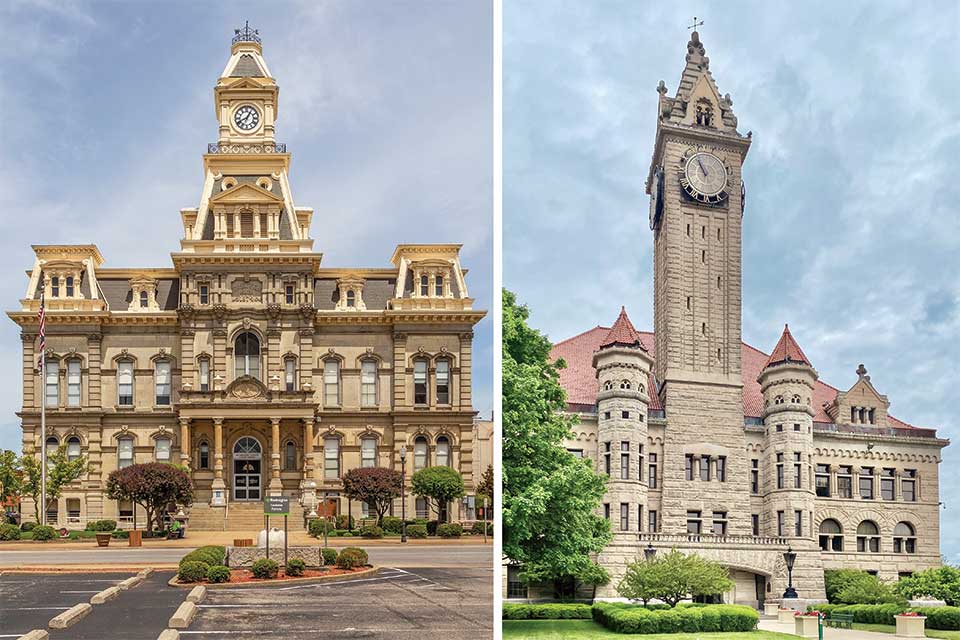
Left: Muskingum County Courthouse in Zanesville (photo by Christopher Riley); Right: Wood County Courthouse in Bowling Green (photo by Warren LeMay)
Muskingum County Courthouse, Zanesville
For one legislative session, from 1810 to 1812, the Muskingum County seat of Zanesville supplanted Chillicothe as Ohio’s capital. The building that served as the state capitol during those years later became the Muskingum County Courthouse.
It was added onto in 1833, but even before the Civil War, it was determined a new courthouse would be needed. A 1869 fire made it a necessity. Construction of the new courthouse was not without controversy though, from arguments over its site to questions of the lack of local employment on the project. Architect Harry Myer, who had previously designed the Stark County Courthouse and would also design courthouses in Licking and Athens counties, embraced the French Second Empire style for the building’s design, most notably its mansard roof. Construction began in 1874, with the cornerstone laid the following year.
The courthouse is notable for being one of the first buildings to use American-made ceramic tile, a product for which Zanesville would become famous.
County officials moved into the courthouse in 1877, and it has withstood threats to its existence over the years, from the Great Flood of 1913 to a 1955 fire, and is still in use today. 401 Main St., Zanesville 43701
***
Wood County Courthouse, Bowling Green
The Wood County Courthouse was born out of an oil boom. Once oil was struck in Lima in 1885, wells popped up throughout northwest Ohio. By the 1890s, Standard Oil alone provided 10 percent of the tax revenue collected in Wood County.
Clearly, a new courthouse was needed in Bowling Green, which had become the county seat in 1868, with offices moving from Perrysburg two years later.
The courthouse was one of three in Ohio designed by Yost and Packard, a firm most notable for its work on Ohio State University’s campus. (It also designed the oversized front porch added to future president Warren G. Harding’s home in Marion.)
The cornerstone was laid for the Richardsonian Romanesque Revival courthouse in 1894, with crowds estimated at around 15,000. The courthouse, which was built with sandstone quarried in Amherst and includes a 185-foot clock tower, opened two years later (and not without controversy, as county commissioners, contractors and the architectural firm were all indicted for corruption and kickbacks).
When the courthouse opened, it was estimated that 30,000 barrels of oil were being taken daily from Wood County — reflected in a courthouse mural showing a field of oil wells, supposedly a view looking south from the train depot in nearby Portage. 1 Court House Square, Bowling Green 43402
***
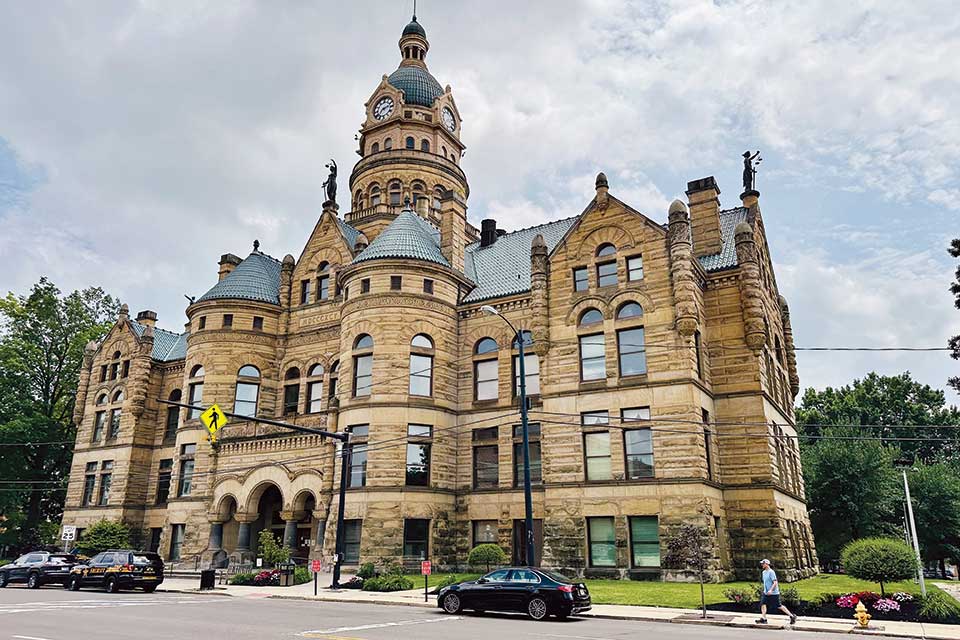
Trumbull County Courthouse in Warren (photo by Paul Chandler)
Trumbull County Courthouse, Warren
Even before there was a state of Ohio, there was a Trumbull County. Formed from part of the Connecticut Western Reserve, the county was founded in 1800, but it took another 15 years for its first courthouse to be built. After outgrowing it, the county built a second structure in 1854, but it was destroyed by fire in 1895.
Locals were looking for something more permanent and more majestic, so they turned to La Belle and French, an architectural firm in Marion, Indiana, to design the new courthouse. Its cornerstone was laid on Thanksgiving 1895, and the new building opened in 1897, featuring Amherst sandstone (leading to its nickname “The Rock Palace”), a copper roof, textured rustification, inset turrets, a clock tower and arches that were hallmarks of the Richardsonian Romanesque style.
“They saw themselves within the county as having this imposing structure that could really make a statement,” says Meghan Reed, executive director of the Trumbull County Historical Society.
The courthouse was at one point home to the city’s library, as well as the local Grand Army of the Republic post and the National Women’s Suffrage Association. It’s also notable for having the largest courtroom in the state, Courtroom #1. Among those who argued there was famed defense attorney Clarence Darrow, himself a Trumbull County native. 161 N. High St. NW, Warren 44481
***
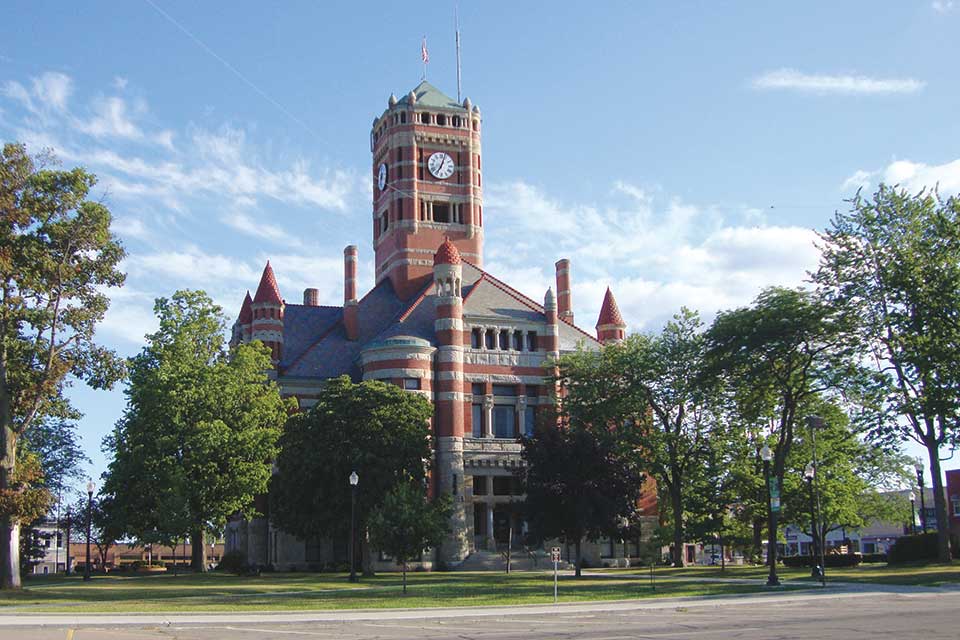
Williams County Courthouse in Bryan (photo by Jordan McAlister)
Williams County Courthouse, Bryan
A county-seat war was brewing as Williams County officials considered the construction of a new courthouse in the late 19th century. Bryan had been the county seat since 1840, but Montpelier was making a push. It was more centrally located, and its case was bolstered by the arrival of the Wabash Railroad in 1881.
The two towns traded lawsuits, and Bryan officials believed the best way to solidify their case for the county seat was to build a new courthouse, even tearing down the current courthouse to build on the same site.
Toledo architect E.O. Fallis, whose works can be seen throughout northwest Ohio today, designed the building, which contains elements of Richardsonian Romanesque and French Baroque styles. The cornerstone was laid in 1889, and construction was completed in 1891.
The brick-and-sandstone building resembles a castle, with its 165-foot-tall clock tower that is visible from outside of town. The central tower, featuring a clock that was refurbished in 1976, is the largest of 12 towers atop the courthouse. Inside Georgian marble was used for the floors and wainscoting, as well as the courthouse’s detailed railings. 1 Courthouse Square, Bryan 43506
***
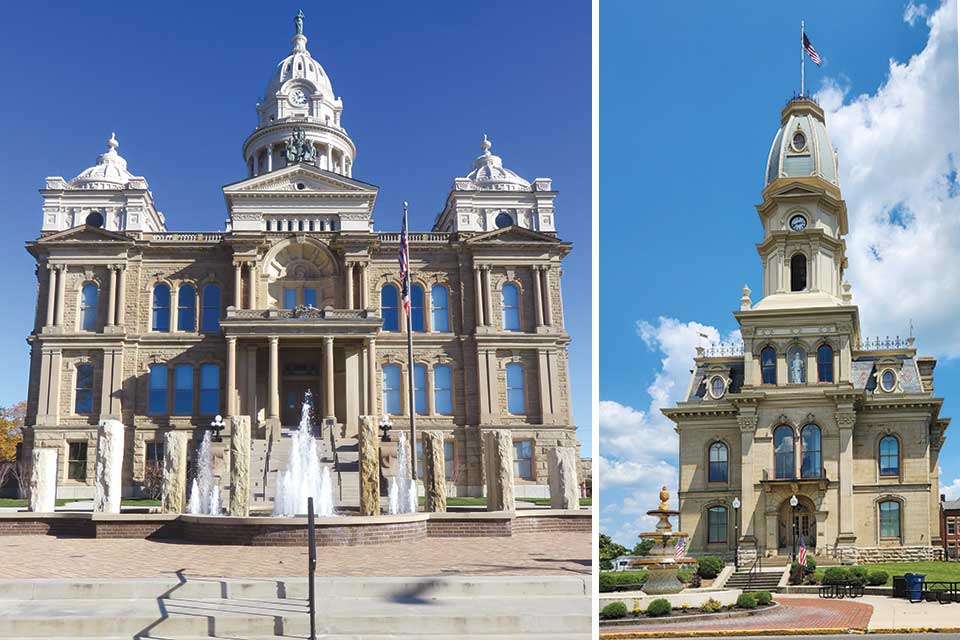
Left: Miami County Courthouse in Troy (photo by Jordan McAlister); Right: Logan County Courthouse in Bellefontaine (photo by Doris Bowling)
Miami County Courthouse, Troy
During the 1880s, when Miami County was looking for a designer to summon grandeur for its fourth courthouse in Troy, they turned to Joseph W. Yost, who had designed several throughout Ohio individually and with his firm, Yost & Packard.
Yost designed the Miami County Courthouse, which was completed in 1888 at a cost of $400,000, in the Beaux-Arts style, and named it for the French school where it started, L’ecole Des Beaux Arts. The design style is known for its ornamental elements, which can be seen in the courthouse’s raised pediments, Corinthian columns and grand archway over the main entrance. It boasts a 185-foot-tall dome with a copper statue of Lady Justice atop it and a third-floor rotunda beneath it, as well as smaller corner domes, each topped with statues representing agriculture, education, industry and transportation.
Features inside include encaustic floor tiles, cast-iron stairs, plaster ceilings and polychrome reliefs of busts showing the diversity of mankind. A $6 million, three-year exterior renovation that ended in 1998 saw all seven exterior copper statues renovated. It was, at the time, the largest cast-iron facade restoration ever done. An interior renovation is currently ongoing. 401 W. Main St., Troy 45373
***
Logan County Courthouse, Bellefontaine
In the early days of Logan County, court proceedings were held in a tavern on South Main Street. But in the late 1860s, as the county was considering its third courthouse — to be built on the site of the second one, in the Bellefontaine town square — something more grandiose was demanded.
“It was the point where people were coming back from the Civil War and realizing the focal point was the courthouse,” explains retired Logan County Judge C. Douglas Chamberlain.
County Commissioners tapped Alexander Koehler, a German immigrant whose architecture work could be seen all over Cleveland. He designed a massive sandstone-and-iron structure in the Second Empire style, a a baroque-influenced architecture so named for its origin in the second French Empire. The centerpiece of the courthouse was a massive courtroom, 70 feet wide and 55 feet long, with a 35-foot barrel-vaulted ceiling (another hallmark of Second Empire architecture).
In 2012, a derecho hit Logan County, and the 58-ton clock tower of the courthouse was moved as much as seven inches. County offices were relocated for fear of building collapse, and the courthouse reopened in 2018 following a $16 million renovation that upgraded the courthouse’s utilities while restoring it to its former grandeur. 101 S. Main St., Bellefontaine 43311
***
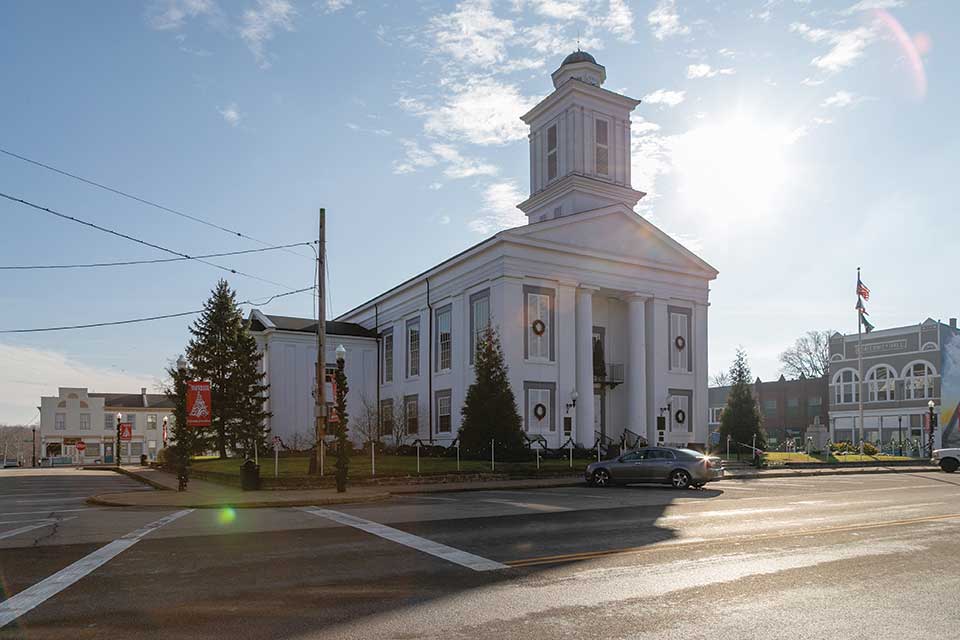
Brown County Courthouse in Georgetown (photo by Christopher Riley)
Brown County Courthouse, Georgetown
The Brown County Courthouse faced a crossroads after it was set afire early June 18, 1977. (Arson was suspected, but nobody was ever charged.) The courthouse’s interior, roof, stairway and cupola were extensively damaged in a second-floor blaze fought by 11 different fire companies. Was it time to tear down the 127-year-old structure and rebuild fresh? Or was the old courthouse worth saving?
The courthouse, designed by local architect Hubbard Baker and opened in 1851, is the second one that has stood on the square in Georgetown. The first opened in 1824 and lasted for 25 years before commissioners sought a new one.
Baker’s courthouse embraced the Greek Revival style, with white painted brick, Doric columns on the building’s exterior, Greek moldings and a cupola. Two additions were made in 1910 for various county offices and courthouse space and kept with the initial design. The courthouse sustained minor damage in a fire in 1888 (also suspicious), but nothing like the 1977 fire, with a damage estimate of $450,000 (nearly $2.5 million today).
Ultimately, the decision was made to restore the courthouse, and it remains a landmark on the square in Georgetown to this day 101 S. Main St., Georgetown 45121
For more Ohio history inspiration, sign up for our Ohio Magazine newsletters.
Ohio Magazine is available in a beautifully designed print issue that is published 7 times a year, along with Spring-Summer and Fall-Winter editions of LongWeekends magazine. Subscribe to Ohio Magazine and stay connected to beauty, adventure and fun across our state.
Related Articles

Living-History Performance Highlights ‘Frankenstein’ Author
The Rutherford B. Hayes Presidential Library & Museums in Fremont shares the story of Mary Shelley during this performance at the Hayes’ Victorian home. READ MORE >>

5 History-Focused Events This Month
Take a trip to the past at these Ohio gatherings, including an old-fashioned baseball match and a period-appropriate reenactment showcasing historic trades and crafts. READ MORE >>
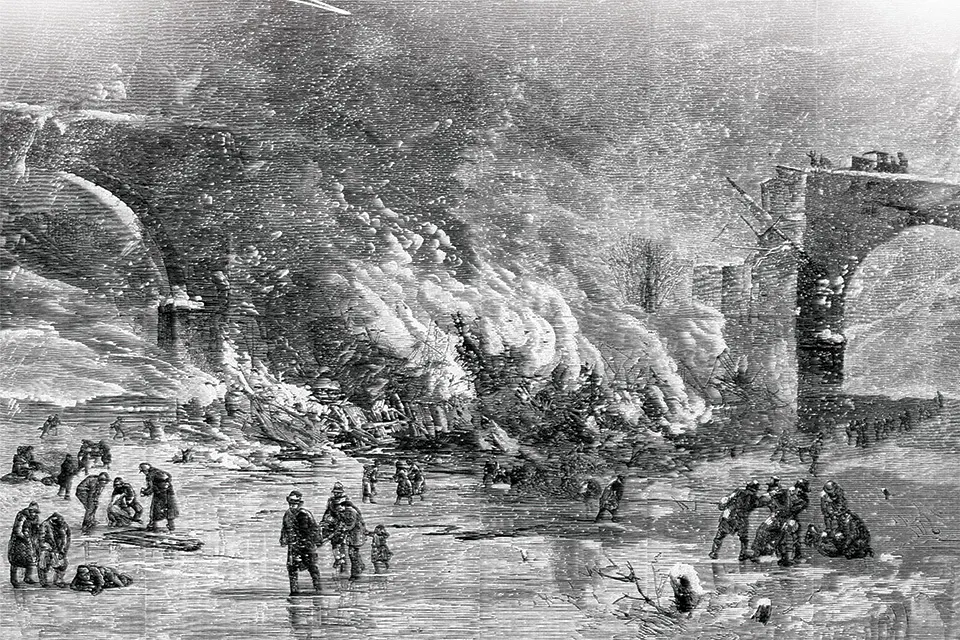
How Ashtabula’s 1876 Train Disaster Changed American Railroads
On Dec. 29, 1876, a passenger train plunged into the Ashtabula River, leaving tragedy, unanswered questions and lasting reforms in its aftermath. READ MORE >>