


See Ohio in a New Way at These Six Historic Sites
In celebration of Ohio Statehood Day on March 1, we share six places, artifacts and landmarks that illuminate history and help us see our shared heritage in new ways.

William McKinley Monument
This statue standing outside the Ohio Statehouse was unveiled five years after the former Ohio governor’s 1901 assassination.
On the west side of the Ohio Statehouse, you’ll find a towering statue of William McKinley, papers in hand, flanked by figures representing industry, peace and prosperity. Unveiled in 1906, the monument honors the 25th president and former Ohio governor, and it was erected as a response to his 1901 assassination.
The day before McKinley was shot at the Pan-American Exposition in Buffalo, New York, he delivered his final public speech, emphasizing the need for the U.S. to expand its overseas markets and build on the prosperity it had achieved at home. The address marked a shift in McKinley’s trade policy, moving beyond rigid tariffs toward reciprocal trade agreements that would open foreign markets to American goods. Having ended the Spanish-American War (which brought Puerto Rico, Guam and the Philippines into the fold and secured the annexation of Hawaii), McKinley outlined a new vision in the speech.
Excerpts from McKinley’s final speech are inscribed on the Ohio Statehouse monument. One reads, “Let us ever remember that our interest is in concord, not conflict, and that our real eminence rests in the victories of peace, not those of war.” The Ohio Statehouse, 1 Capitol Square, Columbus 43215, ohiostatehouse.org
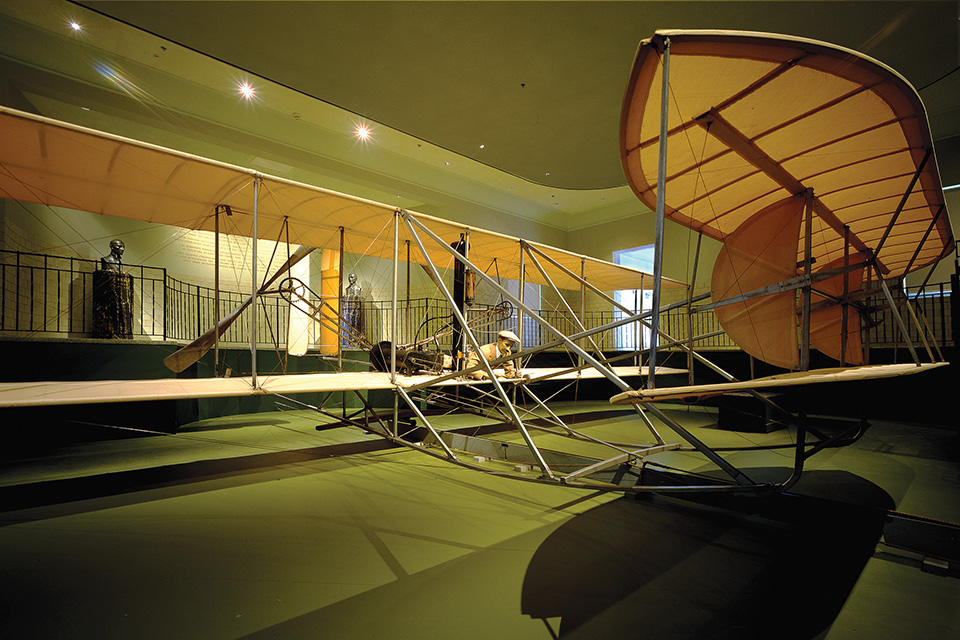
The Wright Flyer III
Following Orville and Wilbur Wright’s early flying machines, the brothers’ 1905 aircraft was the world’s first practical airplane. See it at Dayton’s Carillon Historical Park.
The Wright Flyer III is the official airplane of the state of Ohio and the most important aircraft Wilbur and Orville Wright ever created. They flew it for the first time at Dayton’s Huffman Prairie on June 23, 1905, and then redesigned the flyer after crashing it a few weeks later. Those changes led to their longest flight on Oct. 5 of that year, covering 24.2 miles in 39 minutes and 23 seconds before running out of fuel and making a safe landing.
“The Wright Flyer III marked the completion of their research and development,” says Brady Kress, president and CEO of Carillon Historical Park in Dayton where the aircraft is on display. “They really perfected practical flight here in Dayton with the 1905 model.”
Compared to the original 1903 flyer housed at the Smithsonian National Air and Space Museum, the Wright Flyer III has improved stability. It also has separate controls for pitch, yaw and roll — the three axes of flight.
“They tried to be secretive about their flight experiments by painting the frame silver so that anybody driving by would think the plane was made out of metal,” Kress says, adding the frame is made almost entirely out of spruce and white ash and covered in fabric. 1000 Carillon Blvd., Dayton 45409, 937/293-2841, daytonhistory.org
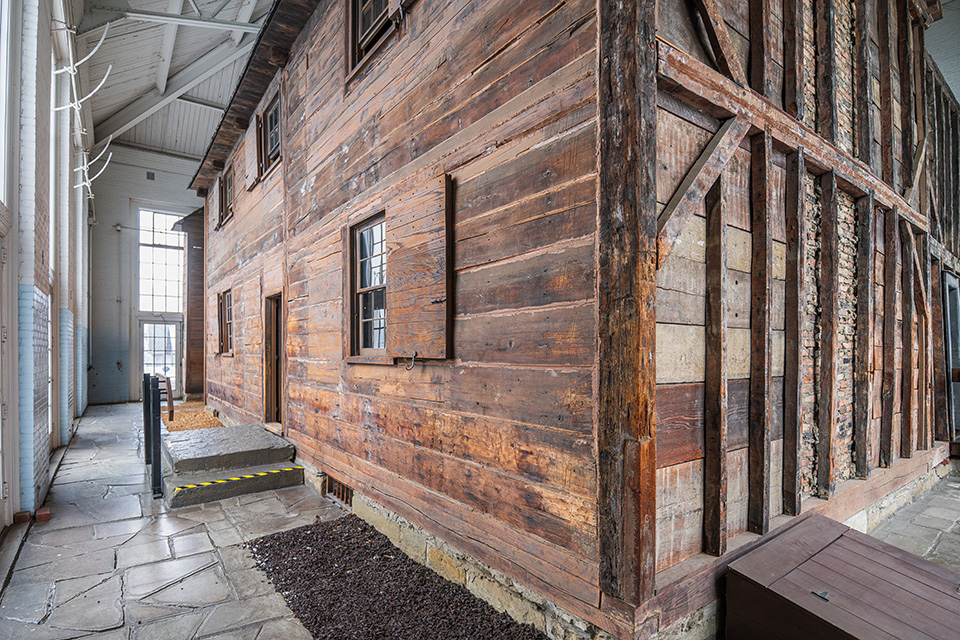
The Rufus Putnam House
Step inside the former home of Gen. Rufus Putnam, who led The Ohio Company of Associates to establish the city of Marietta and open the Northwest Territory to settlement.
The Rufus Putnam House remains from Ohio’s earliest days as part of the Northwest Territory. The structure was part of a stockade constructed by the Ohio Company of Associates led by Gen. Rufus Putnam. When the stockade was dismantled in 1795 following the Northwest Indian War, Putnam stayed in Marietta and used the remaining lumber from an adjacent blockhouse to double the size of his home for his growing family.
Since 1931, the Rufus Putnam House has been preserved in its original location and now resides within the Campus Martius Museum. During daily guided tours, visitors can learn about the home and view a model of the original stockade before stepping inside the place where Putnam and his family resided.
“As soon as you open that door, you’re in 1788,” says executive director Erin Augenstein. “Once the sun goes down, we need a lantern to see anything.”
Notable points of the tour include a brick beehive oven where Putnam’s second wife, Persis, baked bread. Artifacts are scattered throughout the home, including a corner cupboard on the first floor believed to be the oldest known piece of Ohio-made furniture. 601 Second St., Marietta 45750, 740/373-3750, mariettamuseums.org
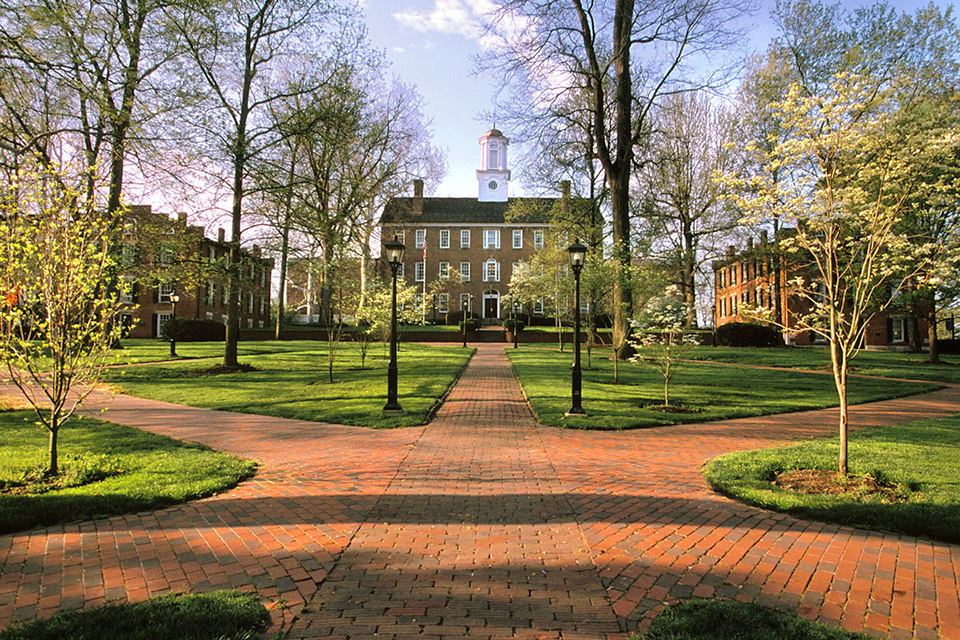
Cutler Hall at Ohio University
This historic building at our state’s oldest public university honors Manasseh Cutler, an early Ohio settler who championed religious freedom, abolition and education.
Manasseh Cutler, a leader in the Ohio Company of Associates, helped carve out the Northwest Territory while pushing for protections of religious freedom, the prohibition of slavery and the establishment of higher education. Cutler’s influence led to the creation of Ohio University in 1804, making it the oldest public university in the state.
The first classes were held in the two-room, two-story Athens Academy building in 1808 under the leadership of Rev. Jacob Lindley. Back then, the university functioned as a college-preparatory school focused on subjects like math, grammar, Latin and Greek. Thomas Ewing — the first of two graduates in 1815 — went on to be elected twice as a U.S. senator, eventually serving as a personal advisor to Andrew Johnson during the Civil War.
It wasn’t until 1819, when the College Edifice opened on the college green, that classes were offered as part of a four-year university program. In 1914, the College Edifice was renamed Cutler Hall to honor the university’s founder. Today, Cutler Hall serves as an administrative building for the offices of the president, provost and other senior leaders. Nearby, a sundial marks the spot where the original Athens Academy once stood. 37 University Terrace, Athens 45701, ohio.edu
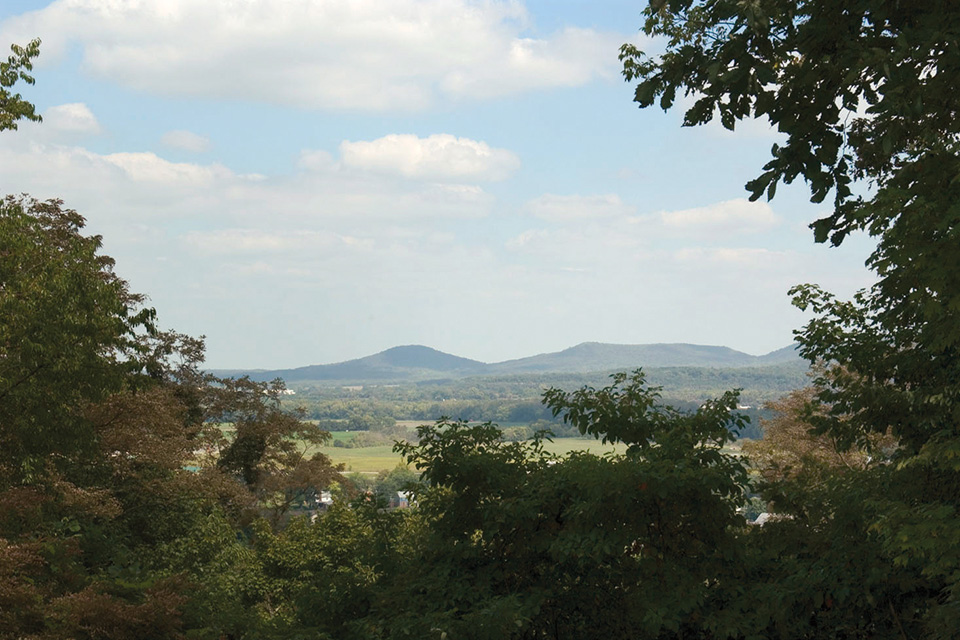
The View from the Adena Mansion
The former estate of Father of Ohio Statehood Thomas Worthington inspired the vista immortalized in the Great Seal of the State of Ohio.
Chillicothe’s Adena Mansion was once the hilltop home of Thomas Worthington, Ohio’s sixth governor and first U.S. senator. It was there that the Father of Ohio Statehood helped draft the 1802 constitution that secured our state as the 17th in the nation. It’s also the place that inspired the view depicted on the Great Seal of the State of Ohio.
After an all-night party in 1803, Worthington took Ohio’s first secretary of state, William Creighton, up to a flat spot on the roof. From there, they sat and watched the sun rise over farm fields, the Scioto River and Mount Logan in the distance. The view inspired Creighton to create a sketch that was then used in every iteration of our state seal, including the most recent version, modified in 1996.
Today, visitors can take in the view from an overlook on the north lawn and see the ladder Worthington used to climb up to the roof. On March 1, Adena Mansion & Gardens staff members give an annual on-site talk about the Great Seal and its origins. 847 Adena Rd., Chillicothe 45601, 740/772-1500, ohiohistory.org
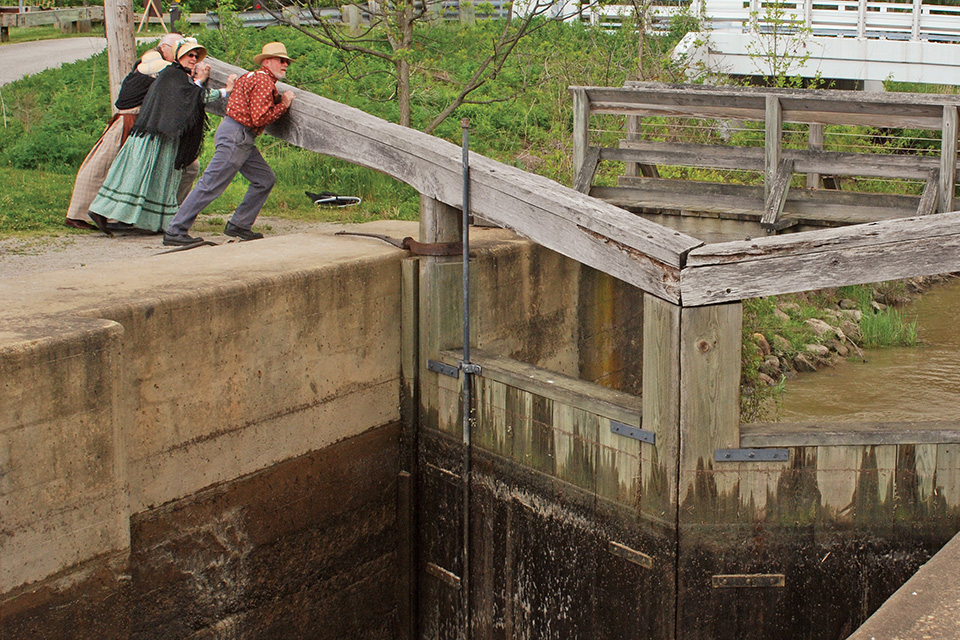
Lock 38 on the Ohio & Erie Canal
The canal era reshaped the United States. Cuyahoga Valley National Park shares that history with today’s visitors at its Canal Exploration Center.
When the Erie Canal was completed in 1825, it allowed for goods from the East Coast to travel through the Great Lakes. Ohioans broke ground on the Ohio & Erie Canal the summer of that same year and had connected Cleveland to Portsmouth by 1832.
“The Ohio & Erie Canal became a waterway into the interior of the United States,” says Rebecca Jones, interpretive park ranger at Cuyahoga Valley National Park. “Immediately, people started shipping out grain, timber and raw goods. In return, manufactured goods start coming in like furniture, coffee, tea, chocolate, spices and cheap cottons from the mills in the East.”
Lock 38 is a remnant of this bygone river highway. Located just outside the Canal Exploration Center in Valley View, it’s one of 44 locks that were once used to help boats navigate the 395-foot elevation difference between Akron and Cleveland. On weekends during June, July and August, volunteers demonstrate how the lock controls the rise and fall of water.
“Most other locks disintegrated into ruins,” Jones says, “but this one is one of the last functioning locks on the Ohio & Erie Canal.” 7104 Canal Rd., Valley View 44125, 440/717-3825, nps.gov/cuva
For more Ohio history inspiration, sign up for our Ohio Magazine newsletters.
Ohio Magazine is available in a beautifully designed print issue that is published 7 times a year, along with Spring-Summer and Fall-Winter editions of LongWeekends magazine. Subscribe to Ohio Magazine and stay connected to beauty, adventure and fun across our state.
Related Articles

Living-History Performance Highlights ‘Frankenstein’ Author
The Rutherford B. Hayes Presidential Library & Museums in Fremont shares the story of Mary Shelley during this performance at the Hayes’ Victorian home. READ MORE >>

5 History-Focused Events This Month
Take a trip to the past at these Ohio gatherings, including an old-fashioned baseball match and a period-appropriate reenactment showcasing historic trades and crafts. READ MORE >>
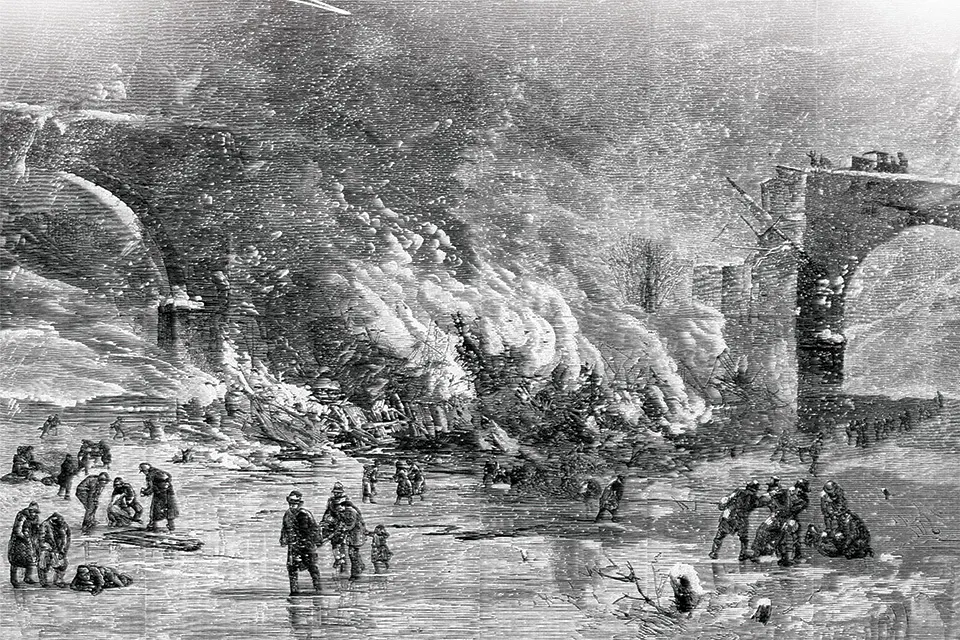
How Ashtabula’s 1876 Train Disaster Changed American Railroads
On Dec. 29, 1876, a passenger train plunged into the Ashtabula River, leaving tragedy, unanswered questions and lasting reforms in its aftermath. READ MORE >>