


Lake Erie’s High-Stakes Steamboat Race of 1901
Two rival shipping companies raced their steamers across from Cleveland to Erie in high-stakes contest that drew thousands of spectators and ended with a thrilling finish.

As dawn broke the morning of June 4, 1901, crowds were already starting to gather in downtown Cleveland for what was being billed as the greatest race on the Great Lakes.
By 7 a.m., crowds were amassing at the Cleveland & Buffalo Transit Co. pier and taking perches at buildings overlooking the harbor. Thousands more could be found in parks downtown along the lakefront. (Unfortunately, the smoke of the city would obscure their view of the start of the race.) And yet more spectators could be found on a ship named City of Cleveland and various other boats and yachts on the water.
Although steamboats had been effectively supplanted as a main mode of transportation on American rivers, they remained popular for hauling people and cargo throughout the Great Lakes. The two boats believed to be the fastest — the Tashmoo (owned and operated by Detroit’s White Star Line) and the Cleveland-based Cleveland and Buffalo Transit Co.’s City of Erie — were set to race from downtown Cleveland to the Presque Isle Lighthouse in Erie, Pennsylvania.
From the time it was launched in 1898, City of Erie was touted by its owners as the fastest ship on the Great Lakes. But a year later, the Tashmoo launched. Built at American Shipbuilding Co.’s Wyandotte Yards in Michigan, the Tashmoo was designed for passengers to sail the Saint Clair River.
Yet when the Cleveland and Buffalo Transit Co. proclaimed the City of Erie would take on any challenger in a race, the Tashmoo was happy to oblige. Each company put up $1,000, with the loser donating that amount to a charity of the winner’s choosing.
The boats, both designed by Frank E. Kirby, were unlikely competitors. The City of Erie was an enormous cruiser, built with four decks of staterooms for overnight excursions across the lake. The Tashmoo was an overall lighter ship, with a hull built like a yacht, to cut through the water. The City of Erie was four feet longer than the Tashmoo (324 feet to 320) but outweighed it 2,000 tons to 1,200 tons and had more than twice the engine capacity, 6,000 horsepower to 2,800 horsepower. Kirby, for his part, favored the Tashmoo, saying it “has never yet been run her fastest.”
The City of Erie, which regularly made runs between Cleveland and Buffalo, arrived in Cleveland around 5 a.m. the day of the race, having finished its regular route from Buffalo. The Tashmoo had come in the day before, fresh off being scraped and oiled in dry dock.
A crowd of partisans from Detroit had also arrived, taking up residence at Cleveland’s Colonial Hotel (now the Residence Inn) along Prospect Avenue.
On the morning of the race, the two ships took their places a half mile west of the starting line on the placid lake, “as smooth as sacred pools of Corinth,” the Buffalo Courier wrote. At 9:35 a.m., a small brass cannon was fired on the deck of the judges’ ship. The racers got off to a “flying start” across the starting line, which was crossed by the City of Erie at four seconds before 9:38 a.m., and the Tashmoo 35 seconds later.
“The most noteworthy contest ever sailed on freshwater,” as The New York Times called it, was underway.
The race drew interest throughout the Great Lakes and was also an inviting target for gambling. It was estimated that more than $100,000 was wagered on the race. The Buffalo Courier reported that the firemen who shoveled coal into the City of Erie’s boilers had pooled $500 — close to a year’s wages from them — to bet on their ship’s success. Former Detroit Mayor John Pridgeon Jr., also a vice president at White Star Line, bet $1,000 with Cleveland shipping magnate Morris Bradley.
Arrangements were made for the race with great care, comparable to a yacht race in the preparation and standards. Two parallel courses were mapped out 2 miles offshore, with the ships no closer than a half mile apart. Lanes on the 95.5-mile race were marked with stakeboats and buoys, and a battery of three judges and five timekeepers were appointed to ensure the race would be run as fairly and accurately as possible.
Both ships were described as “fighting trim.” The City of Erie was laden with 100 tons of coal and 150 tons of ballast, barrels of oil and sugar to keep the ship at an even keel on the water. The ship was stripped down for the race, with chairs removed from the decks and lifeboats removed to lower wind resistance.
More than 100 tons of coal were hand-picked for the Tashmoo, with no imperfections allowed. The coal was stored in the front of the ship to keep its bow down and cutting through the water.
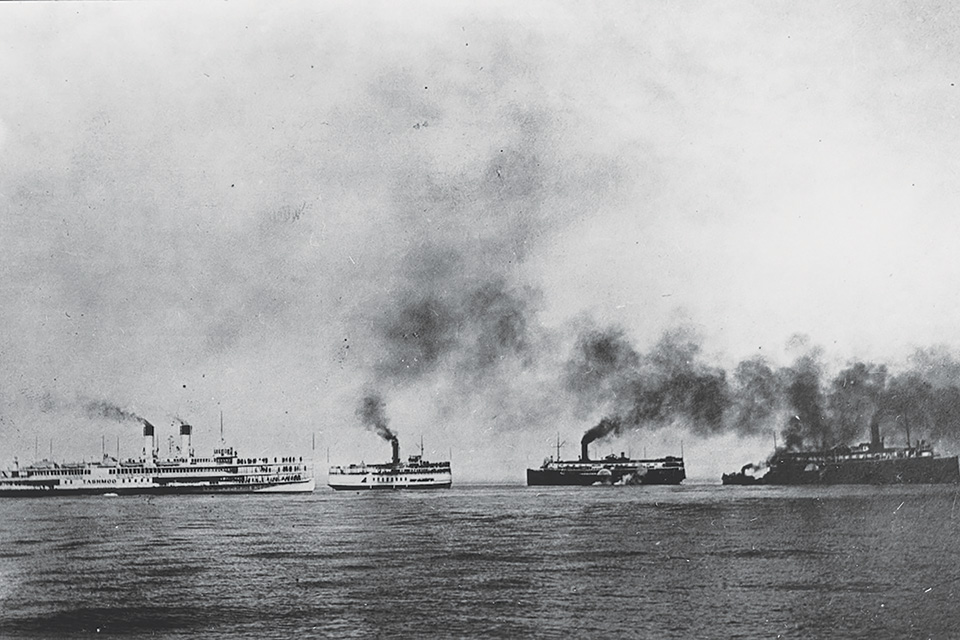
“The Tashmoo” (far left) and the ”City of Erie” (far right) traveled with spotter boats on Lake Erie. (photo courtesy of National Museum of the Great Lakes)
A coin was tossed to determine which path each ship would take. The Tashmoo won the toss and opted for the outer path, putting the City of Erie at a disadvantage. It was built for deeper waters of the lake and would be on the shallower path, which meant it would run slower during the race.
The weather — bright blue skies and a calm lake — also appeared to favor the Tashmoo, but it was running behind the City of Erie in the early stages of the race.About 10 minutes in, it suddenly sped up, blowing past the larger ship.
As the boats reached Fairport Harbor around 11 a.m., the Tashmoo was three to four boat lengths ahead, according to The New York Herald. The City of Erie was going slower in shallow waters. Once they were beyond Ashtabula, in deeper waters, the larger boat was able to speed up, its paddlewheel making up to 36 revolutions per minute.
Meanwhile, the Tashmoo’s coal supply was being depleted, lifting the ship’s prow higher out of the water and reducing its speed. By noon, the boats were running beside one another, but the City of Erie eventually pulled ahead.
Journalists aboard the racing ships and watching (either from the lake or on the shore) were doing everything possible to transmit their stories. That evening’s Cleveland Press carried the complete story of the racing, crediting “a score of staff correspondents, carrier pigeons, special dispatch boats, leased wires, buoys and box kite signals.”
Within 5 miles of the finish line, the Tashmoo made one last burst, but couldn’t catch up to the City of Erie, which finished the route in four hours, 19 minutes and nine seconds. The ship’s average speed during the race was a little over 22 mph.
The Tashmoo crossed the finish line 82 seconds later. Given that the City of Erie had crossed the starting line half a minute earlier than the Tashmoo, the margin of victory was just 45 seconds. “The Tashmoo struggled so gallantly that none but the timers knew she had lost,” wrote the Detroit Free Press.
Charles F. Bielman, the general manager of White Star Line, conceded that the City of Erie was more prepared for racing than was his Tashmoo.
“If we had been sensible, we would have stripped the Tashmoo as the Erie was stripped,” he said, also noting that the City of Erie had its condenser packed in ice, making it more efficient. Ironically, some Tashmoo backers said the ship would have won the race if it had taken the course closest to shore.
But Captain J.J.H. Brown, who’d been on the City of Erie, said if it had been cleaned and oiled in dry dock like the Tashmoo, it would have won more easily.
“I am of the opinion that such preparation would have added two miles an hour to her time,” he told The Cleveland Leader.
A rematch was talked about but never materialized. Both ships had lengthy careers on the Great Lakes. The City of Erie ended its service in 1939, when the Cleveland & Buffalo Transit Co. voted to liquidate. It was scrapped in 1941. A rock tore a hole in the Tashmoo’s hull while it was on a moonlight cruise in 1936. The ship was safely guided to port in Amherstburg, Ontario, with all 1,400 aboard being able to disembark before it sank.
The sinking incident prompted syndicated columnist Frank Parker Stockbridge to recall the race, which he had covered decades earlier for the Buffalo Courier-Express, in his “Today and Tomorrow” column, noting, “It was about as exciting a sporting event as I ever witnessed.”
For more Ohio history inspiration, sign up for our Ohio Magazine newsletters.
Ohio Magazine is available in a beautifully designed print issue that is published 7 times a year, along with Spring-Summer and Fall-Winter editions of LongWeekends magazine. Subscribe to Ohio Magazine and stay connected to beauty, adventure and fun across our state.
Related Articles

Living-History Performance Highlights ‘Frankenstein’ Author
The Rutherford B. Hayes Presidential Library & Museums in Fremont shares the story of Mary Shelley during this performance at the Hayes’ Victorian home. READ MORE >>

5 History-Focused Events This Month
Take a trip to the past at these Ohio gatherings, including an old-fashioned baseball match and a period-appropriate reenactment showcasing historic trades and crafts. READ MORE >>
How Ashtabula’s 1876 Train Disaster Changed American Railroads
On Dec. 29, 1876, a passenger train plunged into the Ashtabula River, leaving tragedy, unanswered questions and lasting reforms in its aftermath. READ MORE >>