

_recto.jpg?sfvrsn=c212b438_5&w=960&auto=compress%2cformat "Songwriter Ernest Ball playing piano in 1952 (photo courtesy of Cleveland Public Library)")
How Forgotten Songwriter Ernest Ball Rose to Fame
He isn’t a household name these days, but it’s estimated that the Cleveland native penned over a thousand songs, including Irish-themed standards that are still sung each Saint Patrick’s Day.

It had been a busy day already for Ernest Ball when he took the stage on May 3, 1927, the last performance of a three-day engagement at the Yost Theater in Santa Ana, California.
Ball had been a fixture on the national vaudeville circuit for more than 20 years. But the Cleveland native’s real accomplishment — if not necessarily fame — was as a songwriter. His compositions included “Love Me and the World Is Mine,” “Will You Love Me in December as You Do in May” and “Let the Rest of the World Go By,” all standards of the era.
Ball grew up in an Irish neighborhood on Cleveland’s East Side. Although he was described as more Irish in spirit than by blood, he carved out a niche writing about the Emerald Isle with songs like “When Irish Eyes Are Smiling,” “A Little Bit of Heaven” and “Mother Machree.”
The day of that last Yost Theater show, Ball appeared at a Rotary Club luncheon, but illness prevented him from singing there. He then canceled an interview with a local reporter. Few had any idea how sick he really was.
That morning, Ball had seen Dr. M.W. Hollingsworth, who told him he was under too much strain. “You must quit now,” Hollingsworth said. “Now! Or there can be but one result.”
“You know doctor,” Ball replied, “I have six men in my company who are depending on me. I can’t desert them. I’ll have to take the risk.”
Ball took to the stage for an afternoon performance, even singing a song. An evening show was added as a benefit for victims of that spring’s Mississippi flood, but Ball could only play the piano. He stepped off the stage around 9:30 p.m., and autographed a photo for Bartley Sims, the theater’s organist. While removing his stage makeup and costume, he crumpled to the floor, dead of a heart attack.
Tributes poured in from across the country. “Ernest Ball, dead in California, touched the heart of the world with his songs,” wrote the Albany Evening News. “Whoever can do that has written his own epitaph.”
“Of all the popular minstrels our country has produced, Ernest R. Ball, who has just died, was probably the greatest,” proclaimed the New York World.
And while Ball’s songs live on, particularly around Saint Patrick’s Day, when everyone’s a little Irish, the man himself has been largely forgotten.
“Although his songs sold beyond ten millions,” wrote Robert A. Simon and James Thurber for the May 7, 1927, issue of The New Yorker, “the ablest ballad writer of his time was scarcely known outside his profession.”
Ernest R. Ball was born July 22, 1878, in his family’s home at 163 Sterling St. in Cleveland. (Following Cleveland’s street renaming in 1906, the family home was at 1541 E. 30th St.) He was the only child of Ernest and Anna (known as Nannie) Ball. His father died when he was a year old, leaving his mother to raise her son alone.
Ball was an avid sandlot baseball player, facing off against future pros like Jim Delahanty, Tommy Leach and Bill Bradley, while Nannie Ball made sure her son received a classical music education at the Cleveland Conservatory of Music. He was eventually practicing up to eight hours a day and became proficient enough to begin giving lessons as a teen. Ultimately, he chose music over baseball — less chance of breaking fingers — even dropping out of Central High School at the age of 15 to devote all his time to his craft.
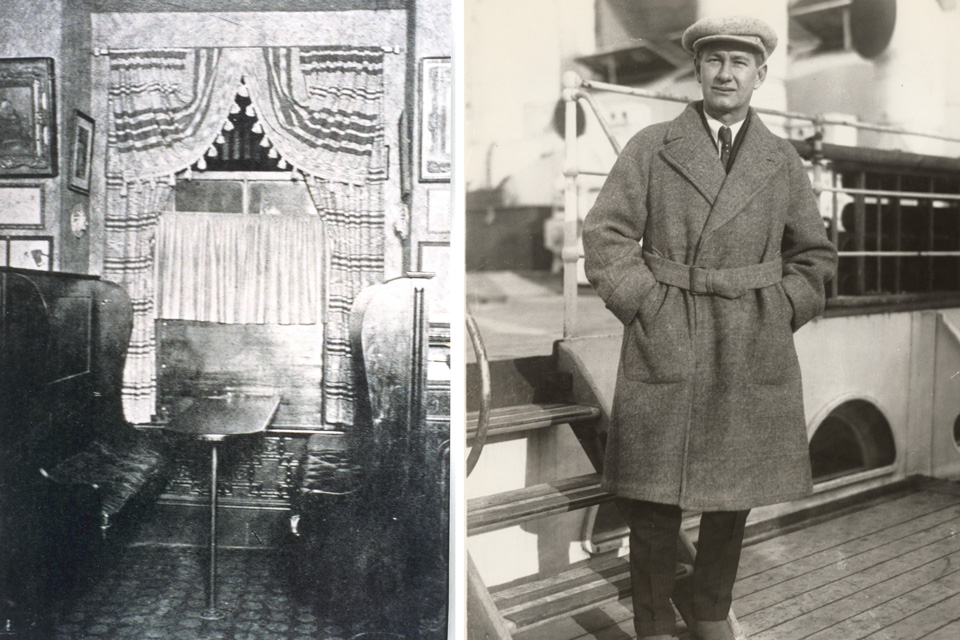
As a young man, Ball set out for New York City. He found a job playing piano in a department store and later with M. Witmark & Sons, a company that was instrumental in the formation of Tin Pan Alley, a block in Manhattan that became the nexus for songwriting in America. Ball worked for Witmark as a “song plugger,” sitting at an upright piano in the company’s office, playing samples of the music composed there. Ball’s skill at the piano was the start of a relationship with the company that lasted for the rest of his life.
While at Witmark, Ball crossed paths with Jimmy Walker, a law school student who aspired to be a vaudeville star. One day in 1905, Walker — who went on to pass the bar and serve as a New York Assemblyman from 1925 to 1932, before resigning due to allegations of corruption — shared a line that Ball couldn’t get out of his head: Will you love me in December as you do in May?
“Everybody around the shop had a lot of respect for him as a musician, but the boys didn’t somehow figure he could put over the popular stuff,” Walker recalled in a 1925 interview with the Literary Digest as he was running for mayor. “I had a different idea about him.”
“I wrote the line on a piece of paper and chucked it in front of him. I said, ‘Ernie, how would you like to do a tune to a lyric with that as a refrain?’ He said, ‘Jim, you’re the first songwriter to come to me and ask me a thing like that. Let me have it.’”
It was Ball’s first big hit, and it established the collaborative relationship he’d become known for, working with lyricists to blend music and words.
“He saw every song as a unit,” recalled George Graff Jr., who had worked with Ball on many songs, including “When Irish Eyes Are Smiling.” “Of the many composers and publishers with whom I worked no one else recognized the merits and demerits of a lyric as he did.”
Ball’s productivity exploded and he penned dozens of songs. In 1910, he wrote “Mother Machree,” inspired in no small part by his own close relationship with his mother. In 1912 came “When Irish Eyes Are Smiling.” “A Little Bit of Heaven” debuted in 1914, and “Let the Rest of the World Go By” arrived in 1919. By 1923, it was estimated that Ball had written more than 1,000 songs, for which he’d made thousands of dollars in royalties, on top of his touring fees.
“I expect to be writing songs when I’m 135 years old,” he said at 35, in 1913.
But his career and life were cut short before he even reached the age of 50. New York services were held at Campbell’s Funeral Church and the city’s Masonic Temple. Walker, who was by then mayor of New York, was named an honorary pallbearer. Irving Berlin, one of Ball’s contemporaries as a songwriter, wept during the service.
Ball’s remains were taken back to his hometown, where he was buried in Cleveland’s Lake View Cemetery, where oil magnate John D. Rockefeller, President James A. Garfield and other famous names are also interred.
Although Ball had been consulting on movies based on his songs during the 1920s, he died five months before the debut of “The Jazz Singer,” the first film with a synchronized music and vocal track. By that time, movies were already starting to compete with vaudeville, but the medium had supplanted the live stage circuit, where Ball was most famous, by the 1930s.
Even after his death, movies reflected Ball’s influence. In 1928, “Mother Machree” debuted and was notable for being one of the early works of director John Ford. It featured a brief early appearance by John Wayne, who was hired for the movie to herd geese.
Ball himself got the cinematic treatment, portrayed by crooner Dick Haymes in a 1944 movie called “Irish Eyes Are Smiling.” The movie, produced by Damon Runyon, was not necessarily an accurate portrayal of the events of Ball’s life, but it premiered at the Hippodrome in his hometown, and local critics delighted in its portrayal of late-19th-century Cleveland. (In 1957, Ball’s former songwriting partner, Jimmy Walker, got his own biopic, “Beau James,” starring another Clevelander, Bob Hope, in a rare dramatic role.)
Ernest Ball is one of a long list of performers who achieved incredible popularity in his day only to be forgotten as the years roll by. But as long as Saint Patrick’s Day is celebrated, people will be singing Ernest Ball’s songs.
“Ball had no competitor as a ballad writer,” Simon and Thurber wrote in their New Yorker tribute, “and it is not likely that he will have a successor. Nor does he need one.”
For more Ohio history inspiration, sign up for our Ohio Magazine newsletters.
Ohio Magazine is available in a beautifully designed print issue that is published 7 times a year, along with Spring-Summer and Fall-Winter editions of LongWeekends magazine. Subscribe to Ohio Magazine and stay connected to beauty, adventure and fun across our state.
Related Articles

Living-History Performance Highlights ‘Frankenstein’ Author
The Rutherford B. Hayes Presidential Library & Museums in Fremont shares the story of Mary Shelley during this performance at the Hayes’ Victorian home. READ MORE >>

5 History-Focused Events This Month
Take a trip to the past at these Ohio gatherings, including an old-fashioned baseball match and a period-appropriate reenactment showcasing historic trades and crafts. READ MORE >>
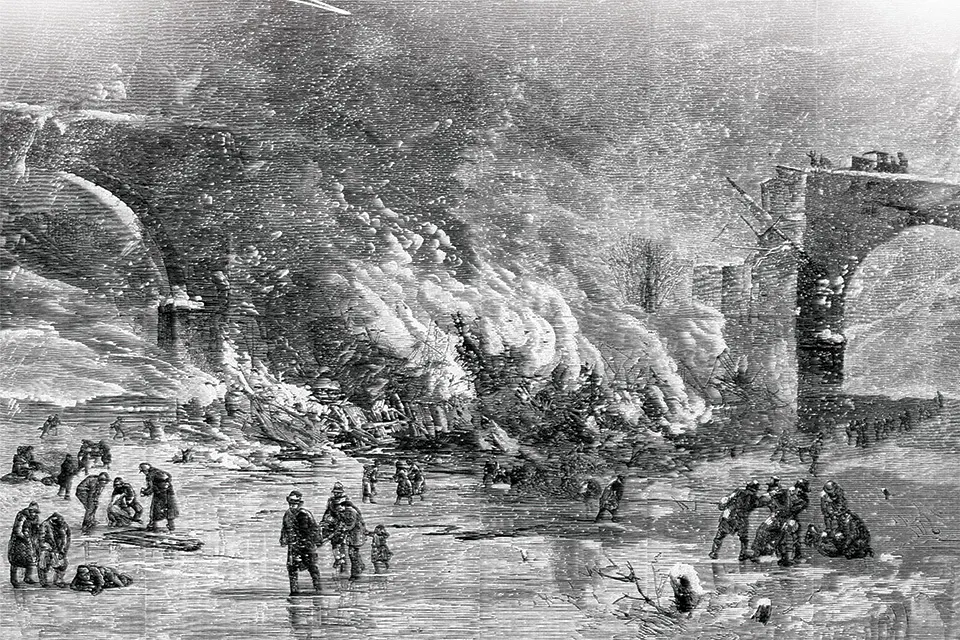
How Ashtabula’s 1876 Train Disaster Changed American Railroads
On Dec. 29, 1876, a passenger train plunged into the Ashtabula River, leaving tragedy, unanswered questions and lasting reforms in its aftermath. READ MORE >>