

Best Hometowns 2026: Marietta
The first permanent settlement in the Northwest Territory honors its groundbreaking past while embracing new energy along its historic streets and riverfront.

The stately structures along Front Street give the impression of neatly plotted and beautiful dollhouses as they roll past the windows of the trolley. They range from modern rebuilds in trendy color schemes to fastidiously preserved Victorian- and Federalist-style homes in warm pastel tones and rich, maroon brick.
Some of the homes along Front Street and beyond have historical markers on their tree lawns. The one standing in front of a Federalist-style brick home with earthy green shutters reads “Meigs House. Built 1802 for Return Jonathan Meigs Jr., Ohio’s first postmaster, fourth governor, U.S. senator and postmaster general.”
The House of Seven Porches on nearby Fifth Street, a Greek-revival home aptly named for its many verandas, has a sign out front explaining that it was built in 1835 by Marietta College professor Diarca H. Allen. On Fourth Street sits another locally famous residence, The Castle. Built in 1855, the Gothic Revival mansion is known for its medieval-influenced turret and spires, and it today serves as a house museum.
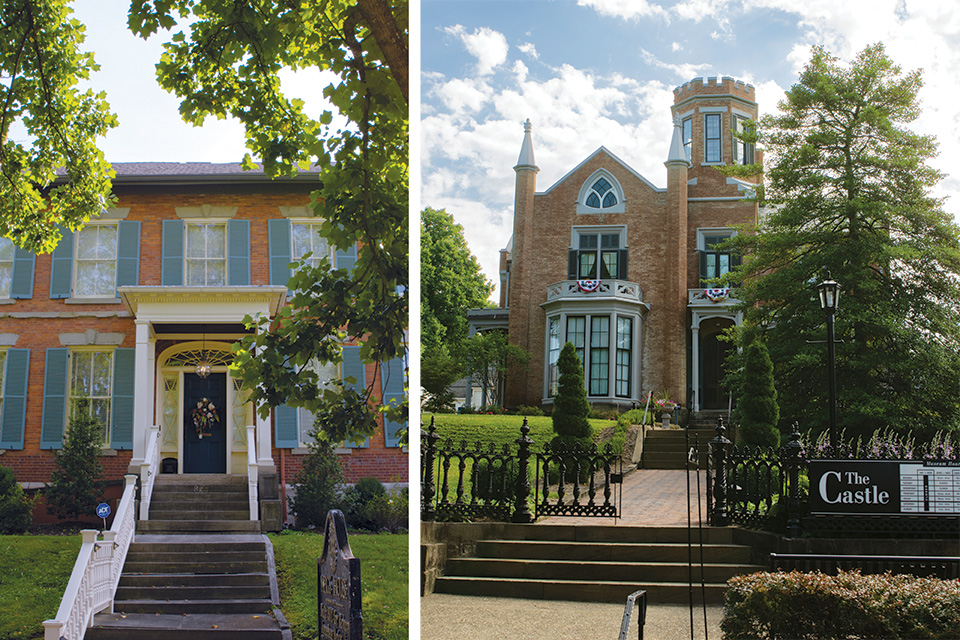
Left: exterior of the Meigs House, right: exterior of The Castle in Marietta (photos by Rachael Jirousek)
In between these grand and often historically significant homes, the everyday buzz of neighborhood life goes on. Our guide for the day, Marietta Main Street executive director Jen Tinkler, estimates that the majority of these historic homes remain residential and occupied. She’s showing us around town on the Marietta Trolley Tour, a 1983 GMC trolley that offers a fun way to explore this riverfront city that played a pivotal role not only in the settlement of Ohio but also the westward expansion of the United States.
It’s a bumpy ride as the trolley traverses some of Ohio’s oldest roads during its 90-minute tour that showcases Marietta’s rich history. The city’s dedication to preserving and sharing its past is everywhere, from the “Start Westward of the United States” memorial in Muskingum Park to the very bricks that the trolley rolls over. Marietta has the most miles of brick streets in the state (approximately 6.5 miles), and you can’t touch the masonry without going through the city’s Brick Street Commission first.
“I’m all about just do it and ask for forgiveness later,” Tinkler jokes, “but I’ve learned, don’t touch the brick.”
Marietta’s pedigree as the first permanent settlement in the Northwest Territory, a rich history that was detailed in David McCullough’s nonfiction book The Pioneers, serves as just part of its charm. A youthful energy also pulses throughout Marietta’s downtown blocks that run up to the edge of the Ohio River. Businesses are already bustling on a summer morning as the old town comes to life. Part of that energy can be attributed to the presence of Marietta College, a private university with enrollment of around 1,000 that brings a new crop of fresh-faced students into the community each fall.
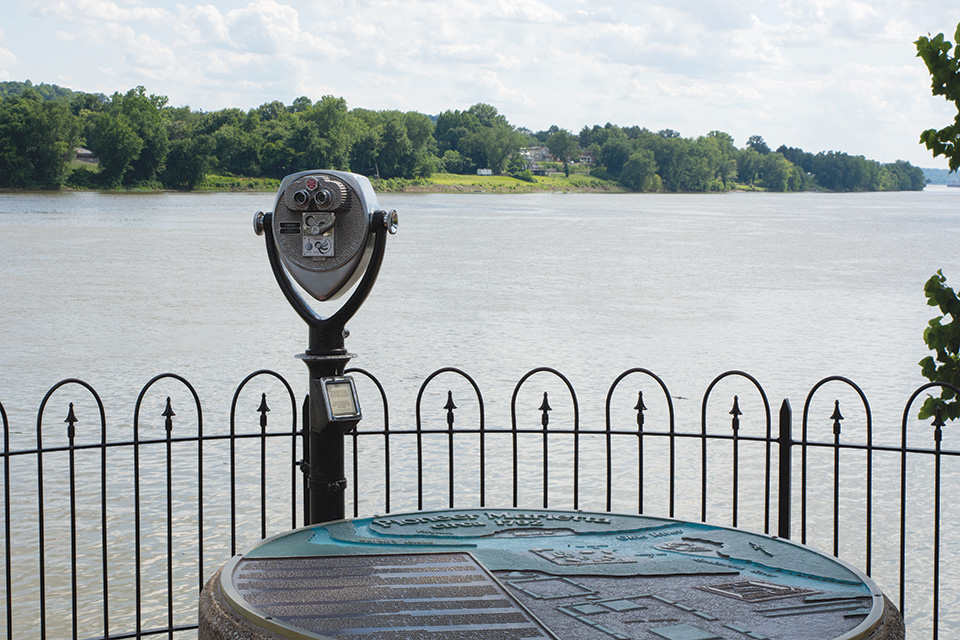
Lookout area on Marietta riverfront (photo by Rachael Jirousek)
The college boasts a long-running and highly respected men’s and women’s rowing program. Passing its sandstone boathouse on the tour, a single-file line of young rowers walk towards the structure, red-faced from off-season training.
Marietta sits at the confluence of the Ohio and Muskingum rivers, with the boathouse on the western side of the latter, just north of a neighborhood called Harmar Village that is today filled with grand homes and a smattering of small businesses.
During settlement by American Revolution veterans from New England known as the Ohio Company of Associates, the neighborhood was the site of Fort Harmar, a military outpost constructed in 1785. Three years later, a civilian stockade known as Campus Martius was built on the eastern side of the Muskingum River to protect incoming settlers during the Ohio Indian Wars. After the signing of the Treaty of Greeneville in 1795, the stockade was no longer needed. Most of it was dismantled and materials were used to build new homes throughout an expanding Marietta.
The story of Marietta’s settlement is told at the Campus Martius Museum, an insightful attraction built on the site of the civilian stockade and includes the home of Marietta founder Gen. Rufus Putnam, which still stands on its original foundation. It sits within an enclosed pavilion and can be seen on regularly scheduled museum tours.
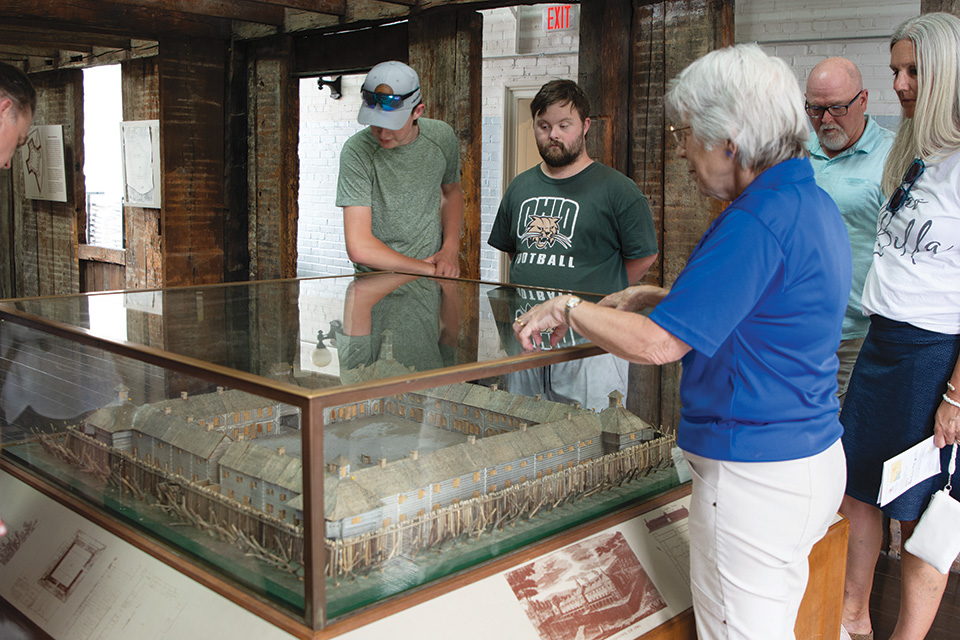
People on tour at Campus Martius Museum in Marietta (photo by Rachael Jirousek)
Just as its riverfront location made Marietta a prime spot for settlement, the waterways shaped the development of its local industries such as boat construction and sandstone extraction. The legacy of the city’s rich oil and gas businesses is still reflected in the wealth of stately homes found in this 8.75-square-mile community of around 13,000 residents.
Today, Marietta’s leading industries are manufacturing and healthcare via the regional Memorial Health System as well as education, from kindergarten through college. The Marietta City School District consists of four schools that serve around 2,300 students.
Understandably, some of the best views of Marietta can be seen from the rivers that hug it. During the 19th and early 20th centuries, steam-powered boats known as sternwheelers fueled commerce on the rivers. Marietta still loves its riverboats and has been hosting the Ohio River Sternwheel Festival each September since 1976. Visitors can also book a ride on the Valley Gem sternwheeler, which has been operating since 1973 and offers regularly scheduled excursions that depart from its dock along Front Street.
Because the rivers are integral to Marietta’s identity, a recently completed $9.4 million levee and riverfront project along Ohio Street has improved the riverfront experience. Completed in September, the Levee Park project rerouted power lines that obstruct the river view, installed new sidewalks and brick details, added stairs to access the Marietta River Trail bicycle path, constructed a new retaining wall and relocated a fountain built for the city’s bicentennial.
“Nothing was really current, nothing was safe, nothing was in really good shape, and so we’ve taken that whole entire area and we’re redoing it,” explains mayor Josh Schlicher. “That’s kind of a generational or a lifetime project … something that isn’t done very often.”
A Marietta native, Schlicher took office in 2020. The major priorities of his administration have been to work to reverse decades of deferred maintenance, including building upgrades, ADA improvements, park renovations and LED-lighting conversions.
He says the key to projects like these in Marietta is to work to maintain the historic integrity of the city while balancing a new era of progress. Schlicher notes that even with all the major projects, the community and small businesses remain the heart of Marietta.
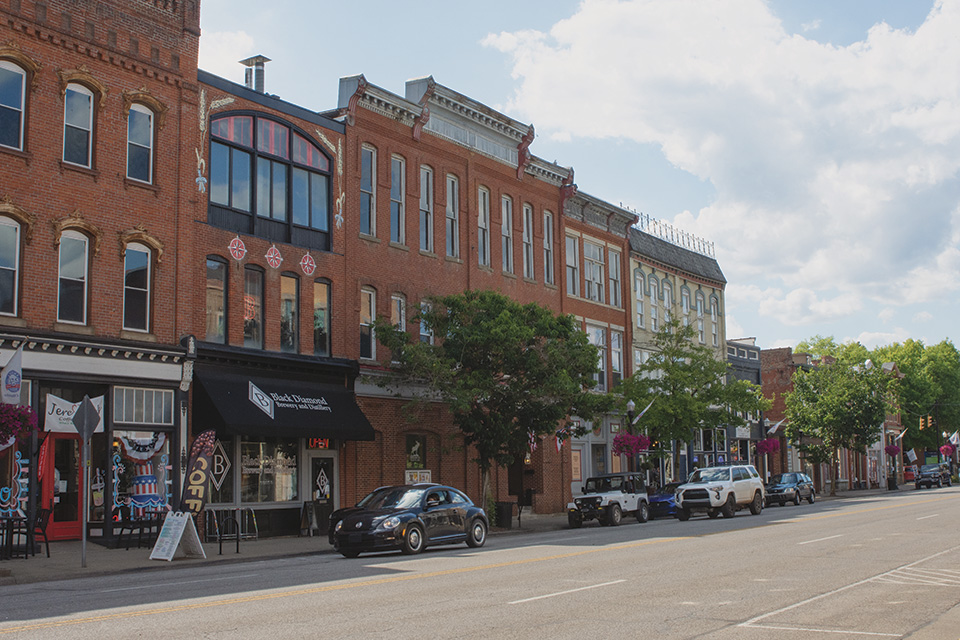
Front Street in downtown Marietta (photo by Rachael Jirousek)
“We can pave streets, we can work on sidewalks, we can put lights up, but it takes the downtown heartbeat of the merchants and the customer base,” he says. “It takes all that to make it work.”
The businesses lining Front Street and the blocks to the east range from quaint cafes like Jeremiah’s Coffee House to specialized retailers like the Cook’s Shop, a kitchen-supply store that offers cooking classes along with packed aisles of kitchen gadgets. Bobby Rosenstock crafts beautiful and intricate woodblock and letterpress posters at his JustAJar Design Press, while the shop Clutch Collective features products made by more than 80 artists from Ohio, West Virginia, Appalachia and other U.S. states.
“Our locally owned shops really contribute to the unique character of our community,” says Sarah Arnold, owner of Clutch Collective. “For a small town in Appalachia of about 13,000 people, we have a lot of culture and a lot to be proud of.”
Arnold moved with her family to Marietta in 2000, and has pretty much lived here since, leaving only briefly to attend Miami University and to live in Cincinnati for a short stint. In 2014, she launched Clutch MOV, a free community-centered digital magazine that published for nine years. She opened Clutch Collective in 2021, which is connected to Wit and Whimzy, a boutique owned by her mother.
Arnold has also been an active volunteer with Marietta Main Street for about 13 years. She estimates that downtown was only 40% to 50% occupied when she started volunteering, but she says in the last 10 years the city has seen continual growth.
“Marietta is on the cusp of its next best self,” Arnold says. “Our history, our artists, our outdoor recreation, our connections to the river — they’re all alive and well, and people feel that when they visit.”
For more Ohio travel inspiration, sign up for our Ohio Magazine newsletters.
Ohio Magazine is available in a beautifully designed print issue that is published 7 times a year, along with Spring-Summer and Fall-Winter editions of LongWeekends magazine. Subscribe to Ohio Magazine and stay connected to beauty, adventure and fun across our state.
Related Articles

Best Hometowns 2026: Massillon
Deep football roots, industrial ingenuity and historic streets define a proud community shaped by its past and focused on the future. READ MORE >>

Best Hometowns 2026: Marion
Downtown investment and redevelopment, industrial strength and presidential history are helping this community build on its proud heritage. READ MORE >>

Best Hometowns 2026: Tiffin
A revitalized downtown, two universities and rich history give this Seneca County city a distinctive energy and a strong sense of community. READ MORE >>