

Best Hometowns 2026: Massillon
Deep football roots, industrial ingenuity and historic streets define a proud community shaped by its past and focused on the future.

The yellow lightbulbs in the sign outside Chloe’s Diner wink against the summer sky, embodying an era of long road trips and quick fill-ups. The gas station turned restaurant sits just a block off the Lincoln Highway, a 3,389-mile road that first connected New York City to San Francisco. Although the creation of the U.S. Numbered Highway System in 1926 divided the Lincoln Highway among several numbered routes, and interstate highways later diverted long-distance traffic from the historic road, it is still celebrated in the places it shaped. Massillon is one of them.
The city’s main thoroughfare bears the name Lincoln Way, which crosses First Street at a brick-patterned intersection that echoes the appearance of early stretches of the transcontinental route established in 1913. Chloe’s Diner fits right in with its classic cars parked out front, old-school gas pumps and illuminated neon signs. Inside, the menu of American lunch and all-day breakfast favorites complements local businessman Jeff Doll’s collection of vintage vehicles and memorabilia displayed among the tables and booths in the converted garage.
The past is never far away in Massillon, and community pride runs deep in the city. A lot of that is thanks to Massillon Tigers football. Depictions of Obie, the helmeted cartoon tiger mascot, are found throughout the city — hanging in windows, adorning T-shirts, painted on the side of an auto-repair shop. There’s even an Obie statue downtown.
Much like the Lincoln Highway, football runs straight through Massillon. Beyond the high school team’s long-running rivalry with the Canton McKinley Bulldogs, Massillon is also where Paul Brown played quarterback in high school. He then returned to his alma mater at age 24 to coach, leading the Massillon Tigers to an 80-8-2 record that included a 35-game winning streak.
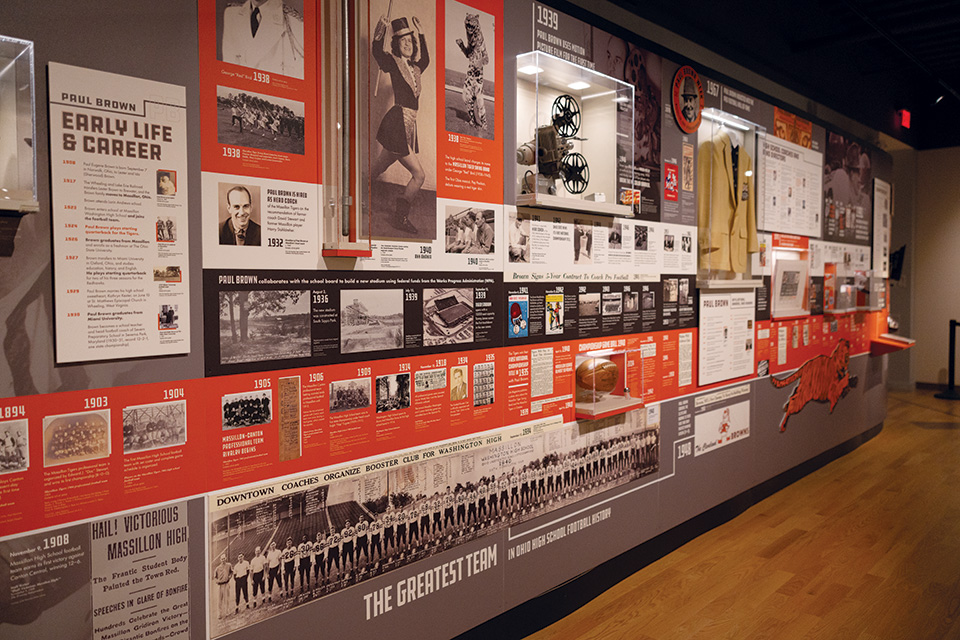
Paul Brown wall-length timeline at the Massillon Museum (photo by Kelly Larson)
Brown went on to coach football at Ohio State University (winning the program’s first national championship in 1942), before building the Cleveland Browns and later co-founding the Cincinnati Bengals. In a lot of ways, Brown’s story of hard work, grit and reinvention parallels the story of Massillon itself.
The 19-square-mile city has been a hub for commerce and industry since the arrival of the Ohio & Erie Canal. Soon after city founder James Duncan bought land along the Tuscarawas River and recorded it as Massillon in 1826, he began lobbying state leaders to route the then-new Ohio & Erie Canal through his town. That happened two years later.
The canal’s arrival made Massillon a city of commerce. (It was for a time known as “The Wheat City” as local mills sought the crop from farmers.) Economic activity only grew with the arrival of railroads in 1852 and across the century that followed.
The Massillon Museum serves as the caretaker of the city’s story and is unique in that it highlights both local history and local art. Admission is free and the attraction, which began in the basement of the local public library in 1933, has been in its current downtown location since 1996.
“There was this concentrated period of time [in Massillon] when there was a lot of wealth and ingenuity and innovation,” explains Alexandra Nicholis Coon, CEO of the Massillon Museum. “That attracted a lot of interesting people in the arts, in technology in its early phases, and a lot of characters whose stories we tell at the museum.”
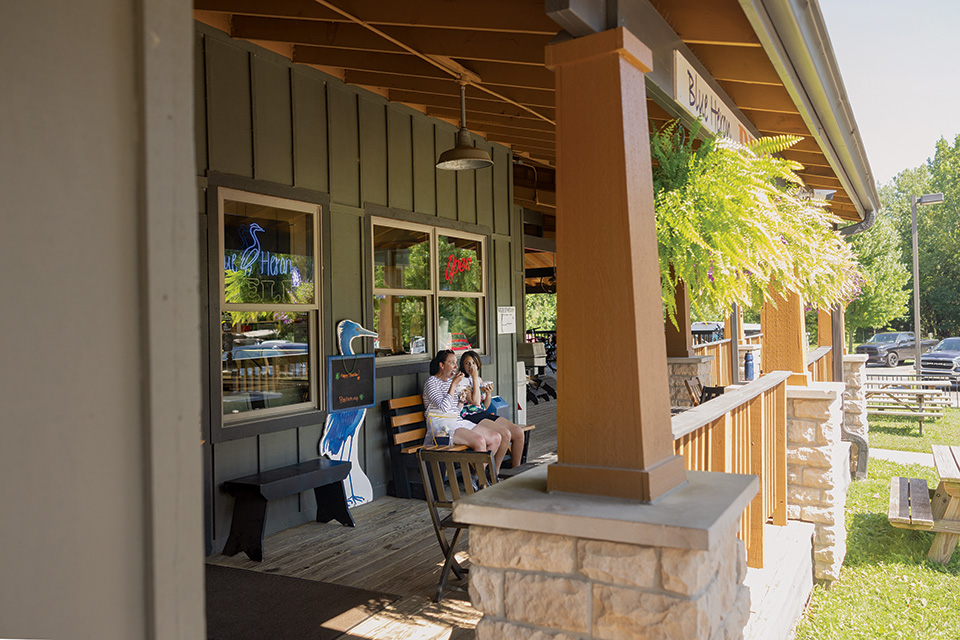
People eating ice cream at Lake Avenue Trailhead in Massillon (photo by Kelly Larson)
The museum’s exhibit space covers three floors and includes the Paul Brown Museum, which features a wall-length timeline of the coach’s life and artifacts that include one of his trademark fedoras. The adjoining gallery hosts a rotating lineup of sports exhibitions.
That’s just a small part of what visitors find here though. The Studio M Gallery features contemporary art, while the Immel Circus Gallery houses a collection of big-top memorabilia from local dentist Dr. Robert Immel, including a 100-square-foot miniature circus with more than 2,600 individual pieces, most of which he carved himself. The Local History Gallery delves into the story of Massillon and the people who built it. The Twilite Cafe offers visitors breakfast and lunch items.
Steelmaking and related manufacturing helped drive Massillon’s economy for much of the 20th century, bringing jobs and periods of prosperity. By 1959, Republic Steel’s Massillon operations employed nearly half the city’s workforce. The industry’s local presence waned though as facilities changed hands or closed.
Prominent employers in Massillon these days include food-industry players such as Shearer’s Foods (the snack-chip maker has its headquarters downtown), frozen-food manufacturer Kraft Heinz and meat processor Fresh Mark.
Other businesses in Massillon include fiberglass-truck-cap maker RealTruck (formerly A.R.E. Accessories), which in 2025 completed a $20 million expansion that brought 330 new jobs to the area. Bitdeer began operating its $180 million cryptocurrency-mining data center in late 2025, bringing 70 high-paying, IT-related jobs to the city. Mayor Jamie Slutz discussed these successes in his 2026 state of the city address, noting that his administration was working to identify future sites for industrial development.
Slutz, a lifelong resident of the city stands tall and square and looks like he could still throw a spiral downfield. He has the no-nonsense personality of a quarterback or a police officer, and he’s been both. On a rainy and windy early November afternoon in the fall of 1988, the then-backup quarterback threw the pass that scored the lone Massillon Tigers touchdown in a dramatic 10–7 win against the rival Canton McKinley Bulldogs.
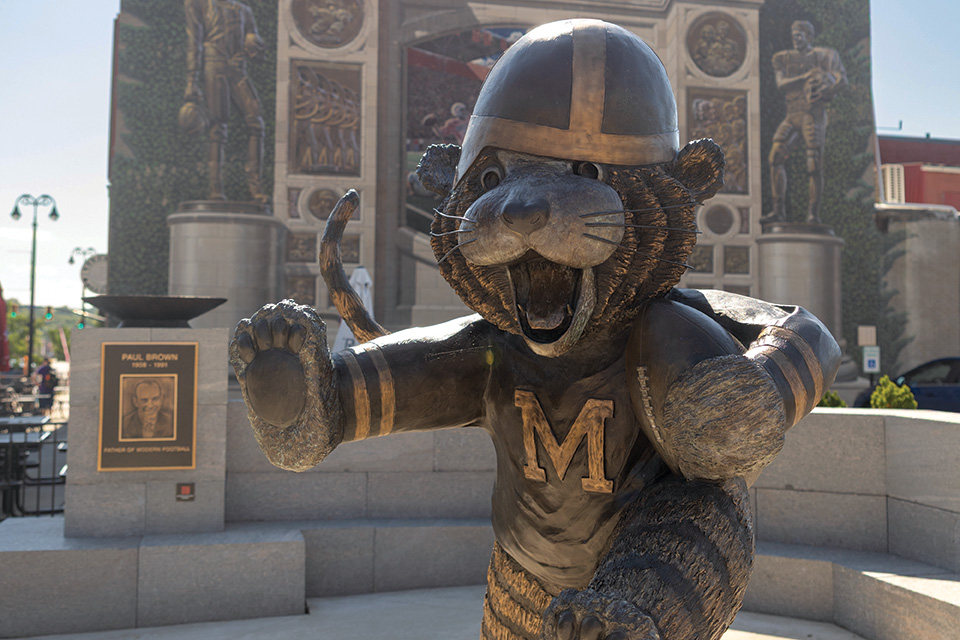
Statue of Massillon Tigers’ mascot Obie (photo by Kelly Larson)
It had been the Tigers’ first victory over their longtime rival in four years, as coach Lee Owens trumpeted in his postgame interview with the Canton Repository, “I won a state championship [at Galion in 1985], but this is bigger.”
The newspaper article even speculated at the time that the goodwill created by the victory could push the Massillon bond issue for a new high school to a win the following Tuesday. After having enduring two losses since 1979, the bond issue passed. The new high school opened next to Paul Brown Tiger Stadium in 1992.
Residents of Massillon are served by one of three public school districts: Massillon City Schools, Perry Local Schools and Tuslaw Local Schools, although the former is where most kids and teens who reside in the city attend public school. More than 4,000 students, from preschool through grade 12 were enrolled in the Massillon City School District in October 2025.
“It teaches you a lot about dealing with adversity and how to manage your schoolwork and family and football … It’s so much more than going out and playing,” Slutz says of how the Massillon Tigers football program shaped him. “Quite honestly, I’m here, and I give Massillon Tigers football a lot of credit for me being here, because it taught me how to be a man, how to talk to people, how to look them in the eye.”
As the city celebrates its bicentennial, it continues to work to find the best programs and strategies for rehabilitating and redeveloping downtown’s turn-of-the-20th-century structures that reflect the city’s long history.
Plenty of progress has been made. Customers line up at Tremont Coffee Co. and record lovers pop into Erie St. Vinyl. Along with Chloe’s Diner, those visiting Massillon can grab a bite at Benders Food & Spirits or Kozmo’s Grille in the city’s walkable downtown.
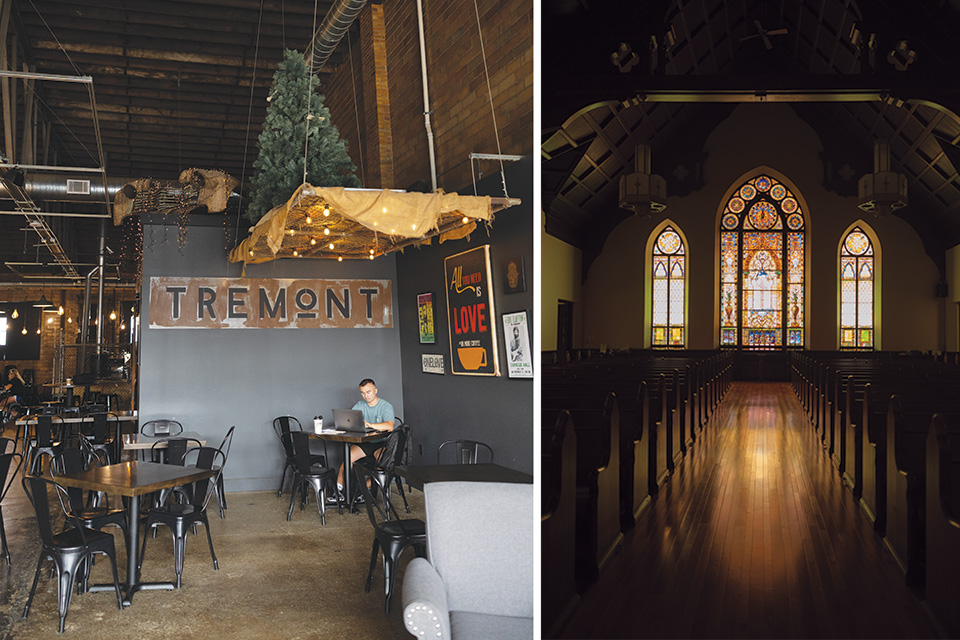
Left: man working at Tremont Coffee Co. in Massillon, right: St. Timothy’s Episcopal Church (photos by Kelly Larson)
No walking tour of downtown Massillon would be complete without a trek down Fourth Street. Margy Vogt, a local historian who has led walking tours of downtown Massillon since 1984, spent time in one of the historic street’s stately homes as a child. Its back stairways and hidden rooms captured her imagination.
The brick-lined street, which was added to the National Register of Historic Places in 1982, has homes in a range of architectural styles that were prominent between 1830 and 1930. From a historian’s perspective, Vogt points to 1894 as a pivotal year for Massillon for a variety of reasons. Five Oaks Mansion was completed on Fourth Street, while local businessman Jacob Coxey organized a first-of-its-kind workers march to Washington, D.C. It was also the year that Massillon’s rivalry with the Canton McKinley Bulldogs began.
“For a long time, there were some people who thought it’s all about football, but we were a steel town and that gave those boys jobs, it gave their dads jobs, and everybody went to the football games … 20,000 people went to the games,” Vogt says. “I think that’s what holds our town together. … football unifies us, even if it’s only on Friday nights.”
For more Ohio travel inspiration, sign up for our Ohio Magazine newsletters.
Ohio Magazine is available in a beautifully designed print issue that is published 7 times a year, along with Spring-Summer and Fall-Winter editions of LongWeekends magazine. Subscribe to Ohio Magazine and stay connected to beauty, adventure and fun across our state.
Related Articles

Best Hometowns 2026: Marion
Downtown investment and redevelopment, industrial strength and presidential history are helping this community build on its proud heritage. READ MORE >>

Best Hometowns 2026: Tiffin
A revitalized downtown, two universities and rich history give this Seneca County city a distinctive energy and a strong sense of community. READ MORE >>

Best Hometowns 2026: Loveland
Riverfront recreation, a thriving downtown district and cherished local traditions create an inviting place to call home in suburban Cincinnati. READ MORE >>