
Concert Posters, Natural History and the Art of Derek Hess
This Cleveland Museum of Natural History exhibition shows how the artist’s concert-poster past evolved into fine art shaped by paleontology, animals and ingenuity.

A man with a baboon’s head wields a crowbar against a black background with the words “Pantera with Special Guests Crowbar” printed above it in large red block letters. Another poster depicts a haloed man riding a Tyrannosaurus Rex, while yet another eye-catching, black-and-pink print features an enormous mastodon skull.
These creations by Cleveland-based artist Derek Hess lifted him to notoriety in the 1990s and his career has ranged from concert posters to fine art. It’s fitting that a selection of his works are currently on display at the Cleveland Museum of Natural History through March 22. Hess drew inspiration from the museum, like how the mastodon skull featured in his poster for the band Jawbox is a sketch of the Johnstown Mastodon skeleton that was discovered in Licking County, Ohio, in 1926 and is part of the institution’s permanent collection.
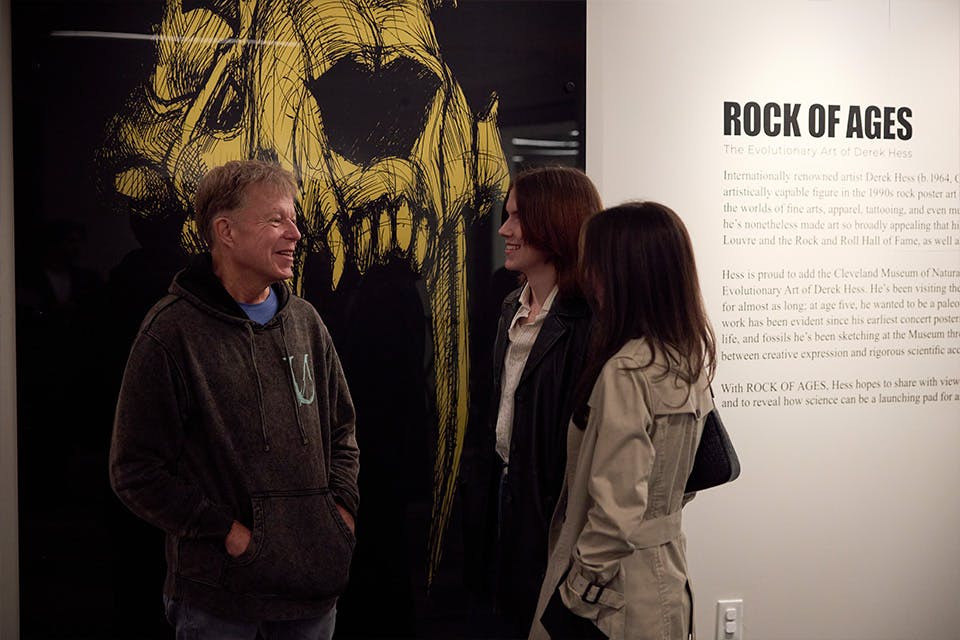
This work, as well as around 50 others are brought together in “Rock of Ages: The Evolutionary Art of Derek Hess,” an exhibition that combines music, fine art and natural history. One of Hess’ drawing desks sits at the center of the gallery, surrounded by dozens of sketches that he has made plastered on the walls. Some resemble more finished works while others are captured in progress. Visitors struck with inspiration are welcome to approach the desk and sketch their own works to take home.
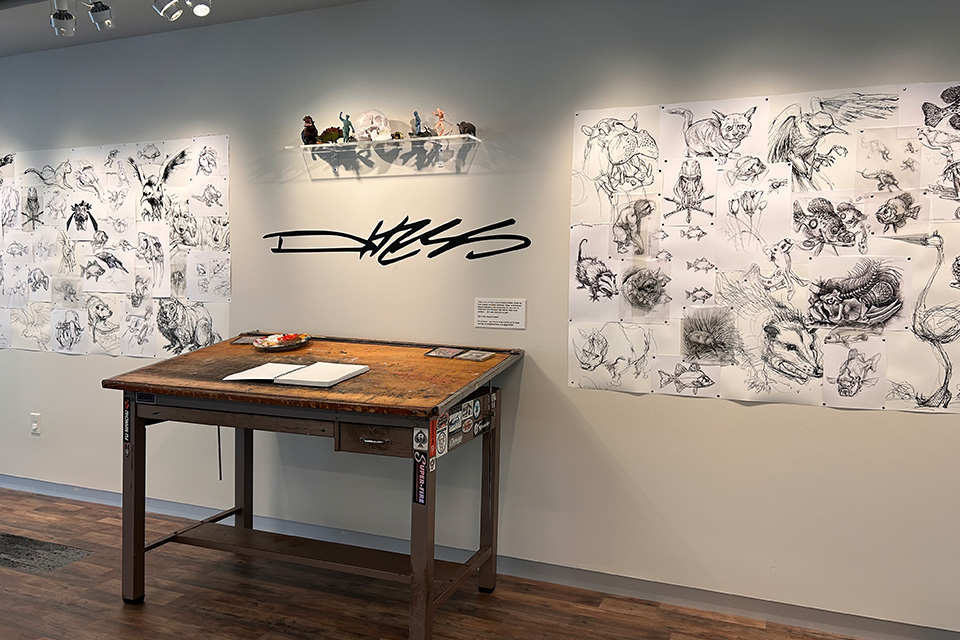
One of artist Derek Hess’ drawing tables is part of the exhibition. (photo by Erin Finan)
Growing up in Cleveland, Hess would often visit the Cleveland Museum of Natural History with his father, who encouraged his son’s curiosity. At a young age, he was fascinated by the bones of ancient creatures and aspired to be a paleontologist. Instead, he found his calling with pen and paper.
In 1989, Hess began working at the Euclid Tavern, and was there until 1995. He started by booking acts, being responsible for both selecting bands and also promoting them. He decided to take his talents for drawing and create concert posters for the various acts.
“I draw very loose,” Hess says of his artistic approach. “And then I’ll tighten them up. … I draw only with the pen — no pencil — and so, therefore, you got to live with the line … And I just like to build on top of it. And as I build on top of it, it tightens up to a certain degree, but it still keeps that loose line and keeps the figure loose, even though it’s been tightened up. I think it’s a good effect.”
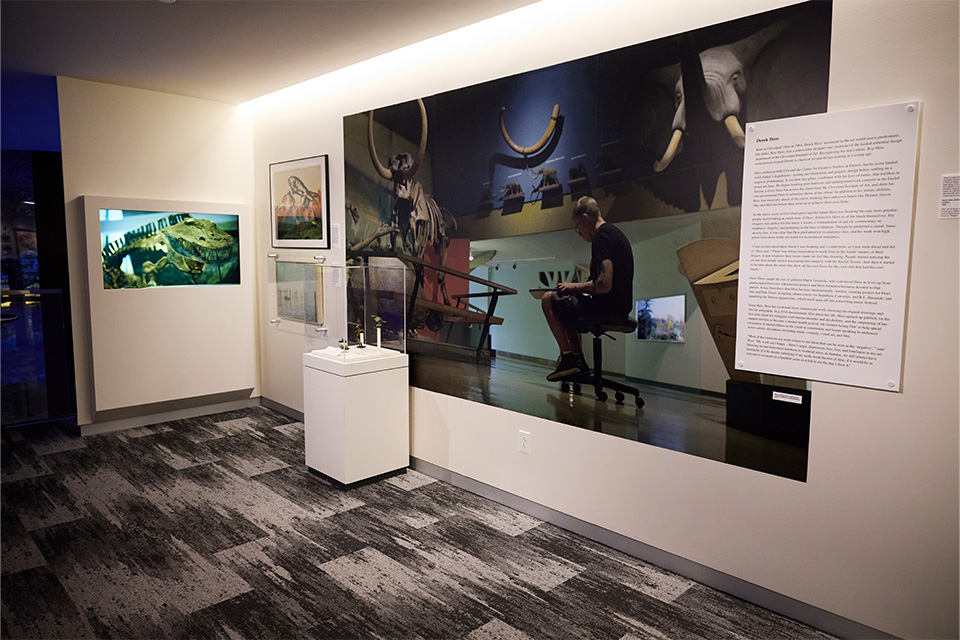
Large photograph of artist Derek Hess drawing at the Cleveland Museum of Natural History (photo by Angelo Merendino)
It was through this work that he discovered his promise as an artist, finding his footing within the grunge and underground movements of the 1990s. His success eventually drew the attention of a manager, who encouraged him to pursue art full time, leading to his transition into fine art, which brought him worldwide recognition.
The artist’s distinctive style comes from his sketch-centered approach and hybrid creations, blending different elements together to create surreal creatures like the baboon-headed man or a crow with ballerina legs. Another theme throughout the exhibition is Hess’ merging of organic elements, like fish, with mechanical forms, often inspired by World War II aircraft.
Hess’ father was a bomber pilot in World War II, and he instilled in Hess an interest in warcraft. The artist took this inspiration one day and blended it with his own affinity for fishing. From there, he developed an extensive series that merged specific species of fish with historically accurate bombers in works such as “Wellington Crappies of NOS 99 Attacking Berlin, April 1st, 1941.”
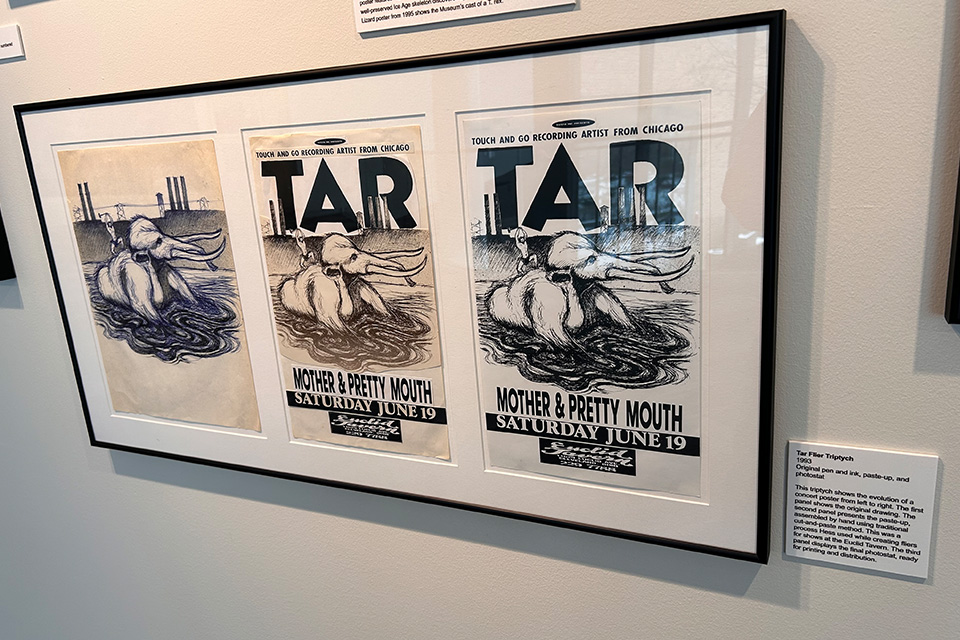
The evolution of Derek Hess’ concert poster for the band Tar is included in the exhibition. (photo by Erin Finan)
“This is an actual bombing raid with Wellington crappies,” Hess says of piece. “The Wellington being a British bomber, and crappies being a fish. And this is the date of the raid. So, I try to make it historical.”
Hess often lets intuition and organic inspiration guide his work, following flows of creative momentum wherever they may lead. He acknowledges the exhaustion that can result from hyperfixating on a certain idea and producing works in large quantities. The World War II-inspired fish-and-aircraft hybrids is a perfect example of this, as he created more than 100 pieces centered around that idea.
“I get on a kick of something, and I got into the kick with the fish. And so I just did them and did them and did them until I burned out,” Hess says, “And then one day I was like, ‘I’m done,’ and moved onto something else.”
For more Ohio arts inspiration, sign up for our Ohio Magazine newsletters.
Ohio Magazine is available in a beautifully designed print issue that is published 7 times a year, along with Spring-Summer and Fall-Winter editions of LongWeekends magazine. Subscribe to Ohio Magazine and stay connected to the beauty, adventure and fun across our state.
Related Articles
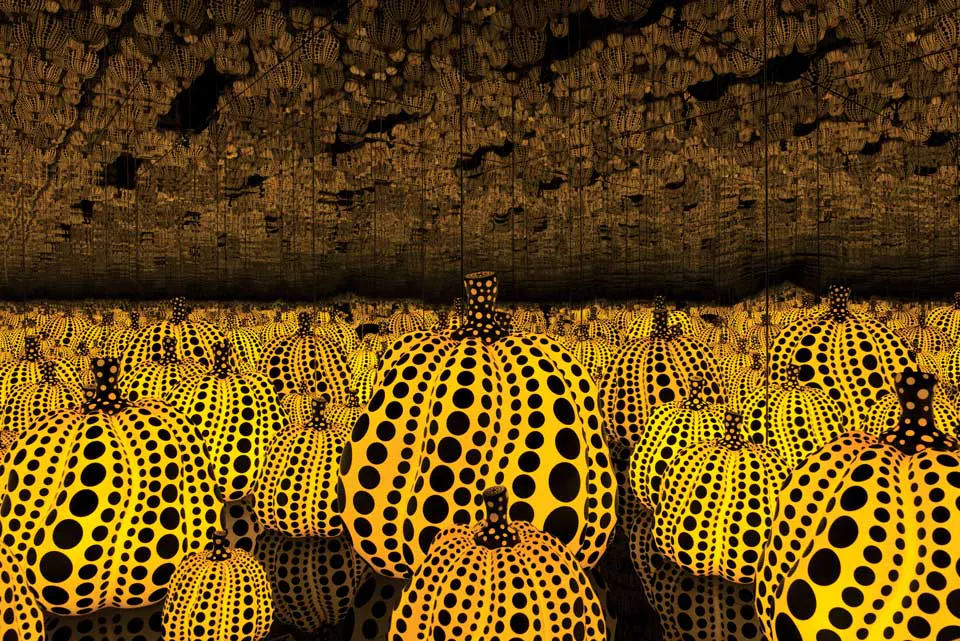
See One of Yayoi Kusama’s Infinity Mirror Rooms in Cincinnati
The Japanese artist’s iconic installations have captivated viewers for decades. The Cincinnati Art Museum hosts ”All the Eternal Love I Have for the Pumpkins” from July 17 through Oct. 18. READ MORE >>

Visit a Museum that Celebrates ‘The Spirit of 76’ Every Day
Archibald Willard painted several depictions of his now-iconic painting, and a three-story museum in the Ohio town where he lived shares his story. READ MORE >>

Columbus’ Cartoon Museum Unveils New Permanent Exhibit and Reimagined Galleries
The Billy Ireland Cartoon Library and Museum at The Ohio State University shared its new look with the public May 23. READ MORE >>