


Why Lake Sturgeon Are Making a Comeback in Ohio
With armored bodies, lifespans that can last a century and roots stretching back to the age of dinosaurs, here is how this ancient fish has made a return here after decades of absence.

The group of kids and adults roll up their sleeves and stand beside the Toledo Zoo & Aquarium’s round freshwater tank, where prehistoric-looking fish swim leisurely. Some visitors eagerly dip their hands in the water, waiting for one of the fish to glide by so they can run two fingers — as instructed by the zoo interpreter — over its smooth skin and the bony plates that line its back.
A little girl squeals with delight as one of the creatures comes straight to her. Her aunt and grandfather stand nearby along the side of the tank, the former snapping photos and the other intently watching for an oncoming fish, which coasts under his fingers.
These fish are lake sturgeon, and they’re an Ohio endangered species that multiple wildlife agencies have worked together to reintroduce to Lake Erie in recent years. This exhibit offers a rare opportunity to see this remarkable and elusive species up close.
“They make a very charismatic conservation species,” says Matt Cross, director of vertebrate conservation at the Toledo Zoo & Aquarium. “Hundreds of thousands of people move through [the touch tank] annually just to see the sturgeon.”
Speaking through a mic, the zoo’s interpreter tells the gathered crowd about the sturgeon, explaining how they differ from other fish, that they were pushed to the brink of extinction in Lake Erie and its tributaries and what the zoo and its partners are doing to help restore their populations. The touch tank is just one aspect of Ohio’s partnership with the U.S. Fish & Wildlife Service to reintroduce sturgeon to Lake Erie. Efforts since 2018 have brought lake sturgeon back to Ohio, but because of the fish’s incredibly long lifespan, whether those efforts will spawn long-term results is still unfolding.
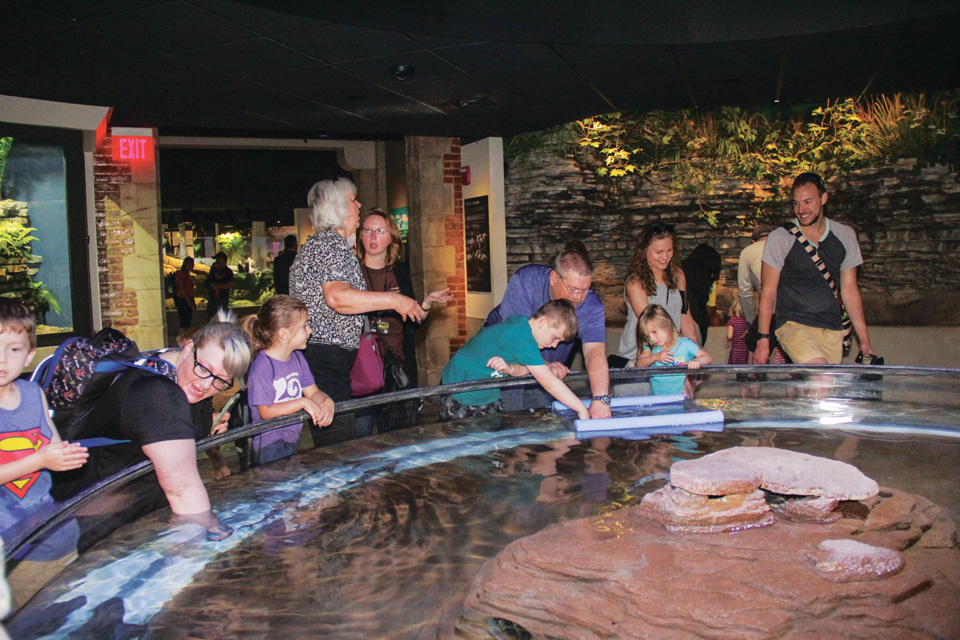
The Toledo Zoo & Aquarium offers a round freshwater tank where visitors can get up close and personal with sturgeon. (photo courtesy of the Toledo Zoo)
Sturgeon are ancient giants of the Great Lakes. They can live up to 100 years and usually grow to around 4 or 5 feet in length in Lake Erie, although they have been found at lengths of more than 6 feet and weighing well over 200 pounds.
“In 2021, the Fish and Wildlife Service was doing some sturgeon sampling in the Detroit River [which empties into Lake Erie], and they caught a fish that was 6-foot-11-inches long, 240 pounds in weight,” recalls Eric Weimer, fisheries biologist supervisor for the Ohio Department of Natural Resources’ Division of Wildlife. “It’s not the biggest lake sturgeon on record, but it’s certainly the biggest I’ve heard of in recent history.”
Sturgeon fossils have been found dating back to the time of the dinosaurs, and biologists consider sturgeon to be physiologically primitive, Weimer explains. Their skeleton is partially made of cartilage, much like a shark, and the bony plates on their body protect them. They also have barbels that look like whiskers that help them gather food.
“Once they reach a certain size, they’re basically armored tanks,” Cross says. “Nothing’s going to eat a lake sturgeon once it reaches a certain size. They really haven’t had pressure to change over time. Where we’ve seen they’re not resilient is when people get involved.”
In the early to mid-1800s — before major human intervention — sturgeon were so plentiful on the Maumee and Sandusky rivers, it’s been said in jest that a person could walk from one side of each river to the other on their backs. The fish were so prevalent that they regularly mangled the nets of commercial fishermen.
“If you accidentally caught one, you never turned it loose,” Weimer says. “They’d pile them up on the beach and burn them. There are even records of them being burned in the boilers of steamships on the Great Lakes.”
By the 1860s, German commercial fishermen in Sandusky realized sturgeon had business value and began harvesting them for their eggs, which they sold in Russia and Europe for caviar, according to the book Sandusky of To-Day, published in 1888. The fishes’ bladders were sold for use as isinglass, a refining agent in winemaking. Some parts were smoked, and undesirable remains were sold for glue and oil.
This led to overfishing. Then other factors caused the near extirpation of sturgeon from Lake Erie, including pollution, dams and the dredging of rivers where the fish return from the lake in the spring to lay eggs and reproduce.
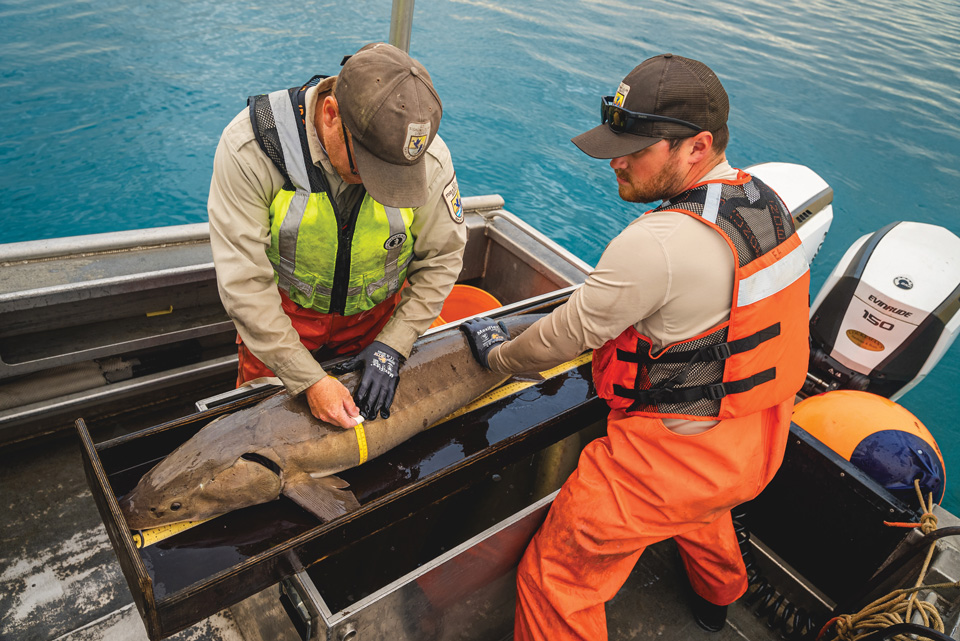
U.S. Fish and Wildlife staffers measure lake sturgeon as part of their catch-and-release program. (photo courtesy of the Toledo Zoo)
For years, biologists at agencies across Ohio and at the U.S. Fish and Wildlife Service wanted to bring the lake sturgeon back. But reintroducing a fish isn’t as easy as getting some and dumping them in waters where they once thrived. Scientists needed to determine if the river spawning habitat as it exists today, which has changed due to human intervention, would work for the fish.
They had to find a stock of sturgeon genetically similar to the ones that historically lived in Ohio waters. And they needed the facilities and means to raise, release and track thousands of sturgeon over time to measure the success of their efforts.
Partnerships between the Ohio Department of Natural Resources, Toledo Zoo & Aquarium, U.S. Fish and Wildlife Service and many other universities and organizations were crucial. U.S. Fish and Wildlife collected a somewhat local population of eggs from the large sturgeon population on the Saint Clair River in Michigan and took them to a facility in Wisconsin to incubate them.
To prepare them for release, the sturgeon eggs are taken to the Toledo Zoo’s streamside rearing facility — the first in Ohio — that pumps water in from the river.
“Anything that happens in the river happens in our facilities,” Cross says. “We need the fish to be exposed to that, to know they can survive. We’re exposing them to the conditions of the river, so they’re ready for it when we release them.”
Once the fish are 4 months old and about 6 to 8 inches long, they are tagged, and the zoo releases them.
“They’re microchipped like a cat or dog,” Weimer explains. “[When caught later,] we can scan them and determine if they’re a fish that we stocked and where it came from.”
In September 2018, the Toledo Zoo and other agencies gathered with members of the public at the Maumee River in Toledo to release the first batch of young sturgeon. Since then, 700 to 900 people have shown up each year to release a baby sturgeon at the event while enjoying food trucks and other activities. This year, the event will take place in September.
“This is one of the ways we get people hooked,” Cross says. “None of this happens without public support. It’s really important that we have their buy-in and their awareness.”
In 2025, the Ohio Department of Natural Resources expanded the program and began releasing young sturgeon in the Sandusky River in Fremont and in the Cuyahoga River in downtown Cleveland and in Cuyahoga Falls. This fall, they plan to release sturgeon in the Scioto River near Circleville in southern Ohio, as the fish once were prevalent in the Ohio River and its tributaries.
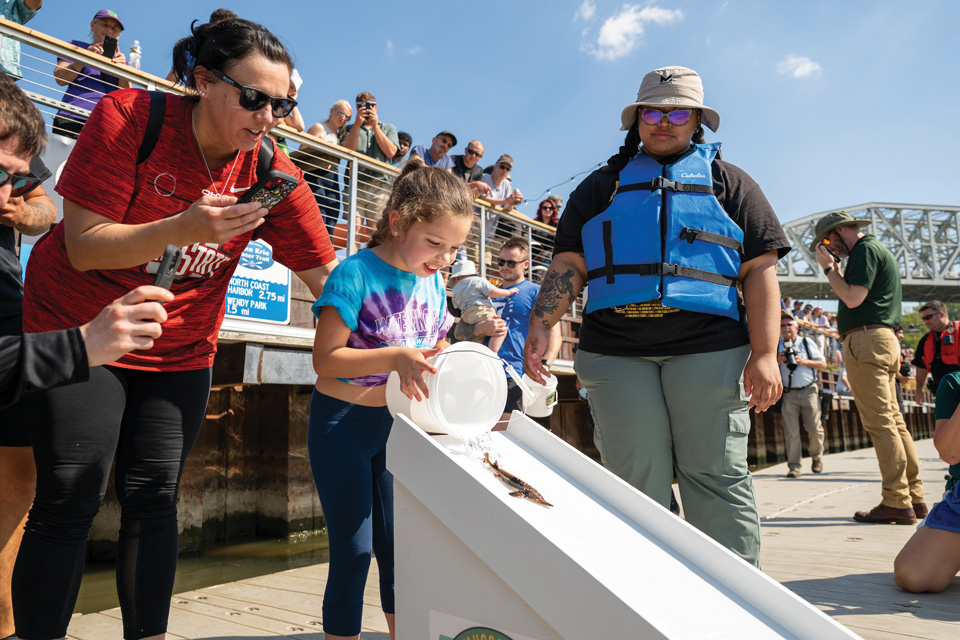
Kids take part in the sturgeon release program at several locations on the Cuyahoga River, including a stop in downtown Cleveland. (photo by Joseph Thompson / Cleveland Metroparks)
Although it’s been eight years since the first sturgeon release, it’s still too early to know whether the fish will spawn and start reproducing en masse in the lake’s tributaries. That’s because sturgeon are very slow to mature, in part because they live so long.
Males reach sexual maturity at ages 8 to 12, and females at 15 to 20. So, it will be a few more years until the fish can start breeding. But there are some encouraging signs that the sturgeon are acclimating.
“We have seen a pretty sharp increase in the number of lake sturgeon out in Lake Erie itself that are being caught accidentally,” Weimer says. “Anglers, especially perch anglers, catch them. The commercial fishermen who use the trap nets have seen the biggest number of incidental catches.”
Those fish are documented and released back into the lake, he says. One of them was a sturgeon released in 2018 on the Maumee River that had grown to 41 inches. More than 40 sturgeon are caught on Lake Erie each year, up from around 4 to 6 in 2018, he says.
“We know it’s having an effect,” Weimer says of the reintroduction program. “We’re watching them grow. Now, we just give it time to see if they will return to those historic spawning tributaries and if they will spawn there.”
He attributes the signs of success to several factors: the hardiness of the high-quality fish raised by the U.S. Fish and Wildlife Service and the Toledo Zoo, the reduction in pollution in the rivers and improvements to habitat and water quality.
“One of the reasons the sturgeon are such an amazing story is it really speaks to how much of an influence we can have — positive or negative — when we put our minds to it, Cross says. “In less than 100 years, we almost wiped them out in Lake Erie, but we’ve also made some pretty positive steps in restoring them in a pretty short amount of time.”
For more Ohio outdoor inspiration, sign up for our Ohio Magazine newsletters.
Ohio Magazine is available in a beautifully designed print issue that is published 7 times a year, along with Spring-Summer and Fall-Winter editions of LongWeekends magazine. Subscribe to Ohio Magazine and stay connected to beauty, adventure and fun across our state.
Related Articles

3 Ohio Species With Halloween Colors
From monarch butterflies to the American burying beetle, meet three orange-and-black critters found in Ohio and learn how conservation efforts are helping to protect them. READ MORE >>

Cincinnati Zoo Chick Arrives at Disney’s Animal Kingdom
A new group of rare sihek chicks are in quarantine ahead of wild release, including one from the Cincinnati Zoo & Botanical Garden. READ MORE >>

Clement Kunkle Talks About Collecting Oddities at Cleveland Curiosities
The co-owner of the Lakewood shop talks with us about expanding his educational and wonderfully strange spot. READ MORE >>