



This is an excerpt of a story that ran in the November 1985 issue of Ohio Magazine. Small updates to align with AP style have been made to this version of the article.
From the deer’s point of view, Dick Tschantz ought to rank as one of the most feared men in Wyandot County because of his prowess as a hunter. Yet, when he opens the door of his house to a timid rapping, it is a doe fawn waiting to enter, her hoof still raised. She bleats like a kid goat, bounces into the kitchen, skids to a halt in front of the refrigerator and, turning soulful eyes toward Dayna, Dick’s wife, begs for a carrot.
Tschantz smiles indulgently. He is a hard man to cram into the anti-hunter’s image of callous, blood-lusting deer slayer. When not hunting, he is a veterinarian keeping animals alive, which explains why some years there are deer in a pen on his farm and even occasionally in his house. Game protectors bring him fawns orphaned by hunter or roadkill, knowing he will raise them until they are old enough to fend for themselves in the wild. He once successfully amputated a doe fawn’s mangled foot. She survives in the woods as Three-Legged Mary.
The Tschantzes name many of the wild deer that frequent their farm, too, especially the big bucks that Dick knows almost as well as a farmer can distinguish between his black-and-white look-alike cows. One is Bullwinkle; another Gramps; still another JC, after the expletive hunters are prone to use when they get a glimpse of his big rack of antlers.
Individual identity of bucks is not difficult in the open agricultural lands of northern Ohio, where any given township may support less than a hundred deer. Good hunters can distinguish slight variations in the antlers — the way they branch or fork out to points or how a particular tine droops — details a casual observer would not notice. “Sometimes you can trace a buck’s ancestry because antler characteristics are inherited,” says Tschantz. “I’ve seen a couple of bucks I’m sure are Bullwinkle’s offspring.” He pauses, turns to Dayna. “By the way, I haven’t seen Bullwinkle since last fall. I’m worried about him.”
A question looms too large to ignore, almost too hard to ask. How can this soft-spoken man who seems incapable of stepping on a spider, a man obviously dedicated to giving life, kill a deer? Even granting that deer left without predators may overpopulate to disease and starvation as has happened in Bernheim Forest in Kentucky and in the mountains of northern Pennsylvania, how can a man like Dick Tschantz deliberately hunt down and kill a deer?
The question does not rattle Tschantz, even when Dayna nods and mischievously adds, “Yes, how do you explain that?” “I don’t try, usually,” he answers quietly, searching for words. He has been through this before.
“The serious anti-hunter derives his point of view from such a different frame of reference than my own. I grew up on a farm. I learned that if you wish to eat meat, someone had to kill animals, even animals raised with love and concern. Hamburger does not generate spontaneously at the supermarket. I eat the deer I kill. But that’s not the point. I could also say that the big bucks I hunt are about at the end of their lives anyway. They’re marked animals, pursued not only by legal hunters but also illegally, by spotters in planes, by four-wheel-drive vehicles, by out-of-season poachers. Hit by cars. I’ve got cautionary deer signs along the highway out front, but I’ve never seen a driver slow down yet until he hits the deer.” Tschantz pauses. For him this is already a long speech. “But that is still not the point. The good hunter is like a good farmer who nurtures first that which he must eventually execute. He can do this because for him life is continuous. If he manages like he should, there will always be more deer. That’s why good hunters are always conservation-minded. On the other hand, I think the anti-hunter sees each deer as an individual whose death will leave a hole in the landscape—an irreplaceable value rather than something that will be continually renewed. Anti-hunters don’t trust hunters to guarantee that renewability. And, in all truth, mankind doesn’t have a good record in this regard.”
Then, in afterthought, he adds: “But I never shoot the deer we raise, even though they become as wild as the others. I couldn’t. And when I kill any deer, I always feel a twinge of remorse.”
***
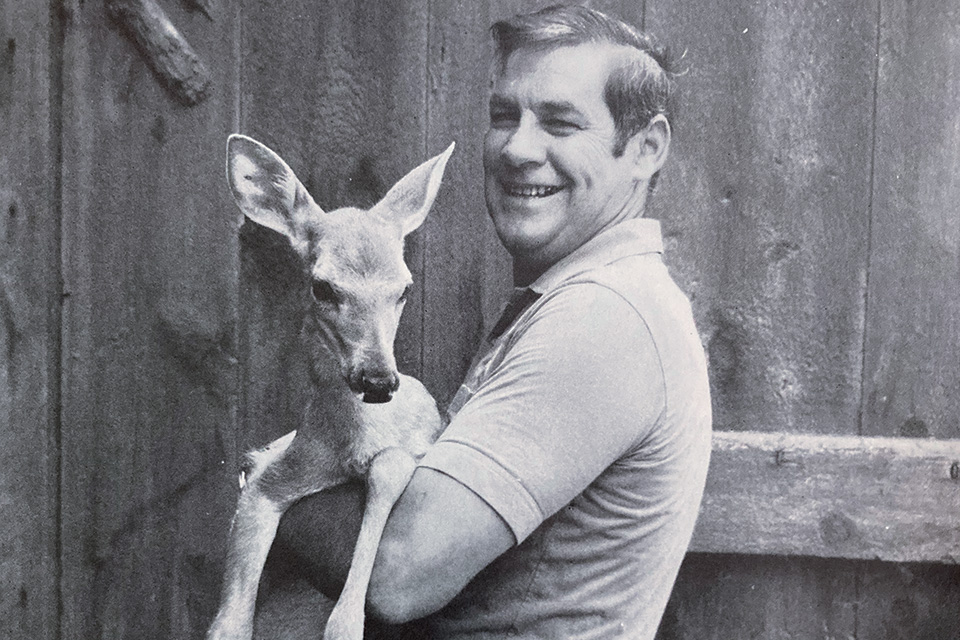
Dick Tschantz of Wyandot County in the November 1985 issue of Ohio Magazine (photo by Lois Abel Harlamert)
The sight of a white-tailed deer running can be, to a human, akin to what philosophers call a metaphysical experience, or what a more plain-spoken hunter once referred to as an intellectual orgasm. The animal’s unbelievable agility, grace and superpower thrills the mind with an exquisite wonderment. From a standstill in the middle of a country road, a startled whitetail can spring over the roadside fence 30 feet away in a single leap. A buck in his prime can run at 40 mph for short bursts, and cruise over broken ground at 30 mph for several miles at a stretch, taking great elegant bounds that downhill may cover 50 to 60 feet each. Fluid drive. Or he may move at a nimble canter, erupting periodically into high bounds that can clear a 7-foot deadfall without hesitation.
If it suits his purposes, he will crawl under a fence or a log, given no more than 20 inches of clearance. Even standing still, deer evoke such awe in the human that seasoned hunters begin to shake uncontrollably with buck fever, go rubbery in the legs, even slump to the ground. Or they may fire wildly over the deer in an almost deranged distraction they later can’t explain.
But if the agile beauty of deer overwhelms human imagination, the animal’s canniness has attained almost mythic proportions. Some hunters, like the Indians, have such great respect for the deer’s sense of smell that they abstain from eating meat a week or more before hunting. The theory is that deer can distinguish a carnivore from a vegetarian. Jason Frey, a Kirby hunter, has a different notion. Deer can tell a hunter from the merely curious because a man intent on the kill smells differently. At any rate, lookers often get closer to deer than hunters. Evelyn Long, of Upper Sandusky, who under the name of Grandma Tellmie writes a syndicated nature column for children, once walked out into a corn-stubble field right up to a deer, and it never moved. “I reached out and touched it,” she says. “It was like a dream. Fortunately, I had a companion for a witness.” That the deer was probably tamed earlier in its life does not explain this phenomenon completely—tamed deer returned to the wild revert to wild ways.
Another theory, popular around deer camp fires if not in the stricter classrooms of wildlife biologists, says that deer are getting smarter because the stupider ones get killed first and so do less breeding. Whether true or not, deer have learned to look up in trees, now that hunting from tree stands is so popular. They learn not to run ahead of a drive into the waiting guns of hidden shooters, too. The old bucks become so man-smart that killing one with bow and arrow is considered a major accomplishment. Killing two is passed off as supreme good luck, and killing three, on the order of a hole-in-one.
“Beyond that, game protectors start keeping a close eye, suspecting illegal methods,” says Roger Rothhaar with a wry grin. He is the only bow hunter in Ohio who has four trophy racks festooning his living-room wall that rank above the minimum size on what hunters refer to as the Pope and Young scale, which makes Rothhaar to Ohio bow hunting what Joe Montana is to football. “I doubt big bucks are getting smarter,” he continues, “but neither are the hunters. Or at least they’re unwilling to discipline themselves to the hard, grueling work and science of hunting trophy bucks. I’ve hunted all kinds of big game all over North America, and the white-tailed deer is by far the most challenging.”
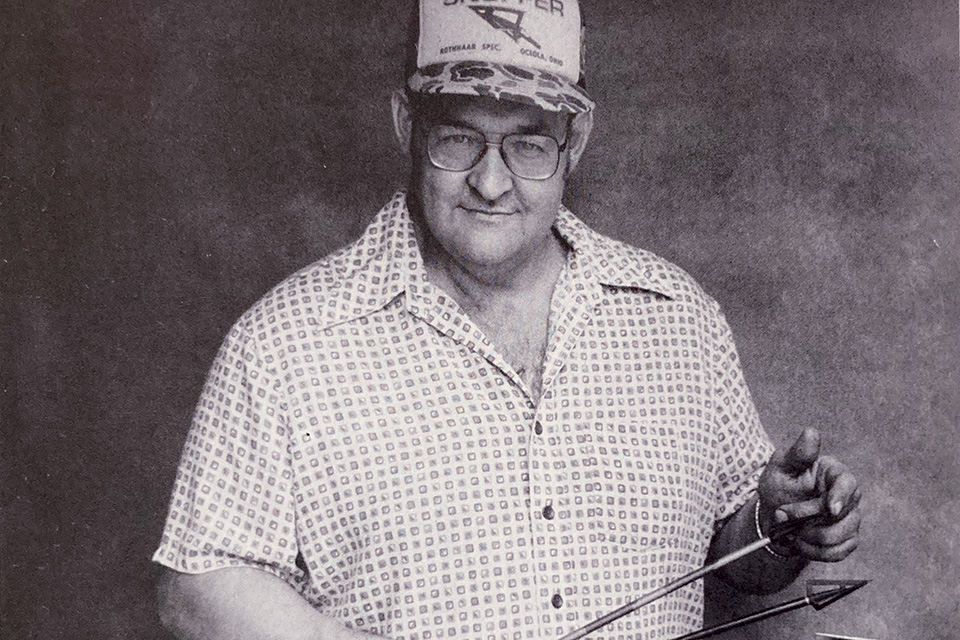
“... for those who can’t get away to far-off wildernesses, [deer hunting] provides that touch of the wildness the soul of man so desperately needs in a crowded world,” says Roger Rotthaar. (photo by Lois Abel Harlamert)
Rothhaar is also well-known for the three-headed hunting arrowhead he and his family make in their backyard shop in Oceola. Called The Snuffer, the arrowhead is one of the most widely favored designs in the country. “Many people think the arrow is crueler than the bullet,” he explains. “The opposite is true. I once shot a deer that was eating an apple. The arrow went all the way through and out the other side before the deer became frightened, quit chewing, ran a few paces and died.”
To hunt trophy bucks, hunters like Rothhaar, who has written a book on the subject, go to what seems to an outsider as outlandish extremes. They spend as many as ten hours scouting for every hour actually hunting. They must learn where not only the major, but the minor, deer trails are located in their chosen hunting area. Most hunters believe that big bucks seldom travel the major trails. They must find feeding and bedding grounds—a herd will establish fairly habitual movements within a given area of a few square miles. The hunters study particularly the way air currents behave in different wind directions and under different weather conditions, so they can evade the deer’s keen sense of smell.
Most of all, hunters must note where the bucks rub bark off trees and where they paw bare spots on the ground. On these rubs and scrapes, especially the latter, the bucks leave their scent—an open love note to the does: I’m ready when you are. It is on the scrapes, during breeding, that the bucks are most vulnerable. Then the hunter, juggling all this information, selects a tree in which to make his stand and wait. And wait. Days may go by. To get to and from a stand, undetected, Rothhaar will brush bare spots in the leaves for his feet to trod so as not to make a rustle. To approach a woods from a cornfield, he will remove the lower leaves from two rows of corn so he can crawl along soundlessly. In the tree where he puts his stand, and perhaps around it, he will clip away branch tips so he has clear shooting alleys in all directions.
Up in his tree stand, the trophy hunter will let smaller deer pass by, waiting for the big one he knows is out there. Unlimited patience is required. Gary Beasley, a veteran hunter from Sycamore, scouted a buck for three seasons, waiting for it to grow to trophy size. The year, almost to the day, he planned to shoot it if he could, it was hit and killed by a car on the highway.
Bow hunters claim the biggest reward for their endeavors is the chance to enjoy nature and the tranquillity of the woods. “You see all sorts of things,” says Tschantz. “I even spotted a badger from my stand and a coyote while scouting. Both are rare here.”
But the actual killing of the deer? Is that tranquillity too? “Anyone who enjoys killing a deer or anything else needs a psychiatrist,” says Rothhaar. “But when you have hunted the way we hunt, worked that hard, there is a rightness, a correctness in the killing no different than if a cougar did it. Are we to be ashamed that we are meat-eaters?”
Is that what he tells anti-hunters?
“My favorite answer for them is something I read in a hunting magazine. Do you know who was an outspoken foe of hunting? Adolf Hitler. And he was a vegetarian, too.”
When that remark is repeated at a restaurant table where four couples are eating, conversation suddenly chills. Who would be so tactless as to bring up the subject of killing deer in mixed company—part pro-hunters, part anti?
Feint: Well, Genghis Khan was a pro-hunter. So what’s that prove?
Thrust: I will never quite see the logic of spending millions of dollars to protect wildlife for eleven months so you can shoot it during the twelfth.
Parry: You want to go back to 1900 and not have any deer at all?
Thrust: Say what you will, I just could never be the person to kill a deer. They are too beautiful.
Parry: But I’ve heard you say that about lambs, and you are right now eating rack of lamb?
Feint: I go hunting with George mainly to do the good-faithful-wife bit. I’ve never even got a shot at one.
Feint: Dear, that’s because you don’t really like to hunt. I don’t think women ever do. The instinct must have evolved only in the male.
Touché: Oh, come on, George. Don’t give me that primitive man, pioneer survival line. I believed that when we first went hunting. But I’ve listened to you hunters talk for hours. All you really care about is who gets the biggest buck. It’s just softball and football all over again—the whole American obsession with winning some damn game. Any damn game.
Silence. The couples fall to eating, the argument forever unresolved. Humans have not yet reconciled themselves to the grisly essence of biological life. All the world’s creatures sit at a vast banquet table, dining on each other. The history of life can be reduced to one word echoing up and down the inextricably interwoven labyrinths of the food chain: Chomp!
Environmental groups like the National Audubon Society and the Sierra Club tend nowadays to agree with the current philosophy of the wildlife specialists—that deer populations must be managed, that is, kept in balance with available food and habitat, which means inevitably some controlled and regulated form of hunting. However, such organizations only softly support hunting, as many of their members are adamantly anti-hunting, which vitriolic letters to the editor of Audubon magazine prove. Groups like Cleveland Amory’s “The Fund for Animals” still maintain a hard-nosed opposition to hunters. Amory once proposed, with tongue in cheek, it is presumed, a “Hunt the Hunter’s Club,” the club’s motto being: “If you can’t play a sport, shoot one.”
***
There are more white-tailed deer in Ohio today than when Simon Kenton blazed trails through the vast forested wilderness. The Ohio Division of Wildlife can claim part of the credit, perhaps, for some initial restocking in the early Thirties and careful management since then. But the main reason for the whitetail’s ascendancy to a population variously estimated at between 120,000 to 150,000 in the state is that humans have unwittingly provided them with a better habitat than they enjoyed in Ohio 300 years ago. The white-tailed deer is not a creature of the deep forest. It is a browser, feeding mainly on tender young tree and bush twigs at the forest edge, or on acorns in sunny, open glades. Where heavy lumbering occurs, deer population rises dramatically as the brush grows back in the wake of the big trees, whose shadows had kept low growth scanty.
Even in the north and central grain-growing regions, where forty years ago deer were as rare as elephants, whitetails now flourish. The little woodlots that dot the farm fields have in aggregate not so much acreage, but miles of edges where the browse grows best. Little creek valleys and hillsides too steep to plow, where once sheep and cattle pastured, are now abandoned and growing up into deer paradise. Cornfields from July to December offer better cover than woodland ever did, and though corn is not a preferred food of the deer, they can winter over on ears missed by the mechanical harvesters. Deer nibble at soybeans and clover for extra protein, then move on for dessert to apple trees. Orchardists contend their businesses are being ruined.
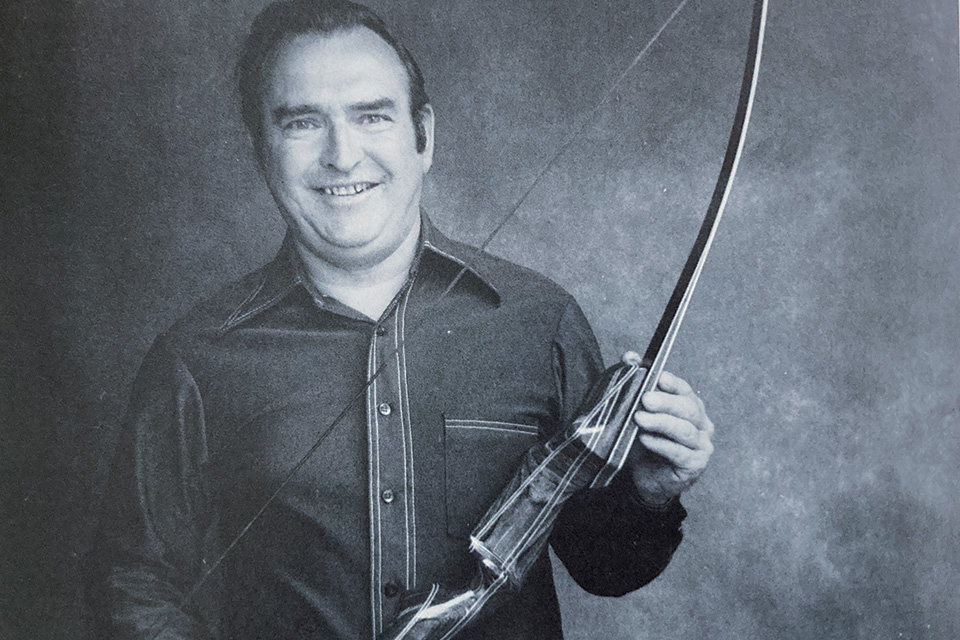
“I don’t put sights on a bow unless a customer specifically orders it. Shooting an arrow accurately is sort of an instinct, like learning to throw a rock accurately.” (photo by Lois Abel Harlamert)
Hunters from wooded southern Ohio or upper Michigan can’t believe there are deer in this open country. “It’s kind of amusing,” says Don Assenheimer, who makes the Assenheimer take-down, recurve bow in a shop in his backyard near Bucyrus. “They come here because they’ve heard this is big buck country. But when they see it, they want to go back home. It doesn’t look like deer country.” Assenheimer’s bows are renowned through the nation. To make them, he likes to use bubinga wood laminated with curly maple. The result is a handcrafted work of art as much as a weapon. But hunters spray black or camouflage paint on the wood grain to keep the sun from glinting off the bow and spooking the deer. Assenheimer does not put sights on his bows unless specifically requested to do so. “Sights are more of a hindrance, in my experience,” he explains. “Shooting an arrow accurately is sort of an instinct—more like learning how to throw a rock accurately. There’s a guy in West Virginia—Stacey Grosscup’s his name, and he’s a preacher—who can shoot aspirins out of the air with a bow and arrow.”
Cities provide attractive menus for deer also—the suburban and urban landscapes growing an even more varied fare than the countryside. Acreage that’s being held for future development and is growing up in brush is a favorite hangout. Deer are flourishing in the Cleveland Metroparks, as many as a hundred in the Rocky River Reservation alone, say officials. As one Clevelander dryly remarked upon hearing that news: “It’s nice that something is safe in this city.”
In fact, these are adventurous times in the humdrum city backyards of Ohio. One man watched breathlessly as a doe and a fawn walked boldly across his lawn and disappeared into a half-acre wedge of brush woodlot left over from a housing development. He decided to pursue. Crawling on his hands and knees through the dense underbrush, he soon came to a cleared space—a deer bedding area. Doe and fawn eyed his approach curiously. Then, instead of fleeing, the doe, perhaps taking the man down on his knees for a dog, reared on her hind feet, front hooves flashing like a boxer’s fists. A deer’s hooves can cut a throat as neatly as a butcher knife can, and the man, aghast, fled. Back to civilization. Just forty feet away.
With so many deer in the state—hunters killed a record high 66,860 last year, and an estimated 9,000 more were killed by highway traffic—both hunter and anti-hunter should be happy. But quite the opposite is true. The anti-hunters continue to oppose almost any kind of deer hunting unless the hunter will “go after the deer naked with only a knife for a weapon,” a confrontation many of them seem to hope the deer will win. Hunters reserve most of their invective for the Division of Wildlife, which they believe is allowing too much hunting—deliberately pursuing a policy of lowering the deer population to please farmers, especially orchardists, and insurance companies who pay out dearly for auto accidents involving deer. Officials repeatedly deny these charges and point to the record kill last year as proof that the herd is being managed well. Hunters say the record highs are the result of good management several years ago, or of manipulated counts, insisting that deer numbers are down drastically in their areas from two years ago. When hunter (not to mention anti-hunter) criticism crescendoed till it could not be ignored last winter, Bob Donohoe, a Department of Natural Resources wildlife biologist, told the newspapers: “They (hunters) are great people, but they don’t know anything about counting deer.”
Talk like that infuriates hunters, especially bow hunters who scout the woods constantly and believe they know more about deer populations in their areas than the specialists making guesstimates based on a few observed locations. Even Tschantz, who is not given to idle criticism, has his doubts. “I’d say wildlife biologists are truly concerned about the long-range good of the deer, but my opinion of present official state policy is that they are seeing how many licenses they can sell. How much money they can make. We need less doe season for a while in this area and shorter gun seasons.”
Hunters by no means agree, however, on how deer “harvest” ought to be managed. (Officially, deer are always “harvested,” never killed.) Few gun hunters would favor a shorter gun season, for instance. There is, in fact, almost as much animosity between bow hunters and gun hunters as between hunters and anti-hunters. Maybe more. Although hunters laugh at the jibe of “hunting naked with a knife,” they themselves unconsciously rank the various methods of killing deer by the amount of skill demanded, which in turn reflects how much of a sporting chance the deer are given. In this ranking, trophy buck hunting with a bow merits top place, even a gun hunter will admit. At or near the bottom of the list is the gang hunter who shoots button (yearling) bucks, the least wary of all deer to kill. A complete ranking would look something like this:
- Trophy buck bow hunters.
- All other bow hunters.
- Crossbow hunters. There is some disagreement here. Bow hunters object to crossbow hunters being allowed the same long season they get because, they say, the crossbow is more like a gun in range and accuracy and ought to be considered as a gun for hunting purposes.
- Muzzle-loading rifle hunters. Since the hunter so armed has only one shot before the comparatively lengthy reloading process, the deer has more of a chance than against other legal firearms. Last year near Harpster, a deer wounded by a muzzleloader chased its bearer half a mile before the latter was able to reload and kill the deer, narrowly escaping serious injury in the process. Both hunters and anti-hunters seem to love to tell this story.
- Shotgun slug hunters who hunt alone or in very small groups.
- High-powered rifle hunters, where legal. It is, or should be, comparatively easy to kill a deer from 200 yards with today’s rifles and scopes. A bow hunter must get within 30 yards for an accurate shot.
- Gang hunters.
- Gang hunters who use all-terrain vehicles, walkie-talkies, snowmobiles or airplanes to chase deer to exhaustion.
- Poachers.
A gang hunt resembles a military operation more than a hunt; although if it were a military operation, it could hardly vanquish a troop of boy scouts. Originally, a gang hunt was the same kind of drive used by Indians and other primitives: a line of hunters driving game ahead of it toward a line of hidden shooters or spear throwers. Organized this way in wooded, hilly terrain, as in southern Ohio, this mode of hunting is not deemed despicable. But in the more open northern part of the state, where county roads run regularly every mile east to west and north to south, the gang hunt becomes disgusting or embarrassing to “serious” hunters. A cordon of pickup trucks and men line up on the roads that border a square section of land (640 acres).
A line of drivers advances on foot across the section. (Sometimes advances are made with ATVs, but this is illegal.) If a flushed deer manages to break through the entrapment into the adjacent section, the trucks roar into action, and that section is immediately surrounded. A fresh line of drivers repeats the process. Airplanes may enter the invasion as spotters, although using them is illegal. Shooting from the road is illegal, too, but the temptation can prove irresistible, especially if it is known by radio that the game protector is watching another gang someplace else. So the day continues, until a deer is run to death or the hunters give up from exhaustion.
“As the big buck passes through his prime years, the constant wariness that has kept him alive against all odds begins to take its toll. He seeks, above all, security.”
In actuality, gang hunting is seldom as grim as this description implies. First of all, as bow hunters like to say, the hunting IQ of a mature buck is somewhat higher than that of a typical gang hunter even when armed for modern warfare. Man-smart deer won’t drive. They slip back through the line of drivers in wooded terrain and may just stand there under cover rather than break into the open. Button bucks, inclined to wander away from their mothers more than doe fawns, and so left without wise guidance, are about the best a shooter ahead of a drive can hope for. Secondly, the typical gang hunter joins the hunt mostly for the camaraderie.
If he carries a gun at all, he is a greater danger to his fellow hunters than to the deer. He spends most of the time shivering on the road with his hands in his pockets or warming up in a truck listening to the football game. If by some stroke of luck he gets a shot, he invariably misses, a fact he secretly rejoices in. If he killed a deer, everyone would find out he didn’t have the foggiest notion how to dress it out. The point of most gang hunts is to laugh a lot, tear around in trucks awhile, and then retreat to a favored bar or kitchen and brag about the afternoon’s exploits.
In any deer camp of, say, five people, the level of hunting prowess is about the same. There will be one Serious Hunter, a second hunter trying hard to become a Serious Hunter and three people who just want to get away from their normal world for a week or a weekend. One of these, a male, will invariably become the camp cook, although he refuses to touch a dish at home. He stays in the tent, probably alienated by the natural world outside. He turns out to be a fairly good cook. A fourth person hunts the first morning, then settles down to tinkering with the portable TV, trying to fix the focus to see the football game better. In the evening, he persuades the others to play poker. He loses $50 every year. The fifth member of the camp is a “guest,” a first-timer who has borrowed the Serious Hunter’s older gun and must be instructed on how to fire it. In the woods, he whistles, stumbles and thrashes around a lot, drops his coffee cup out of the tree stand and shouts when he gets lost. But quite often he is the only one to kill a deer.
The serious hunter usually graduates out of one or all of the various gang and camp hunts, becoming interested finally in pursuing only trophy bucks with bow and arrow. Alone. There is another reason, never mentioned, for this ultimate choice. The trophy bow hunter is, with a few notable exceptions, a middle-aged male. Younger people either
have not yet learned the greater satisfactions of this kind of hunting or have not yet been able to order their lives so as to have the extensive free time necessary to scout and hunt the wary old bucks successfully. Older people lack the will or the stamina such hunting demands.
What the middle-aged male pursues is the middle-aged buck, and between them are certain similarities that belie the charge of anthropomorphism. As the big buck passes through his prime years, the constant wariness that has kept him alive against all odds begins to take its toll. He seeks, above all, security. More and more he lingers alone, away from the herd. Or runs with other old bucks. More and more he is willing to let the foolhardy younger bucks play most of the mating game, exposing themselves to the greater dangers. At the peak of the rut, when the moon is just right and the wild night winds blow, he comes to the rutting scrapes to claim his dominance or be driven back by a younger buck. Let it be so. He retreats to the deepest fens of the woods, as far from the man-smell as possible, there to dream of endless feasts of white cedar boughs and apples.
The middle-aged man understands. He searches for the hoof marks of the big bucks, looking for the tracks of his own soul. Where to now? he asks—as much of himself as the buck. His offspring have gone to find their own bedding grounds. If he and his wife have remained lovingly together, hardly the rule, what is there between them but an enduring patience—except occasionally when the moon is right and the night winds blow wild? Solitude takes on certain pleasures not appreciated in earlier life. The deep woods beckon. The days of old age are just down the trail, perhaps waiting behind that beech tree already in sight.
The haunting, hunting questions: Is it so bad to die now, still able to race at 40 mph, white tail flashing, antlers glistening in the sun? Or to wither and shrink into a mangy-backed feebleness that even a stray dog can drag down?
Would it be so bad to die now, a hunter, still strong enough to draw 75 pounds on the bow string and hold it steady, full drawn, without a tremor? Or to suffer the slow, humiliating slide into the old folks’ home?
The bow comes up. The string tightens. The haunting, hunting questions, for the moment, vanish. Release!
For more Ohio history, sign up for our Ohio Magazine newsletters.
Ohio Magazine is available in a beautifully designed print issue that is published 7 times a year, along with Spring-Summer and Fall-Winter editions of LongWeekends magazine. Subscribe to Ohio Magazine and stay connected to beauty, adventure and fun across our state.
Related Articles

Backstory: Lion in Autumn
“The pressure I put on myself is always tougher than any put on me.” — Woody Hayes READ MORE >>

Backstory: From A to Zoar
Zoar Village has enough history for a hundred towns and enough citizens who see its present value. READ MORE >>

Backstory: Ohio’s Real-Life Cowboys
Rodeo! It’s what keeps the East Sparta Gang thirsty for beer, aching with pain, hungry for glory and happy with life. READ MORE >>