


See ‘Tony Foster: Exploring Time, A Painter’s Perspective’ in Dayton
Artist Tony Foster examines both the enormity and fleeting nature of time with his watercolor paintings. An exhibition of his work opens at the Dayton Art Institute on Feb. 21.

Delicate brush strokes steeped in muted earth tones capture the vast, layered expanse of Mount Everest in Tony Foster’s “Mt. Everest, From Ocean Floor to Roof of the World, 45-50 Million Years.” The watercolor artist created this piece at roughly 16,000 feet using a blend of gin, hot water and pigments to capture the north face of the highest mountain in the world.
Through the art of watercolor, Foster’s works have the power to put viewers in a time and place, and his exhibitions — what he refers to as “Journeys” — are always structured around a theme, using the natural world as a lens to explore larger ideas. It was this painting of Mount Everest that inspired his 19th Journey, “Tony Foster: Exploring Time, A Painter’s Perspective,” which originally opened in Cornwall, England, and is running Feb. 21 through May 17 at the Dayton Art Institute. It explores four themes of time: geological, biological, human and fleeting moments.
Each theme is conveyed through watercolor pieces that depict some of the most permanent things on Earth (like the Grand Canyon) to the most temporary (like a crashing wave or the shimmer of a rainbow).
Viewers may notice handwritten notes around the margins, a smattering of brushstrokes in various colors or even small sketches of leaves, fossils and other objects Foster encountered while painting. These elements give the works a journal-like quality. This is because his works are done on-site, rather than taking a rough sketch back to a studio to create a more polished version later.
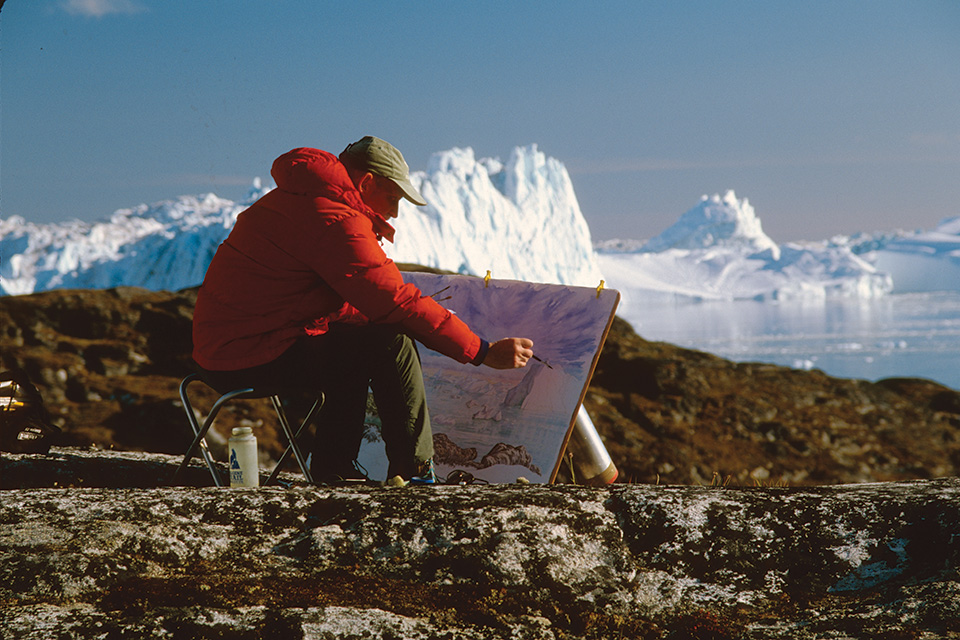
“Most of my work is done a long way from the end of a road,” Foster says. “It requires hiking or kayaking or canoeing or getting into the backcountry somehow or other. … Because they’re celebrations of wilderness, really, watercolor is very practical.”
Biological time is depicted through Earth’s ancient living organisms, such as the giant sequoias in California or the Pando aspen grove in Utah, while human time is represented through sites such as Malakoff Diggins in the Sierra Nevada, a former goldmine that was abandoned in the 1860s. Foster’s watercolors capture the site’s slow return to nature.
“If people leave realizing how human beings are merely an eyelash in terms of the whole sweep of the Earth’s history,” Foster says of the exhibition, “perhaps we’ll be a bit more humble and a bit less bombastic about the way we use the Earth.” 456 Belmonte Park N., Dayton 45405, 937/223-4278, daytonartinstitute.org
For more Ohio arts inspiration, sign up for our Ohio Magazine newsletters.
Ohio Magazine is available in a beautifully designed print issue that is published 7 times a year, along with Spring-Summer and Fall-Winter editions of LongWeekends magazine. Subscribe to Ohio Magazine and stay connected to the beauty, adventure and fun across our state.
Related Articles

See Aimee Lee’s Korean-Paper Art at the Kent State University Museum
The exhibition features more than 50 of the Cleveland-based artist’s handmade dresses that feature Korean paper-making traditions. READ MORE >>

Columbus Screening Celebrates Ohio-Born Poet Mary Oliver
A new documentary exploring the life, work and Ohio roots of Pulitzer Prize-winning poet Mary Oliver to screen at the Wexner Center for the Arts on Sept. 25. READ MORE >>

12 Fall Arts Events to See This Season
See art exhibitions and performances across the state this fall, from “Boop! The Musical” to 150 of Charley Harper’s wildlife-inspired works. READ MORE >>