







Printer Friendly VersionEmail A FriendAdd ThisIncrease Text SizeDecrease Text Size
September 2009 Issue

Songbirds and Skyscrapers

Bring your binoculars to the new Audubon Center in Columbus, and you'll see wildlife juxtaposed with views of the city.
Songbirds and Skyscrapers
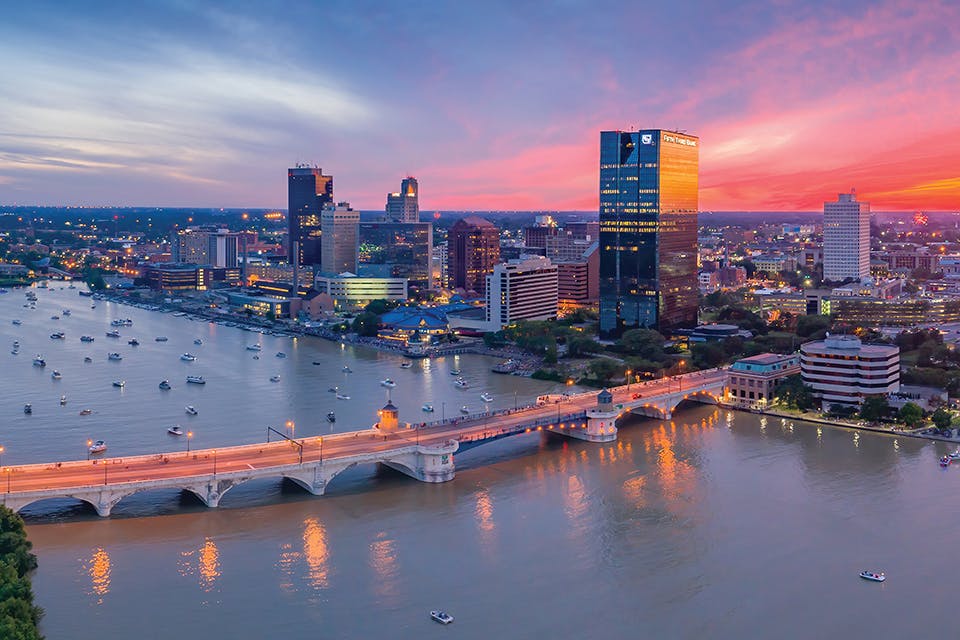
You can find the new Grange Insurance Audubon Center about a mile from the languid confluence of the Scioto and Olentangy rivers, about half that distance from the frenetic interchange of interstate highways 70 and 71, a stone’s throw from one of the most popular bird-watching areas in central Ohio, and in the shadow of the downtown skyline of Ohio’s capital city.

In other words, squarely at the crossroads of pastoral nature and urban chaos. A look out its spacious north window proves it.

The backdrop catches your eye first —multiple lanes of speeding traffic hard against the skyscrapers of downtown Columbus. In the near distance, you’ll see the Scioto River and its wooded banks, where mink and beaver cruise the waters and deer and rabbits browse young trees and shrubs. Close by, there’s a restored wetland where, this autumn, migrating waterfowl and wading birds will find food and rest on their way south.

But over there, just to the east of the wetland, you’ll see a huge slab of concrete — the foundation of an old warehouse — and a rusting water tower. And then there’s the most obvious example of this property’s long industrial past, the Columbus auto impound lot, looking like some post-apocalyptic car dealership: rows of cars, vans, and pickup trucks in various stages of decay.

In the late 1990s, when the city, the Columbus Metro Parks and the National Audubon Society first considered a 160-acre area south of downtown for a park and nature center, the chorus of skeptics was loud and persistent. Two centuries of industrial use had left the soil contaminated and the landscape scarred with artifacts of human commerce — warehouses, water tower, railroad tracks and an abandoned landfill among them.

“And yet, while it was a wasteland, it was also known as an important natural area,” says Heather Starck, the director of the new nature center. Migrating birds follow the river on their semi-annual journeys and use the wooded river corridor as a place to rest and refuel, she explains. More than 200 bird species have been spotted in the area, including bald eagles, peregrine falcons, herons and other wading birds and a host of warblers.

Audubon named the site an Important Bird Area, and fishermen know it as a hotspot for saugeye and catfish. “The city understood how important it was, ecologically, and talked to the local Audubon chapter and Metro Parks about ways to protect it,” Starck says.

A decade later, as the 18,000-square-foot center opens, the transformation is incomplete but still impressive. The impound lot remains — the recession stalled development of a new lot – but the city has committed to removing it next year. The new, $7.8 million Audubon center is complete, an inviting antidote for “nature deficit disorder” perched on a hill in the middle of the 84-acre Scioto Audubon Metro Park.

The wood, glass, and steel structure rises from the top of a small hillside with an appealing mix of modern design and natural construction materials.

“We challenged our architects to balance the design, to reflect that we’re in an urban area but still be a nature center,” Starck says. “We didn’t want a log cabin.” The center is seeking LEED certification, a program through which the U.S. Green Building Council recognizes energy-efficient and environmentally friendly construction.

All of the center’s furniture is made at least partly of recycled content; the wood siding is certified as forest-friendly. Part of the roof is covered with vegetation to minimize runoff, while excess water is absorbed in the porous parking lot and rain garden.

Inside, the building is designed to bring in as much of the outdoors as possible. The most interesting feature is a central skylight designed to work as a type of sundial. As the sun changes its seasonal position, it highlights certain dates marked by disks on the floor — among them the winter solstice and the birthday of John James Audubon.

While the urban location came with its share of challenges, the site accomplishes Audubon’s goal in recent years: to bring hands-on conservation and nature-based learning to city-dwellers who might not have easy access to the natural world. In the past, Audubon centers were built in more remote locations, but in recent years the conservation organization has been building them closer to the center city — from Brooklyn’s Prospect Park to Debs Park in Los Angeles. The organization is working with the Columbus Urban League’s Head Start preschool program to bring children to the center and plans a variety of programming to immerse urbanites in the outdoors.

“You’re not having to bus kids out 40 miles away and tell them about nature. It’s right here in their back yard,” Starck says.

While Audubon and its contractors have readied the nature center for its September coming-out party, the Columbus Metro Parks has been carefully nursing the metamorphosis of an industrial wasteland into an attractive urban park.

They’ve created pockets of prairie and restored wetlands in the river’s floodplain. They’ve added trails, some connected to the city’s bike path system that skirts the park’s edge. They’ve cleaned up the boat launch and built new observation decks to give birders and others a better view of the natural area.

But Metro Parks also recognizes the unique location of this park, says John O’Meara, executive director of the park district. “The focus of the park will be to conserve and interpret nature in the heart of the city,” he notes, “but we do recognize that the heart of the city is a vibrant place and that we have to serve many diverse audiences. We want to encourage people to get outside and play as well as to discover nature.”

So playgrounds are in the works, both for children and adults. The vision includes sand volleyball pits, a skating rink, a ropes course and a 35-foot-high climbing wall that is expected to draw rock-gym rats from throughout the Midwest.

It’s true that, at the moment, O’Meara’s new park remains marred by the view of the city impound lot. But he hopes visitors will see the potential in the park and overlook its unseemly past.

“If the site didn’t have polluted soils and the impound lot as a neighbor, there probably wouldn’t have been land available for a Metro Park in the heart of the city,” he argues. “If we want to address urban sprawl and a host of other wasteful development practices, then we have to make the cities more attractive places to live, work and raise families.”
 
Related Categories
- Life


Subscribe
COMMENTS
Be the first to leave a comment.
ADD YOUR COMMENT


Subscribe
Ohio Magazine Cover

Subscribe to
Ohio Magazine
two ways:
Digital Subscription Print Subscription Newsletter

FacebookFlickrOhioBlogsTwitter Podcasts

Tender Moments

It's a story filled with hope and courage — not to mention two dozen tunes that are an integral part of the Great American Songbook. In a nutshell, that's "Tenderly: The Rosemary Clooney Musical," which debuted last week at the Victoria Theatre in Dayton. As I sat in the audience during the Sunday matinee of this stellar show — produced by the acclaimed Human Race Theatre Company — I couldn't help but marvel at the fact that there is indeed so much more to this legendary song stylist than the image we se... Read More »

Older Posts »

Copyright © 2011 Ohio Magazine All rights reserved. | webmaster@ohiomagazine.com
1422 Euclid Avenue Ste. 730 Cleveland OH 44115