



Printer Friendly VersionEmail A FriendAdd ThisIncrease Text SizeDecrease Text Size
January 2007 Issue

Miracles in the Music

Songs have always provided a sound track  to Deforia Lane's life.  Now, the director of music therapy at University Hospitals of Cleveland uses harmony to help others heal.
Miracles in the Music

Geraldine M. Brown is impatient. She knows it, and she apologizes.

But it's three o'clock, and this session -- the one where the singing angels make her forget that she's lost 25 pounds in the last 25 days -- this is what she's been waiting for. She's not going to waste a second.

"Come on! Come on!" the 81-year-old says, her tiny feet excitedly shifting back and forth beneath the hospital blanket. "Come on with the singing!"

Music therapist Deforia Lane stands at the foot of the bed, calmly smiling back. She knows she's doing her job right if Geraldine is in such good spirits. After all, this is a woman who, when she checked herself into University Hospitals of Cleveland just six days ago, was starving and dehydrated. The great-grandmother and retired minister had spent weeks in misery at her Cleveland Heights home, unable to keep food down and suffering from mysterious abdominal pains that varied from sharp to searing.

And yet, here she was: still fragile, still only able to ingest liquids because of what doctors have diagnosed as pancreatitis -- but lying in bed just as eager as a kid on Christmas morning.

"I really don't mean to rush you," Geraldine says. "It's just that I'm enjoying you so thoroughly."

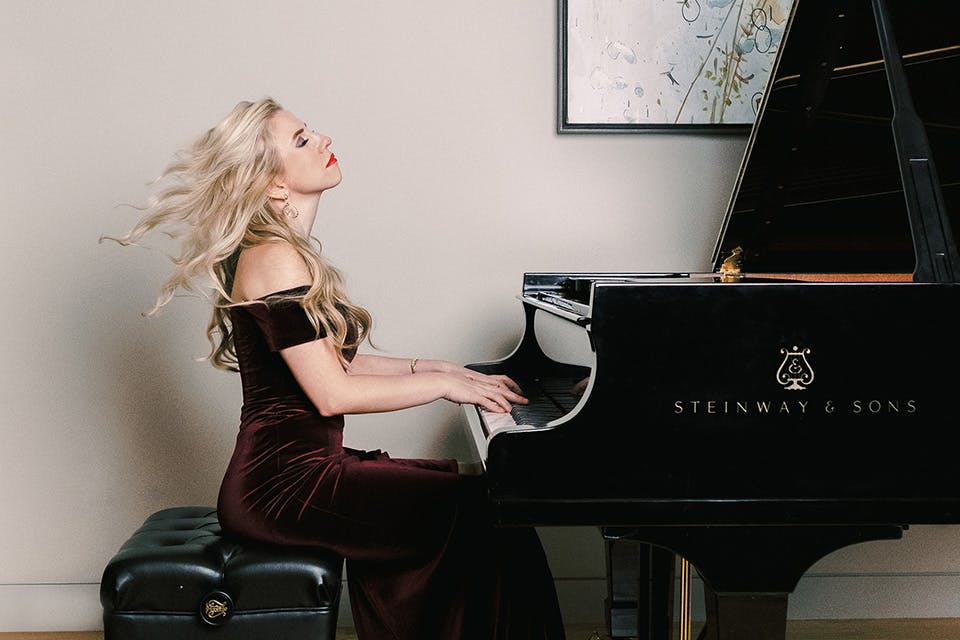
"No, no, it's quite all right," says Lane, UHC's director of music therapy and a woman who's made it her life's mission to help people heal through the power of harmony. She lays her long, slender fingers on the keyboard in front of her and starts playing a familiar gospel refrain. Before long, everyone in the hospital room is making like they're at a Sunday church service: Lane belts out the lyrics to "Down By The Riverside" in a voice rich with vibrato; her two young interns, standing beneath the hospital room's mounted TV, sing backup as if they were a choir; and Geraldine's husband of more than 50 years, George, croons from his recliner in the corner: "Gonna put on my long white robe, down by the riverside..."

Geraldine nods her head to the beat, sways her feet beneath the blanket, her smile burning megawatts, her pain temporarily gone.

That's how music therapy works.

It's a lot more technical than that, of course. Lane, one of the field's pioneers and most renowned practitioners, will be the first to tell you that. For instance, she'll explain how the steady beat of a song can allow the brains of some stroke victims to latch on to a predictable rhythm, ultimately helping them regain their speech. Or, how having patients with decreased motor skills strum guitars, bang drums and tickle piano keys helps aid in their physical rehabilitation.

But some things just seem to defy technical explanation; for example, the occasions when patients have awoken from a coma while Lane was at their bedside, singing an aria.

And then there's the way in which she was indirectly steered toward the profession: that night when, as a teenager full of faith but lacking direction, Lane heard a mysterious voice -- an event that she now refers to as "one of those moments you never forget."

As far as Geraldine M. Brown is concerned, not everything needs technical explanation. Hearing her favorite gospel and country-western tunes soothes the ache in her stomach, she insists. That isn't something that needs to be defined with medical jargon.

Experiences like hers would help explain why some patients -- upon seeing the nearly 6-foot-tall Lane gliding down the hospital's hallways at full stride, pushing her gray crate of instruments in front of her, her two cheery blonde interns at her side -- refer to the music therapists as the singing angels.

Says Brown, "Deforia's doing the Lord's work." 
 
"Okay - I had an experience once ... I never know how people are going to interpret it, so I don't ever say it."

Lane, 58, is sitting in her small office at University Hospitals, contemplating her childhood in a lower-middle-class neighborhood in Dayton. Looking back, the fact that she wound up working with music isn't too surprising. Whether it was dancing in the living room with her older sister, Deborah, as her mother played classical sonatas on the piano, or later receiving a bachelor's degree in vocal performance from the University of Cincinnati College Conservatory of Music in anticipation of a singing career, Lane has always had a sound track playing in the background of her life.

And her spirituality certainly has deep roots. All those Sundays spent sitting in pews and singing in the choir at the local Methodist church were bound to have an impact: seeing the severely arthritic parishioner whose body seemed to jolt to life whenever the choir launched into a hymn; or watching the serious face of her handsome, stoic minister crumble at the sound of one congregant's soulful voice singing an old spiritual. "Those tears rolled down his cheeks, and it was like watching stone crack," says Lane. "It was music that was the catalyst for all those things."

But that incident in her youth -- that was something altogether different.

As Lane tells it, she was a high school junior when she went to Camp Minnewanka in Michigan, a two-week camp that focused on improving emotional, physical, mental and spiritual health in youth. She'd always been a high achiever, tirelessly striving to be the most diligent student, the most faithful churchgoer, the most devoted daughter. "If I knew that something I did would make someone say, 'Oh, look at her!' I'd want to do it as much as possible and as best as I could," says Lane. "I was a real people-pleaser that way ... and I became my own worst critic."

At Camp Minnewanka, Lane attended a lecture during which a speaker talked about the importance of slowing down -- of not just dutifully praying and attending services for the sake of trying to please Him, but of sitting in the silence. "The man said, 'Prayer is a two-way conversation,'" Lane remembers. "Nobody had ever said that to me before."

After the lecture, she went for a walk on the beach, mulling over those words. She lay on the sand and looked up at the sky. She prayed, asked aloud what she should do with her life.

She got an answer. "All these years later, I still remember it so clearly," says Lane. "A voice said, 'You must give yourself to God.'" Even then, she knew that didn't mean entering the ministry (although later, a college counselor advised her that she could follow that path).

Fortunately for the patients at University Hospitals, she would eventually offer up her talents -- which include knowing how to play piano, violin, tuba, saxophone, trumpet and drums -- in service of music therapy. She's been there for 22 years, serving as a certified music therapist, putting into action the skills she learned while earning her Ph.D. in music education from Case Western Reserve University. And if the mother of two (her sons, Martin, 34, and Curtis, 25, are both engineers in Chicago; her husband, Ernest, is a Cleveland architect) doles out extra doses of compassion along with the therapy sessions, it's because she knows something about the pain that some of them are going through.

In the 1970s, Lane went through her own bout with breast cancer; that's why she first came to University Hospitals, joining a group support session for survivors. When it ended, she thanked everyone involved by singing a song to bolster their spirits. The hospital later invited her back to do an in-service, singing for other patients. Then, a social worker paved the way for her to volunteer to sing to the terminal patients in the bone marrow transplant unit.

Six months later, Lane was summoned to the head doctor's office.

"He said, 'I heard what you're doing with my patients,'" recalls Lane, furrowing her brow and mimicking the doctor's deep, stern voice. "'Iunderstand that they are actually taking off their oxygen masks and are singing along with you. I also hear that you have nurses bringing in instruments in the middle of the night, and now they're standing up against beds and singing and playing or some such thing. And I have letters from the families of the patients, writing to me to tell me what you're doing. And I have two questions for you.'

"By this time," says Lane, "my whole body was like Jell-O."

"'Number one, when can you come to work for us?,' the doctor finally asked. "'And number two, how much money do you want?'"

Patients in Cleveland have not only benefited from Lane choosing music over ministry, they've also had opportunities to meet some of Lane's notable friends and colleagues, such as opera singer Kathleen Battle -- a Portsmouth native and Lane's old UC college roommate, who at Lane's request has sung with children suffering from AIDS at University Hospitals' Rainbow Babies and Children's Hospital.

And Broadway star Maureen McGovern, a Youngstown native, certainly counts herself a fan of Lane and her work. As a spokesperson for the American Music Therapy Association, McGovern went on rounds with Lane several years ago. She remembers vividly a woman in agony from the flesh-eating bacteria that had taken up residence in her body -- and how her eyes lit up when Lane took the poetry that the woman's husband had written to his ailing wife, and transformed it into a beautiful song.

"Hope is half the battle in any life-threatening illness, and music has the power to attach to something inside of you, something of great meaning," McGovern says. "So often, music gives people the will to live, the will to go on.

"There's a reason why I call Deforia the Mother Teresa of Cleveland."

 
Copyright © 2013 Ohio Magazine All rights reserved. | webmaster@ohiomagazine.com
1422 Euclid Avenue Ste. 730 Cleveland OH 44115