



Printer Friendly VersionEmail A FriendAdd ThisIncrease Text SizeDecrease Text Size
March 2008 Issue

Wish You Were Here

Postcard images of the National Road recall the golden age of auto touring.
Glenn Harper and Doug Smith
Wish You Were Here
The New Concord log cabin birthplace of William Rainey Harper, first president of the University of Chicago, is typical of the treatment of these pioneer dwellings. Though log buildings were nearly always sided over, when converted to historic house museums, the siding is invariably stripped off, perpetuating the myth of the humble log cabin origins of many of our ancestors. Because of their unaltered glimpse of early-20th-century life, real photo postcards are very collectible.
 
In this view of Blaine Hill, three 1920-era automobiles descend a steep incline near the last of 20 curves on a stretch of highway where serious brake wear was common before reaching the Blaine Bridge at the bottom of the hill. A service station was conveniently located here. Lady Bend Hill, between Cambridge and St. Clairsville, is the subject of a fascinating piece of National Road lore. A young lady from Wheeling was on her way to Fairview to elope with her lover and was ejected from an overturned buggy and killed during a thunderstorm. Legend has it that stormy nights still find the victim’s ghost riding recklessly up and down the hill.
 
 This succinct, amusing message is found on the back of an old postcard of the National Road, dated September 18, 1925. By the time this card was mailed, travelers had been sending postcards to friends and relatives for over a half-century. The images of the National Road featured on these pages offer a glimpse of a simpler and quainter era and illustrate how the road and the facilities that catered to travelers have changed over time.

The United States Post Office began issuing prestamped postal cards in 1873. Congress passed the Private Mailing Card Act in 1898, allowing the private printing and publishing of postcards. Writing was permitted only on the front of the card, often across photographs or art, until 1907, when the back of the card was divided into two sections, one for the message and one for the address. The “divided back” card ushered in the golden age of American postcards, which dovetailed nicely with the golden age of auto touring on America’s highways, including the National Road.

People had long collected and traded postcards known as view cards of buildings, streets, towns and highways. As the major east-west highway during the early automobile era, view cards of the National Road were plentiful. Storied and picturesque segments of the road, service stations, tourist cabins, motels, bridges, commercial main streets and historic landmarks were common subjects.
By the 1940s, motor courts and motels that integrated all of the rooms under a continuous roofline had begun to replace tourist cottages and cabins. Some even included an adjoining one-car garage, such as the Shamrock Motel just east of Etna, Ohio. By the 1930s, new technology allowed publishers to print cards on linen-type paper stock. Like the Shamrock Motel card, they were characterized by bright and vivid colors.
 
The road’s unique bridges were also favorite postcard subjects. The S-bridge seen here is located just west of New Concord. Now restored, it is the focus of a small park. Eastbound motorists on Zanesville’s famous Y-Bridge, looking for downtown, would be asked to “go to the middle of the bridge and turn right.” The old covered bridge over Wills Creek in Cambridge, shrouded in handbills, and its 1925 concrete viaduct replacement also are represented. 
 
In this 1909 view of Hebron, the National Road shares space with the interurban railroad. The card is produced directly from a negative. Known as Real Photo cards, they were printed in black and white or sepia. With Eastman Kodak’s invention of the Folding Pocket Camera, people were able to take black and white photographs and have them printed onto postcards.
 
 
Past & Present
 
Blaine Hill Bridge: This 1828 structure is the oldest documented bridge in Ohio. It is located just west of Blaine before you start up the Blaine Hill Viaduct.
 
Salt Fork S-Bridge: The rural setting for this bridge appears much as it did during the heyday of stagecoach travel. From U.S. 40 veer right onto Co. Rd. 6794 and cross Salt Fork over the bridge.  
 
National Road/Zane Grey Museum: Located in Norwich near the entrance ramp to I-70, this museum includes a diorama of the road and numerous artifacts. The museum is open from Memorial Day through Labor Day, and year-round by appointment.
 
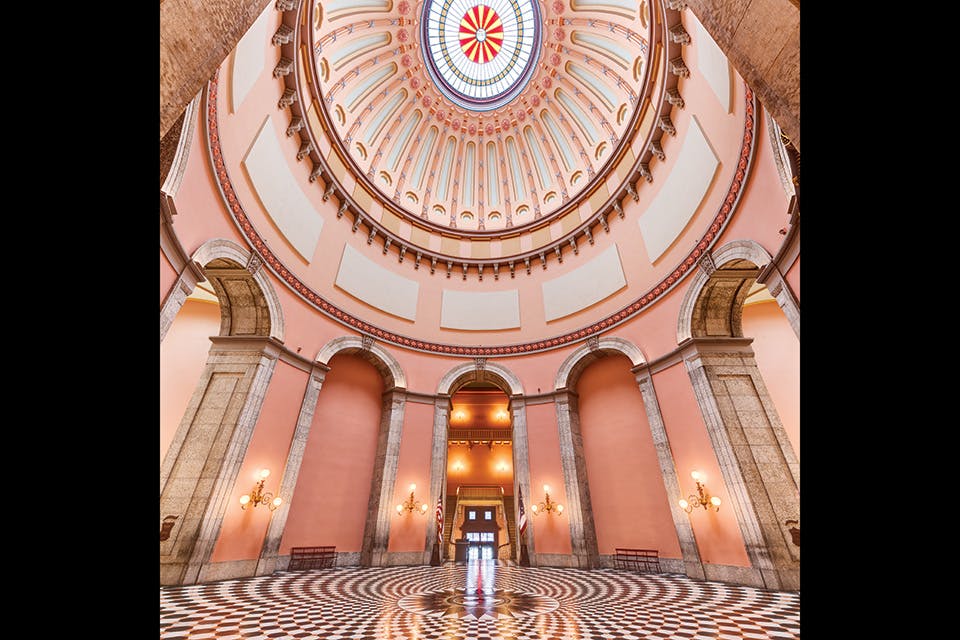
The Ohio Statehouse: Located on U.S Rte. 40 (Broad Street) in downtown Columbus, Ohio’s capital building is considered one of the finest examples of Greek Revival-style architecture in the United States.
 
The Pennsylvania House: This recently restored inn and tavern in Springfield was a welcoming site for National Road travelers when it opened in the 1830s. The guest list includes Presidents William Henry Harrison, James K. Polk and Andrew Jackson and author Charles Dickens. The house is the epitome of Federal-style grandeur with its magnificent porches and tall chimneys.
 
To Learn More:
Read A Traveler’s Guide to The Historic National Road. This guide provides a concise history of “The Road That Helped Build America.” For a free copy, call 800/686-6124.
 
 
Springfield: In Step with History
A stop in Springfield is truly a trip through ages past, from historic architecture to experiences that mirror the flavor of the ’50s. Learn about it at the Heritage Center of Clark County. The block-long building, constructed in 1890 for city offices and a farmer’s market, also features exhibits chronicling Ohio’s agriculture and industry and contains a genealogy-research library.

“Happy Days” are indeed here again all summer long at the Melody Cruise-In Theatre, which has been screening first-run movies under the stars since 1952.

Designed by renowned architect Frank Lloyd Wright, The Westcott House (left), built between 1904 and 1908, is an outstanding example of the Prairie School of architectural design he’s known for. Our foremothers are commemorated in the city’s Snyder Park. The “Madonna of the Trail,” one of a dozen identical statues placed along the National Old Trails Road by the Daughters of the American Revolution, was dedicated on July 4, 1928. The 5-ton, 10-foot-tall statue depicts a pioneer mother clasping an infant, as another child clings to her skirt.


Real photo postcards sometimes reveal the adaptive use of earlier structures. The Ramsay Hotel, pictured here, is actually an earlier house hidden behind a newly constructed service station. This predecessor of the motel offered overnight lodging and the chance to fill up your tank. Establishments like the National Trail Restaurant and Tourist Court offered one-room cabins and 6 percent beer.
 
 
The period from 1916 to 1930 is called the white-border era of postcard printing. Germany dominated the postcard market until World War I. After the war, most postcards were printed by U.S. publishers. Postwar printing costs were significantly higher. Possibly to save on the price of ink, white borders were left around many postcards. Like the earlier divided-back card, the growing use of white-border view cards corresponded with another historic era of the National Road.
 
In 1916, Congress passed the Good Roads Act, providing $75 million for states that organized “responsible” highway departments. By the 1920s, a uniform highway numbering system identified the National Road as U.S. Rte. 40. The growing car- and truck-traveling public sparked road improvements, with many sections of the National Road bypassed, straightened or leveled to accommodate higher-speed travel.
 
This succinct, amusing message is found on the back of an old postcard of the National Road, dated September 18, 1925. By the time this card was mailed, travelers had been sending postcards to friends and relatives for over a half-century. The images of the National Road featured on these pages offer a glimpse of a simpler and quainter era and illustrate how the road and the facilities that catered to travelers have changed over time.

The United States Post Office began issuing prestamped postal cards in 1873. Congress passed the Private Mailing Card Act in 1898, allowing the private printing and publishing of postcards. Writing was permitted only on the front of the card, often across photographs or art, until 1907, when the back of the card was divided into two sections, one for the message and one for the address. The “divided back” card ushered in the golden age of American postcards, which dovetailed nicely with the golden age of auto touring on America’s highways, including the National Road.

People had long collected and traded postcards known as view cards of buildings, streets, towns and highways. As the major east-west highway during the early automobile era, view cards of the National Road were plentiful. Storied and picturesque segments of the road, service stations, tourist cabins, motels, bridges, commercial main streets and historic landmarks were common subjects.

By the 1940s, motor courts and motels that integrated all of the rooms under a continuous roofline had begun to replace tourist cottages and cabins. Some even included an adjoining one-car garage, such as the Shamrock Motel just east of Etna, Ohio. By the 1930s, new technology allowed publishers to print cards on linen-type paper stock. Like the Shamrock Motel card, they were characterized by bright and vivid colors.
 
On the eve of World War II, U.S. 40 was a busy 24-hour-a-day artery, but traffic peaked about 1960 and quickly diminished with the construction of Interstate 70. National Road images soon disappeared from postcard racks. Today, the National Road is recognized as an All-American Road and National Scenic Byway, and old postcard images of the road are more collectible than ever.
 
Related Categories


Subscribe
COMMENTS
Be the first to leave a comment.
ADD YOUR COMMENT


Copyright © 2013 Ohio Magazine All rights reserved. | webmaster@ohiomagazine.com
1422 Euclid Avenue Ste. 730 Cleveland OH 44115