


Printer Friendly VersionEmail A FriendAdd ThisIncrease Text SizeDecrease Text Size
November 2008 Issue

Westward Ho!

Dramatic history, small-town charm, vast farmlands and natural beauty are on proud display in this fascinating heritage area.
Westward Ho!
As usual, the official description doesn’t quite do the place itself justice.

Visit the Web site for the part of the state that calls itself “Ohio’s Historic West” —www.ohioshistoricwest.com — and you’ll read that it is “a State Designated Heritage Area dedicated to the development of cultural and heritage tourism in an eight-county area: Auglaize, Champaign, Clark, Darke, Logan, Mercer, Miami, Shelby. It is truly a patchwork of diverse places, and highlights many historic, cultural, scenic, and agricultural sites and attractions.”

True enough, as far as it goes. But should you take a few days to visit and explore that patchwork, you’ll experience a rich, fascinating and slightly out-of-the-way region that shows off the Buckeye state at its rural, rootsy best: vast farmlands that stretch past the horizon; curving county roads dotted by produce stands with handmade signs; old red barns proudly sporting American flags; hidden creeks and massive lakes; quaint small towns and old-world churches that sprout suddenly from the surrounding countryside.

This is a land that trumpets its heritage, embraces its culture and understands its history. In Darke and Mercer counties, to the far west along the Indiana border, the land is flat and open, and the sky seems endless. Farther east, in Champaign and Logan counties, the country rolls and buckles, undulating prettily into a landscape of wooded hills — toward the highest point in the entire state, Campbell Hill, which rises to 1,549 feet above sea level just northeast of downtown Bellefontaine. There is variety, indeed, to this region.

South of there, Clark and Miami counties are where the flatland and the hilly countryside converge, home to larger towns and industry, and cut through by river valleys that have helped define their history.

In fact, history is a big part of what draws these eight counties together. This was the edge of the violent frontier that saw battles between great American Indian war chiefs and aggressive American generals — where names like Tecumseh, Little Turtle, and “Mad” Anthony Wayne resonate now in historic sites.

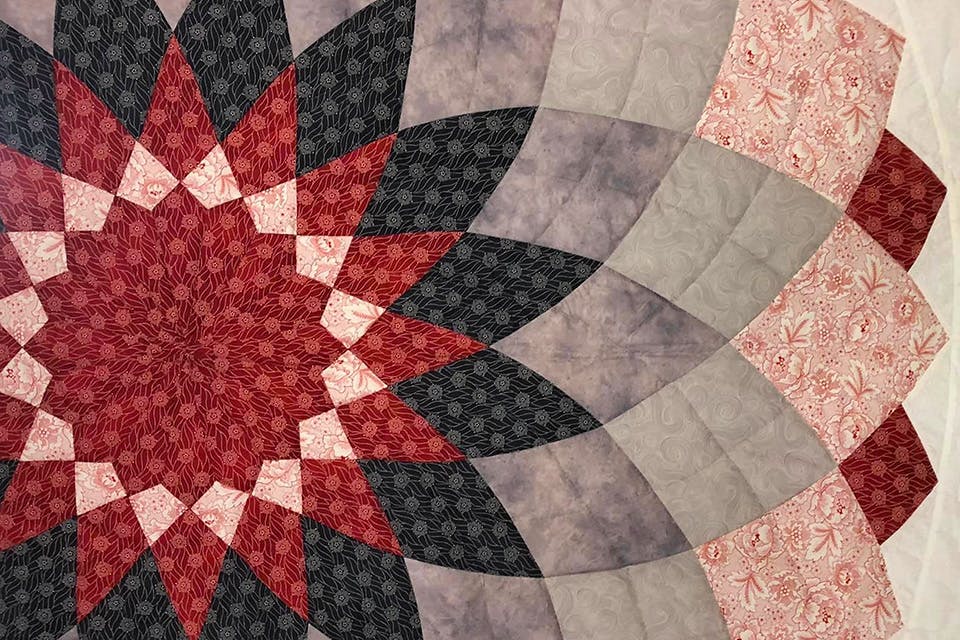
In the early- to mid-1800s, it was the land cut through by the Ohio & Erie Canal that opened the state to transportation, industry and commerce — and left its mark on the area by introducing a huge number of European immigrant workers whose influence still hovers over the area. Later still, the area flourished as an agricultural breadbasket, with farming providing the beating heart of the people who live and work here — a life that is visible in the farm market on the downtown square in Versailles, on the colorful “barn quilts” of Champaign County, or in the clusters of dark-blue silos that tower over the verdant fields of Darke County.

The eight counties that comprise “Ohio’s Historic West” have as many marvelous, offbeat differences as they have traits in common.

Before traveling, visit www.ohios historicwest.com and browse its lists of events and itineraries, including several scenic-byway tours. For specific sites and stops, call ahead to check times and admission prices.

Natural Treasures

The most striking natural features of this region are its two great lakes — created to feed transportation, but used today for recreation.

The largest is Grand Lake in Mercer County. It’s nine miles long and three miles wide, bookended by two towns that are different in character but share a coastline and an appreciation for water recreation. Celina, the Mercer County seat, perches on the lake’s western end, its downtown marked by a marina, a striking white lighthouse and a tidy city park where you can enjoy the boaters and anglers while you picnic.

St. Marys is on the eastern end, and so has the advantage of lakeside sunset views. Grand Lake St. Marys State Park is nearby, providing boat ramps and a beach. St. Marys State Fish Hatchery specializes in raising largemouth bass, and is open for public visits.

The lake was built to feed water into the Ohio & Erie Canal that ran from Cincinnati to Toledo and was essentially the state’s first highway. Its canal boats and locks required four feet of water at all times, and Grand Lake helped keep the canal flowing. From 1837 to 1843, the lake was dug by hand, mostly by German and Irish immigrants who made 30 cents and some whiskey per day.

To the east, Logan County boasts Indian Lake, a bit less than half the size of Grand Lake, at 5,800 acres, but just as attractive and constructed for the same reason, as a canal feeder. Surrounded by eye-catching real estate and dotted with picturesque islands, it’s a favorite of water-skiers and sail-boaters alike. Russells Point and Lakeview bubble with a small-town touristy atmosphere, and Indian Lake State Park provides camping and the place for a quiet, wooded respite.

East of the lake, Logan County’s hill country provides the heights of Mad River Mountain in Zanefield, a ski area that draws visitors from all over the state once the snow flies. Those hills are there because, while ancient glaciers flattened the surrounding landscape, they diverged around Logan County. That same geological phenomenon created the county’s two remarkable underground cave formations — the dramatic Ohio Caverns near West Liberty, the state’s largest and most colorful, with more than a mile of passageways, and the impressive Zane Shawnee Caverns near Bellefontaine.

Miami County lays proud claim to the Brukner Nature Center near Troy, which lies along the Stillwater River and encompasses more than 160 wooded acres cut by hiking trails and an animal rehabilitation center. It’s a marvelous family place.

Want to go more rustic? In Champaign County, between Springfield and Urbana, Cedar Bog is a walk back into Ohio’s natural prehistory. The bog is a rare 450-acre wetland where plants and animals thrive.


Past and Present

History is close to the surface in these counties. Museums, markers and state historical sites abound, explaining and celebrating the accomplishments, struggles and even the tragedies of the people who have lived here.

For a good overall view of their areas’ history, pay a visit to the Garst Museum in Greenville and the Heritage Center of Clark County in Springfield. The Garst has a wonderfully diverse and sometimes offbeat range of artifacts, from Native American relics to a collection of U.S. military uniforms (including a rare one from the War of 1812). There’s memorabilia from broadcaster Lowell Thomas and sharpshooting entertainer Annie Oakley, who were born in Darke County, and a neatly reconstructed turn-of-the-century Main Street to wander. The museum also marks the soldiering of Gen. “Mad” Anthony Wayne, who opened Ohio for white settlement by forcing Native Americans to accept the Treaty of Greenville in 1795.

In Springfield, the Heritage Center occupies the huge, renovated City Hall and Marketplace that has towered over downtown for more than 100 years. From Civil War and military exhibits to displays about the city’s past as an industrial powerhouse, the Heritage Center is an unusual and educational museum experience.

Nearby, the Westcott House is testimony to what a small city can do to restore its architectural treasures for

future generations. Built in the early 1900s by world-famous architect Frank Lloyd Wright for Burton Westcott, a Springfield mayor and wealthy automaker, the lavish Prairie School-style house fell into disrepair for more than 50 years before dedicated citizens recently brought it back to its former luster and thrust it into the center of the city’s cultural life. Today, it’s open for tours and special events.

Americans know that, like the Westcott, their truly great houses are often the product of wealthy eccentrics with a vision and bankbook that went hand-in-hand at just the right time. That’s surely the case with Champaign County’s remote but oddly European Piatt Castles. The pair of English-styled brownstone mansions in the middle of the rolling farm country were built by brothers who named them Mac-O-Chee and Mac-A-Cheek, harking back to a similarly named Shawnee village that once stood on the site. Today, visitors can tour and marvel at the imagination and zest that went into these grand homes.

If unforgettable is what you’re after, you’ll want to stop by the National Marian Shrine of Holy Relics in the tiny Mercer County village of Maria Stein. Very much reflective of its German Catholic past — those canal workers, again — the big redbrick building here is a former convent, garden and motherhouse for the Sisters of the Precious Blood. It was built in 1875 and today houses a museum and a chapel containing more than 1,000 relics of saints. Standing in the quiet chapel, one can’t help but be amazed to find such a thing in the middle of Ohio’s farm country.

Perhaps the same could be said for the Neil Armstrong Air and Space Museum in Wapakoneta, which lauds the efforts not just of the first man to walk on the moon, but also of many others who explored space. The museum sits just off I-75.

That modern-day artery was preceded by the now-lost canal. Visit the Piqua Historical Area, a state-run park, to see and ride aboard a full-scale replica canal boat that traverses a restored part of the original canal. A few miles north of downtown Piqua are stone locks that once regulated the water level and let the boats go where they needed to.

For a reminder, finally, of Ohio’s early days, head for Fort Recovery. This village near the line of Darke and Mercer counties has something most towns can’t claim — a reconstructed frontier fort right downtown. That fort marks the site of two major battles between early American forces and the Native Americans who didn’t want to give up this rich, fertile land: the infamous “St. Clair’s Defeat” of 1791, to this day one of the ugliest disasters in the Army’s history, and Anthony Wayne’s 1794 victory. Today, a state-managed stockade and museum tell the tale, and a stone obelisk marks the graves of those who fell here.

Byways and Back Roads

Really, the most fun thing to do in the counties that call themselves Ohio’s Historic West is to get off the main roads and just drive around.

There’s the Champaign County barn quilt tour that gives you a reason to wander the curving roads and hilly highways.

In southern Mercer County, the area called “the Land of the Cross-Tipped Churches” — through the villages and hamlets of Coldwater, Wabash, St. Henry, Minster, Fort Loramie, Cranberry Prairie, Fryburg, Sharpsburg, Russia, St. Sebastian, Osgood and McCartyville — you’ll see grand old Catholic churches of dark brick and tall spires, most topped with a gold cross that looms over the surrounding cornfields with a magnificence that is, well, inspiring.

Sound exotic, and a bit off the beaten path? Not if you live there. But if you don’t, grab a map and plan a visit.
 
Copyright © 2013 Ohio Magazine All rights reserved. | webmaster@ohiomagazine.com
1422 Euclid Avenue Ste. 730 Cleveland OH 44115