



July 2005 Issue
Shaker Made
Driving east on St. Rte. 63 in southwestern Ohio's Warren County, travelers don't realize they are moving linearly across history. They pass two state prisons, a local detention center, sprawling farms and some ranch houses, never suspecting that this
Cheryl Bauer
Shaker agriculture and lifestyle vanished here long ago. The only obvious evidence that the celibate religious sect once lived here is a historical marker and bell at the Otterbein-Lebanon Retirement Community on St. Rte. 741. These days, elderly residents live in two large buildings built by the Shakers and on land that once supported their enterprises. Since the demise of Union Village in 1912, this quiet place has been a retirement home affiliated with the Methodist Church. Travelers who look closely, however, will see traces of Shaker life all over Otterbein and eastern Warren County.
Dwellings for the faithful
Marble Hall, the first old building glimpsed on the Otterbein campus, is the most atypical Shaker building imaginable. The building was once the Shakers' Office, a no-nonsense two-story frame structure that was home and office for trustees. In the 1890s, the building underwent a complete transformation, becoming a stately Victorian showplace with a third floor, twin turrets, side porches, and gingerbread trim. Elder Joseph Slingerland also transformed the interior of the building, hoping to make it more attractive to potential converts. Marble was used copiously - on the floors, tabletops, even sink tops. A graceful butternut staircase commanded the center hallway, and solid, wooden cupboards anchored pass-throughs between the trustees' dining room and the kitchen.
The building was originally built by the Shakers in 1810 as the Center House, a dwelling for established members of the faith. Archivist Mary Lue Warner has led the effort to retain as much of the Shaker craftsmanship as possible during multiple renovations of Marble Hall over the years. "We've saved every nail, shutter, and window we could," she notes, "while making sure that the building is comfortable for modern residents." A Shaker Museum Room chronicles the life of the Shaker village that started there in 1805 and grew to foster six other communities in Ohio, Indiana and Kentucky.
Next door is Bethany Hall, the Shakers' "new" Center House, completed in 1846. The Shakers cut their own cherry and oak lumber, and fired more than a million bricks on site to build what they claimed was the largest brick building in Ohio at the time. This building has been remodeled over the years but retains the more traditional T-shape and the date 1844, the year that Andrew Houston, a prominent Shaker, fell to his death while helping to construct the building.
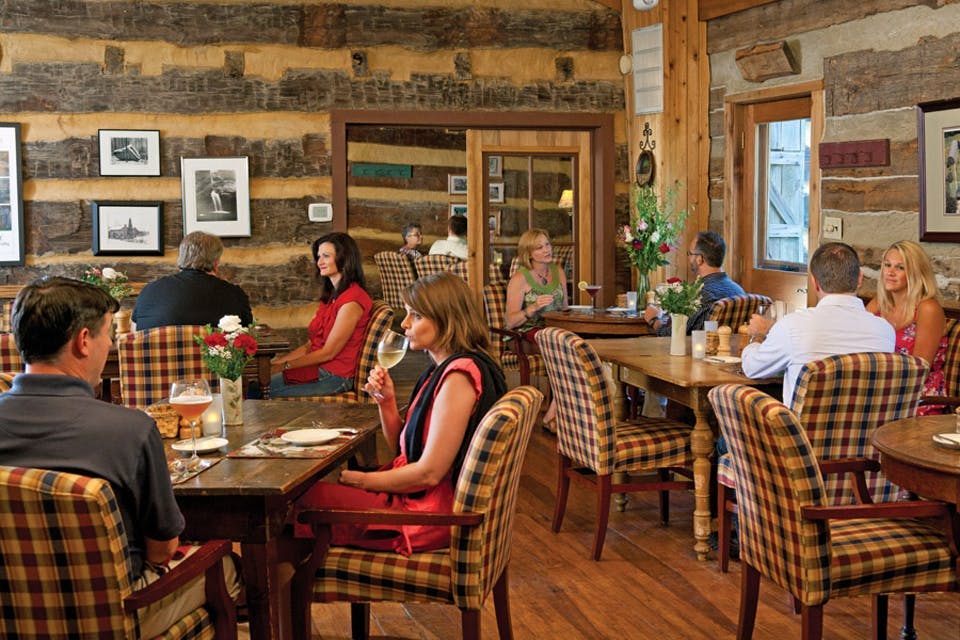
Many of the Shakers' artifacts retained by Otterbein are on long-term exhibit at the Warren County Historical Society Museum in Lebanon. The Robert and Virginia Jones Shaker Gallery, considered one of the Midwest's finest Shaker collections, contains hundreds of items from Union Village and other Shaker communities. The pieces there come from Otterbein, from local citizens and from the Joneses. As a young couple in the 1930s, they purchased Shaker pieces to refurbish another Lebanon icon, the Golden Lamb Inn. Many of their pieces are displayed throughout the inn, particularly in the Shaker Dining Room and in two fourth-floor display rooms.
Form and function
Shaker style is admired for simplicity, functionality and craftsmanship. The products that the Shakers became famous for in the 19th century are rather surprising. While collectors today search for Shaker cupboards and chairs, furniture making was never a commercial industry at Union Village. Boxes, brooms, textiles, and pottery were in high demand from the public, however.
"The ideal was a pure simplicity in form and content of everything the Shakers made," notes Mary Klei, curator of the Warren County Historical Museum. "At first glance, most Shaker objects seem deceptively simple but the more you study them, the more you find the extras that make them so extraordinary. The ladies' little sewing kits lined in silk, the beautifully cut-out apron on a chest of drawers - these things all speak of the Shaker spirit.
"They tried to use their gifts to the fullest. They were trying to establish a paradise on earth, so perhaps they were trying to bring the beauty of the Creator into everything they did."
Craftsmanship helped the Shakers gain acceptance in Ohio after a turbulent beginning that paralleled the sect's creation in England in the 18th century. The sect, formally called the United Society of Believers in Christ's Second Appearing, started with Ann Lee, the wife of a Manchester blacksmith. The basic tenets of the sect included celibacy, pacifism, public confession of sins, and the belief that the divine spirit had reappeared within a woman. Women were men's spiritual equals, and they preached publicly. Members, who called themselves Believers, often broke into ecstatic dancing during worship, leading detractors to mock them as "shakers." The name stuck, even after Lee and eight followers fled persecution in England for refuge in western New York State in 1774.
Lee died in 1784, but her followers continued to proselytize. By 1800, Shaker villages thrived in New York, Massachusetts, Connecticut, New Hampshire and Maine. The Shaker elders decided to send missionaries to the western frontier that included Ohio, Indiana and Kentucky. Union Village, begun in 1805, was the first Shaker community west of the Allegheny Mountains. Its members founded several communities including Pleasant Hill and South Union, Kentucky; North Union, east of Cleveland; White Water, west of Cincinnati; and Watervliet, east of Dayton. The public, unsure of what to make of the sect's communal lifestyle, often opposed the Shakers, who tried to sway public opinion by controlling interaction with "the world," as they referred to non-Shakers.
"They invited the public into the village to attend their worship services, and they went out into the world to sell their goods," Klei says. They later accepted outside children into their schools as well. "Seeing someone at worship, sitting beside them in a schoolhouse, buying their goods for your home - all of those elements improved the relationship between the Shakers and the world."
Spirituality and skills were intricately connected, explains Charles Muller, a Shaker expert and writer from Groveport. "If you were a Shaker, what you made reflected upon God and upon the whole community. You were no longer working for yourself, but the whole Society. When you put yourself and God into everything you make, the person who buys your product is going to have an element of respect for the faith that produced it."
By mid-century, the Shakers could grow, produce and manufacture almost anything they or the public wanted on their 4,500 acres. The 1850 census showed 448 people living in the village, representing a wide range of talents and skills. In addition to agricultural and horticultural workers, builders, teachers and physicians, the community boasted weavers, lace makers, shoemakers, broom makers, bookbinders, printers, tinsmiths, blacksmiths, candle makers, potters and silversmiths.
The Shakers began producing goods for sale in much the same way that secular rural people did. They first made products for their own needs, and then expanded to serving their neighbors. An over-abundance of butter or eggs was offered for sale to avoid waste and provide extra income. A talented tinsmith would move into the village, and soon his wares would be in demand throughout the area.
Wool and silk
Some of Union Village's most popular early items were apparel and textiles. Wool from the Shakers' prized Merino and Saxon sheep was used to knit hats, gloves, scarves, socks, coats and blankets. Hats of all sorts became a true cottage industry at Union Village during the 1800s. Fashionable ladies eagerly sought Shaker bonnets made of silk and palm leaf. The sisters planted mulberry trees to nurture the silkworms that they raised to produce silk. ? Silk production was enhanced in 1830 by two Union Village brothers' inventions: Abner Bedle invented a silk-reeling machine and Thomas Taylor created an iron vessel and furnace for Bedle's machine. The result was a more efficient means of producing high-quality silk. A decade after the brothers' inventions, a small shop of sisters could reel an impressive 50 to 60 runs of silk in a day.
Bedle also invented a palm-leaf-weaving loom, which in 1837 opened up the burgeoning sales of hats, fans and tablemats. The Shakers had crafted straw hats and bonnets for themselves and the world for decades, but the loom increased the production of the more elaborate palm leaf bonnets for women. Palm leaves were one item that the Shakers couldn't grow for themselves in Ohio, so they imported the leaves from Cuba, then made the bonnets in the village.
Most of the Shakers' products sprung from specific needs. Covered storage boxes, a traditional utilitarian staple, became art in their skillful hands. The graceful oval boxes were traditionally crafted with pine tops and bottoms and maple rims. Overlapping "fingers" or "swallowtails" secured with copper tacks held the boxes together. They were frequently painted blue. The boxes came in many sizes and were used to store anything the owner wanted to protect.
While many Shaker communities sold textiles, seeds and brooms, Union Village had one industry that apparently was unique: pottery. Although Ohio became famous for pottery later, in the early 19th century only a few potters worked here. Most Shaker villages had kilns to fire their own bricks and (before the Shakers discouraged smoking) most produced their own clay pipes, but no other commercial Shaker potteries have been uncovered yet, according to Jerry Grant, a researcher and writer at the Shaker Museum Library in Old Chatham, New York. "It could be that some of the converts were potters and brought their skill along with them when they entered the community," Grant said.
By the time Union Village disbanded in 1912, the pottery - like so many other Shaker features - was just a memory.
Learn more about the Shakers and their life in Union Village at the following sites and events:
Otterbein-Lebanon Retirement Community, 585 N. St. Rte. 741, Lebanon. Tours of Marble Hall and Bethany Hall, led by archivist Mary Lue Warner, are by appointment only; call 513/932-1607.
Annual Shaker Seminar, July 24-29. Eastern Shaker style meets western when Hancock Shaker Village of Massachusetts brings its annual seminar to Otterbein-Lebanon Retirement Community. Explore Shaker history, music, antiques, and arts and crafts. Participants can visit two of Union Village's most spectacular buildings at Otterbein: the Trustees Office and the Center House. An even rarer glimpse into historic buildings of the Whitewater Shakers in Hamilton County will also be offered. Information is available at www.rootsweb.com/~ohwarren/Shaker/wssg.htm.
Warren County Historical Society Museum and Library, 105 S. Broadway, Lebanon, 513/932-1817. Library includes the Robert and Virginia Jones Shaker Gallery, research library and gift shop, which carries Shaker-inspired items and books. Tues.-Sat. 9 a.m.-4 p.m; Sun. 12-4 p.m.
The Golden Lamb Inn, 20 N. Broadway, Lebanon, 513/932-5056. The inn, which traces its lineage back to a tavern that opened in 1803, offers lunch, dinner and overnight accommodations to guests. Call for more information.
The Western Shaker Study Group meets bi-monthly to study the Shaker culture that grew up west of the Allegheny Mountains. Meetings are often held at the Otterbein-Lebanon Home. For more information, visit www.shakerwssg.org or call 513/932-1607.
Cheryl Bauer is co-author, with Rob Portman, of Wisdom's Paradise: The Forgotten Shakers of Union Village (Orange Frazer Press).
Be the first to leave a comment.