







August 2007 Issue
Out of the Earth
A passionate gardener and an innovative new chef are bringing the legacy of Louis Bromfield back to life at the Malabar Farm Restaurant.
It's 10:30 a.m. at Malabar Farm State Park and Peggy Eilenfeld - Farmer Peggy if you're a local - already has a day's worth of dirt on her well-worn brown work boots. Standing outside the property's youth hostel, she waves a gloved hand and hops in the passenger seat, pointing me in the direction of the farm stand where, hours earlier, her day began.
At the same moment, at our destination less than a mile down Pleasant Valley Road, Chef Dan Bailey mulls over the day's menu, the sleeves of his white chef's coat rolled up to his elbows, readied for prep work. As the new executive chef of the Malabar Farm Restaurant (he took over this spot in January and reopened in March), Bailey has been cranking out 12-hour-plus days, huffing and puffing some needed new life into the longtime restaurant's menu and style.
Her job is in the hot sun, his over a hot stove. But make a reservation at Malabar Farm, and you'll taste the seamless fusion of their crafts.
Malabar Farm was the home of author and conservationist Louis Bromfield, whose commitment to sustainable farming and eating well is part of his legacy to the now-state-operated property. In 1941, Bromfield purchased the two-story building that would become Malabar Inn, intending to create a restaurant that incorporated the farm's fresh produce into its dishes. The dream was never realized before his death in 1956. But the forging of the relationship between this farmer and chef has restored the sensibilities of the late author, making meals here worth the drive for diners.
Most skilled chefs strive to incorporate locally grown ingredients into their menus. Bailey literally does his daily shopping next to his restaurant at the Malabar Farm Market, where Eilenfeld stacks her freshly picked lettuces, beets, potatoes and other produce each morning. On this 90-degree day, we pull up just a few minutes before the chef arrives with his "cart" - prep cook Rachel Mitchell carrying a large Lexan container common in most restaurant kitchens.
The scene unfolds quickly. "I'm gonna take all this," he calls out to Eilenfeld, firing frisee and other lettuces into the rectangular white tub that Mitchell has already positioned in anticipation of his trajectory. "I can get you more," Eilenfeld interjects. "And these," he adds, piling yellow squash and zucchini on top of the lettuces. "Those are nice," she agrees. "And I'm gonna take the kohlrabi and make a gratin," he finishes.
Already halfway back to his kitchen, produce in tow, Chef Bailey calls over his shoulder: "We've got about eight pounds of squash. I'll write it down."
Watching Bailey and Eilenfeld poke, prod and sniff their way through the day's pickings is like watching two kittens in a planter of catnip. Somehow during this whirlwind exchange, they also manage to crush and smell the vibrant yellow dill tops, which Bailey uses on breads and as a sunburst-like plate garnish, sample sugar snap peas and discuss possibilities for the blueberries and peaches that would be coming soon.
"I met Dan when he was first taking over the restaurant," explains Eilenfeld after the smoke has settled. "I'm so happy to have a guy here who's using what I grow." Born and raised on a 300-acre farm "10 minutes down the road," farming is in her blood, Eilenfeld explains as she bounces around her stand straightening her stock. She took her post as a conservation aid for Malabar Farm straight out of high school - "almost 27 years ago," she grins, knowing that guessing her age is a losing game. "I tend cattle, mow grass, whatever needs done," she says.
Considering the physical nature of her job, it's tiring to even think that each day at 4:30 p.m., she clocks in for her second shift of tending the five acres of specialty produce she sells at Malabar's roadside stand. An eight-minute drive later, we arrive at her 160-acre farm and hop into a fire-engine-red Kawasaki Mule for a tour of the property. "I've got summer squash, Swiss chard, over here I have Brussels sprouts and all that back there is planted with pumpkins for a fall crop, plus red potatoes, blue potatoes - you can tell by the blue in the stem," she says, pausing only to throw out a "hang on lady" when the route gets bumpy. Walking the rows in her longest garden on top of a ridge, the list continues. "Over here I've got beets, and over here zinnias and here cucumbers," she says. Eilenfeld gets help with the picking from her daughter Patty, who's home from Wittenberg University for the summer. But most of the digging, weeding ("I don't use herbicides," she says) and hauling of her crops until sundown is done solo seven days a week.
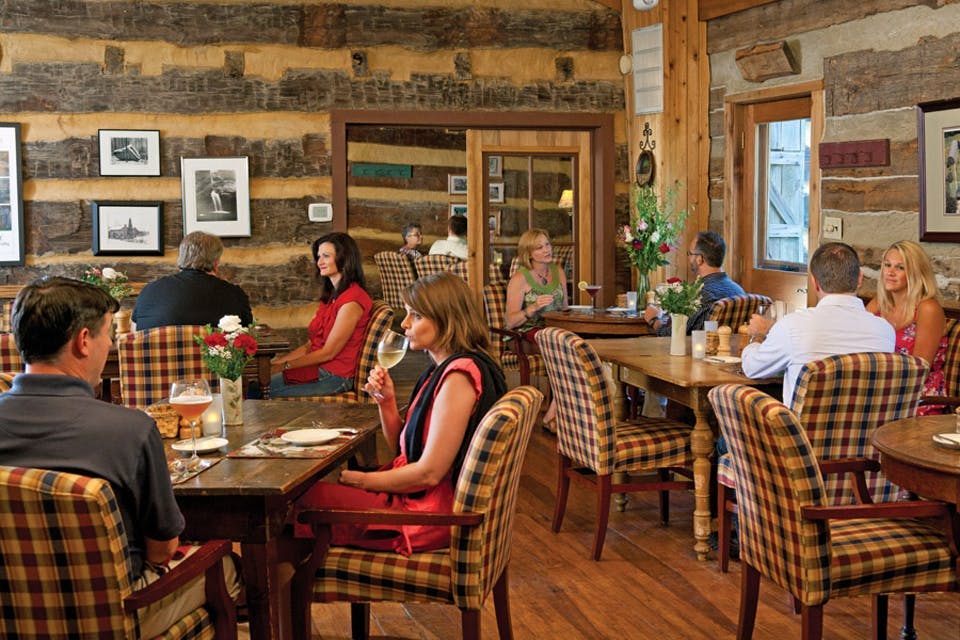
Back at the restaurant, Chef Bailey and his crew are too busy chopping to talk, but a few weeks earlier he came out of the kitchen to show us around the remodeled dining rooms and talk about his plans for the restaurant.
"I'm from California, so I'm used to year-round farmer's markets," says the 20-year kitchen veteran. "It's a lot different here. When I first came [to the restaurant], Peggy and I sat down with a [seed catalog] and I just pointed. Usually she said ‘I can get that,'" he recalls. Chef Bailey says he requested herbs, lettuces, purple-, chocolate- and white-colored bell peppers and "about 400 pounds of exotic potatoes." This summer, diners can expect to see these items on the menu, as well as a bigger selection of fish, including day-boat scallops and king salmon, plus a few Ohio wines on the wine list.
"Bromfield envisioned having a French chef on the property, cooking with the food he grew on the farm" Chef Bailey explains. "I'm an American chef, but I'm trying to do just that - I use local pork, beef, brown eggs and produce from the stand. All of the breads and desserts are made on site. So far, it's working," he says, before disappearing back into the kitchen to get ready for the dinner rush.
For Eilenfeld, who admits she "goes nuts" in the winter, farming is simply who she is. "My reward is taking my vegetables down to the stand, and watching people get excited when they see and smell them," she says. "And knowing that I'm selling my stuff from the same stand where Louis Bromfield sold his produce all those years ago," she chimes. "I'm so proud of that."
Malabar Farm Restaurant, 3645 Pleasant Valley Rd., Perrysville, is open for lunch and dinner Tuesday through Sunday. The restaurant is closed on Monday. For reservations, call 419/938-5205.
www.malabarfarm.org. The Malabar Farm Market is open daily, sunup to sundown.
|
Recipes
Courtesy of Malabra Farm Restaurant Chef Dan Bailey
|
|
Pickled Beets
½ pound kosher or sea salt
3 pounds fresh beets
3 tablespoons chopped fresh ginger
3 cloves chopped garlic
3 tablespoons whole mustard seed
1-¾ cups sugar
1-¾ cups apple cider vinegar
pinch of red pepper flakes
Preheat the oven to 300 degrees. Cover the bottom of a rectangular cake pan with ¼-inch layer of salt. Cut the tops and bottoms off the beets, and place on the bed of salt. Cover the pan with plastic, then foil, and bake the beets at 300 degrees until soft (about 1½ hours). Remove the beets from the pan, scrape away excess salt and let cool. Using a sharp knife, peel the beets. In a saucepan, combine the ginger, garlic, mustard seed, sugar, vinegar and pepper flakes and bring to a boil. Add beets and cook for 1 to 2 minutes. Let cool. Beets can be used as a garnish, in salads or eaten as is.
|
|
Herbed Goat Cheese
8 ounces high-moisture goat cheese (can use French or local Amish cheese)
3 pounds cream cheese
1 tablespoon each dried thyme, basil and oregano (leaf only, do not use ground)
1 tablespoon cracked black pepper
2 tablespoons chopped fresh garlic
1 tablespoon Dijon mustard
1 dash Tabasco
1 dash Worcestershire sauce
1 teaspoon salt
Garnish
4 ounces drained artichoke hearts
4 ounces chopped Kalamata olives
4 ounces diced roasted red pepper
4 ounces grated Parmesan cheese
In a large bowl, combine the first nine ingredients. In a separate bowl, mix the garnish ingredients until combined. Add the garnish to the cheese mixture, mixing until thoroughly combined. Cover and refrigerate for 24 hours. Serve with crackers, crusty bread or as a salad garnish.
|
|
Maple Pecan Diamonds
(A kitchen scale is recommended for this recipe.)
For the crust:
1 pound white sugar
2 pounds butter
3 pounds all-purpose flour
For the filling:
1 pound butter
1 pound brown sugar
4 ounces white sugar
8 ounces honey
4 ounces pure maple syrup
2 pounds whole pecans
6 ounces heavy cream
Preheat the oven to 325 degrees. In a bowl, using fingertips, combine the sugar, butter and flour until it forms a flaky dough.
Roll the dough to ¼-inch thickness, and lay into a half-size commercial sheet pan (12 ½-by-17-by-1 inch) and up the sides to the rim. Trim. Lay foil over the crust and fill with dried beans or pie weights. Bake at 325 degrees until lightly browned, about 5 to 6 minutes. Remove from the oven and let cool. Gently remove beans and foil.
Raise the oven temperature to 350 degrees. In a heavy-bottom saucepan, bring the butter, brown sugar, white sugar, maple syrup and honey to a boil. (Chef’s note: It’s not necessary to stir the mixture once the ingredients are at a boil). Boil the mixture rapidly for four minutes. Remove from the heat. Stir in pecans. Stir in cream until thoroughly combined. Spread mixture over the crust and bake until the mixture boils in the center. Let cool. Cut into triangles and serve.
|
Malabar Farm Restaurant Slide Show >>
Be the first to leave a comment.