











October 2008 Issue
Night Owls
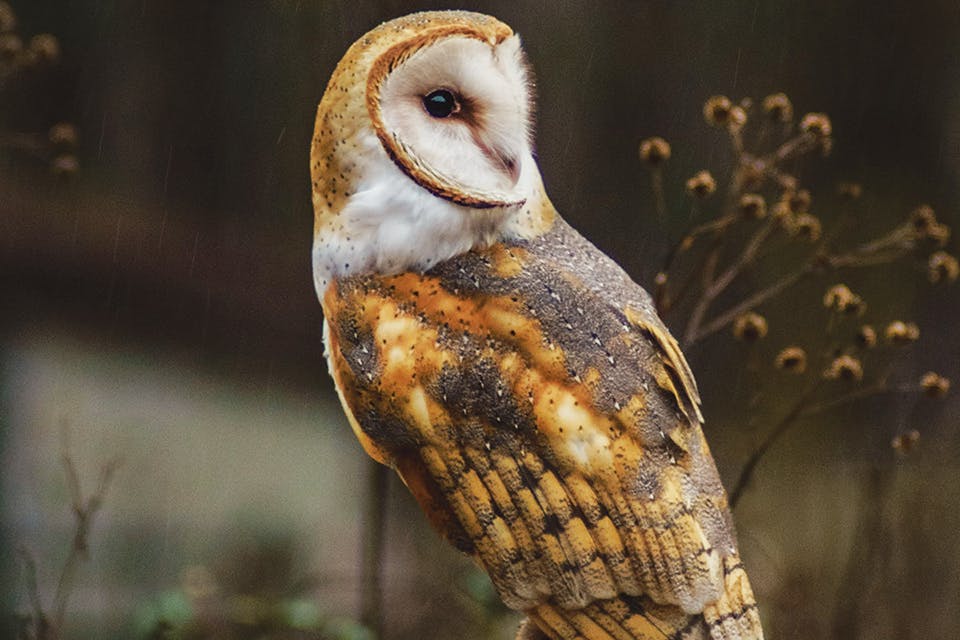
Researchers in Chillicothe are studying the saw-whet owl, an impossibly cute micro bird that makes its way through Ohio each fall.
The e-mail from the Ohio Division of Wildlife’s Jim McCormac popped up at 8:45 a.m. one morning last October. Subject: Micro Owls. The message held an invitation. “There is a group of bird banders in Chillicothe that specialize in capturing and banding Northern saw-whet owls, the smallest owl in eastern North America,” it said. “They have been banding these owls every fall for several years, but this year holds promise of being the best to date. Let’s work out a visit to see the owls firsthand.”
Attached was a picture of possibly the cutest creature I’ve ever seen. Perched almost lovingly on the fingers of one of the banders, its tiny frame and soft, oversized eyes seemed better cast in a Disney movie than a National Geographic special.
I was sold, and two weeks later, McCormac and I were heading down U.S. Rte. 23 to the Buzzards Roost Nature Preserve Banding Station near Chillicothe in Ross County, where the saw-whet project began five years ago this fall. “Saw-whets breed in northern forests and migrate through Ohio,” McCormac explains. “But until this operation began, no one had any idea that this many passed through here.”
Arriving at the station at dusk, the volunteer team of banders was already assembled. Led by researcher Kelly Williams-Sieg, the group is a mix of dedicated naturalists and birding enthusiasts who willingly brave the pitch-black woodland and brisk night temperatures to learn more about these little-known nocturnal creatures.
“In 2003 I went to a bird-banding training program at Powdermill Nature Reserve,” the biological research station of the Carnegie Museum of Natural History southeast of Pittsburgh, explains Williams-Sieg. During the week, the group caught and banded a saw-whet owl. “I came back to Ohio, looking for information about saw-whets, and found only two or three published reports,” she says. “I thought, ‘If they migrate through Pennsylvania, why wouldn’t they pass through Ohio?’ I just got hooked.”
Williams-Sieg, who earned her masters in environmental science from Ohio University last June and is working toward a Ph.D., acquired permission to use the preserve for her research from the Ross County Park District, and assembled equipment necessary for banding the birds.
The effort got off to a slow start in November of 2003. “We thought there weren’t any saw-whets in Chillicothe,” laughs Bob Placier, a natural resources instructor at Hocking College and volunteer who has been involved with the project since its inception.
“The first night we didn’t have success,” he recalls. “By the second night, we were getting discouraged.” Placier says about halfway through the second evening he saw a shape hanging in one of the nets. “I couldn’t believe it,” he says. “I put it in the bag and took it back up” to the small A-frame facility on site that doubles as a banding station. “I’ll never forget the look on Kelly’s face.”
The group logged seven birds in six nights that year, a modest beginning, but one Placier partly attributes to not having the proper nets or much local information to help them predict the owl’s migratory pattern. “Once we saw an owl fly in and bounce out because the nets weren’t the right size,” he says.
This night promises to yield better results. According to McCormac, the owl banders have caught and released about 20 owls in the past few nights, which he says is possibly the biggest invasion of this species ever recorded. Plus, the good fortune of having one of Ohio’s most prominent bird lovers was on our side; “Jim is a good luck charm,” says Placier. “We always get at least one bird if he’s here.”
As the sun went down along with the temperature, the researchers opened up the two sets of nets under the forest canopy, one stretching about 160 feet long and eight feet high, the other nearly 200 feet long, and started up the audio of the male owl’s territorial hooting — essentially their song, which lures owls of both sexes to investigate. After 45 minutes, the volunteers checked the nets; they turned up empty during the first session, but the second yielded two owls in each. We watched the volunteers carefully remove the owls and place them in a soft-cloth bird bag to transport to the research station.
Inside the A-frame, the data collection begins. Placier sits at a table surrounded by calipers, rulers and other equipment. Removing an owl from a bag, he first attaches a tiny clasp to its leg, which will let other researchers know where and when it was banded if it is caught again. “We band first in case it gets away,” he says.
Placier flattens the wing, then the tail against the ruler to measure length. Next he does a “fat and molt check” and looks at the animal’s wings under a black light to gauge the bird’s age based on the amount of pink that appears. “The newest feathers have the brightest pink colors,” he says. “The birds replace their feathers in the fall, so if it has one set of all bright pink feathers, we would know it was born that year. As birds get older, they may have two or three layers of feathers, so it becomes more difficult to assign an age.” While Placier collects his data, the owl makes an occasional sharp “clack clack clack” noise with its tiny beak, but is otherwise surprisingly calm.
“Want to hold one?” McCormac asks, already handing me one of the saw-whets. It perched on my index finger and I stroked the side of its head and neck, causing it to close its eyes and lean into me, hypnotized. “It’s likely that these owls have never seen humans before,” says McCormac. “They’re probably more curious about us than scared by us.”
While there may not be much existing data about Ohio’s transient saw-whet population, the birds certainly aren’t rare, says Williams-Sieg. “Saw-whets are a boreal forest bird,” she adds, explaining that their short, rounded wings are adapted to move through thickets and brush. Since they are small and need more coverage, they tend to hang out in dense, thick woods, preying on woodland mice and other small rodents.
By the end of 2007, Williams-Sieg says the Buzzards Roost station had banded 131 owls, a notable contribution to Project Owlnet, which monitors saw-whet migration in North America. “[The project] keeps us in contact with researchers and other stations in North America, so we can see other areas’ numbers and watch migration patterns,” says Williams-Sieg. So far, participating stations have banded more than 10,000 of the mini owls.
Despite the amazing efforts of Williams-Sieg and her team, they can’t do it all alone. To support their research, the banders sponsor an adopt-an-owl program. For $25, participants get a picture of their owl and migratory updates if it turns up at another station. The group also sponsors an adopt-a-net program, which, for $100, gives participants photos and details about birds caught in one of the station’s nine nets.
It’s a nightly nature lesson worth the trip. “We have discovered that the saw-whets migrate in and through Ohio in much greater numbers than we realized,” says Placier. “They used to be called ‘rare visitors,’” he says. “I don’t think we’d say that anymore.”
Be the first to leave a comment.