







July 2012 Issue
More Than a Dwelling Place
An Ohio couple realizes their longtime dream to build a universal design living laboratory.
Lori Murray
For most people, life changes occur gradually, and there is plenty of time to adjust. That wasn’t the case for Central Ohio resident Rosemarie Rossetti. Fourteen years ago, she was involved in a life-altering accident that left her paralyzed from the waist down. It happened when she and her husband, Mark Leder, were biking, and a 7,000-pound tree fell and crushed the lower half of her body. Almost from the minute Rossetti arrived home from the hospital, she and Leder embarked on a crusade to build a more accessible home. They wanted a place where Rossetti could cook in her own oven, plant flowers in her garden, and enter and exit without using a lift.
As the couple began to research universal design, they soon discovered that the concept goes way beyond specialized design for people with disabilities. Done right, universal design is for everyone. It has evolved into a much broader concept that improves products and environments for all people, regardless of size, age and ability.
“Universal design is not prescriptive; it’s more of a philosophy or strategy,” says Patrick Manley of
Manley Architecture Group in Columbus, architect for the project. “It’s crucial that the home not look like it was specially adapted.”
Rossetti and Leder are on a mission to spread this message to people in the building industry — architects, builders and designers — but also to people like you and me. They hope their house serves as a blueprint for across-the-board changes in home design that will impact future generations.
The couple’s journey since Rossetti’s accident has culminated with the completion of a 3,500-square-foot, four-bedroom, Prairie-style home — a one-of-a-kind living laboratory built on one and a half acres in Jefferson Township. Thanks to more than 180 national and international sponsors — including Marvin Windows, Kohler and KraftMaid — and a team of expert builders, architects and designers, the living laboratory is scheduled to open its doors for public tours later this summer. Proceeds from the tours will benefit spinal cord research at The Ohio State University.
“[This house] will be a national demonstration home like no other, with first-class building and design so people can borrow a few ideas and integrate them into their homes,” Rossetti says. “We like to say we are starting a movement.”
That movement incorporates more than just a home for Rossetti and Leder. The house will showcase principles of universal design, green living, healthy home living and feng shui, making it perhaps the most comprehensive home of its kind ever built. And it couldn’t be happening at a better time.
“Everybody knows someone who has a physical challenge or is aging in place. More than 78 million Americans fall into this category,” says Robert August, president of Denver-based
North Star Synergies Inc. and a consultant to Rossetti and Leder since the project’s inception six and a half years ago.
It’s worth noting that Leder acted as general contractor for the project, assuring that it meets his and the team’s standards and expectations. “It has to show well on behalf of all the people who are participating in this project,” he says.
The couple’s lifestyle provided some interesting dynamics for the home's design. For starters, Leder is more than
2 feet taller than his wife when she is seated in her wheelchair. That alone posed challenges in the kitchen and bathroom designs, and was the reason the couple turned to award-winning designer Mary Jo Peterson for her universal design expertise. In addition, Rossetti and Leder run separate businesses from home offices, entertain frequently and often host overnight guests.
The home’s universal design features include everything from step-free entrances and casement windows to wider door openings and hallways. The kitchen features island countertops at three different levels, and 50 percent of the kitchen can be accessed from a seated position. Cupboards were lowered, making it easier to reach the bottom shelves; a side-hinged oven means that Rossetti can access it; and open knee space exists under the sinks.
As for green features, the roof was made from recycled aluminum beverage cans and all windows were made with low-e glass to minimize the heat from the sun’s rays. Channel drains around the perimeter of the house capture rainwater runoff from the roof and send it to a built-in harvesting system and 500-gallon holding tank in the basement.
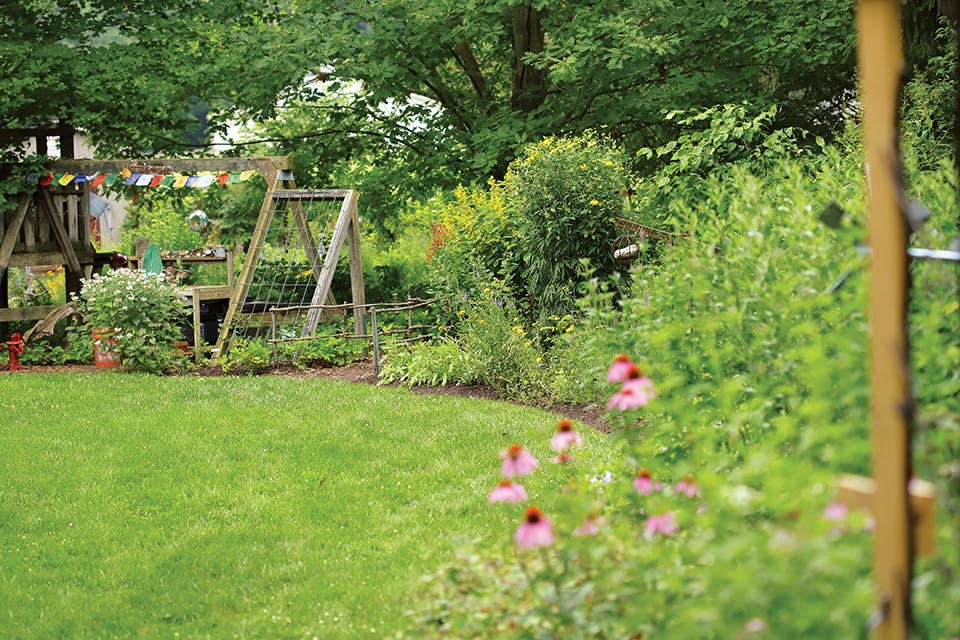
Outside, the patio and grounds will showcase a waterfall and raised flower beds, Ohio native plants and wheelchair-accessible pathways. Rossetti, a horticulturist by trade, has played an integral role in planning the landscaping.
Still, the most unique aspect of this home is that it will continue to be a resource for years to come. The basement, which can be accessed by elevator, is being outfitted as a classroom for universal design education and presentations. Rossetti, who has mastered the art of public speaking, will continue to speak both at the house and at various events around the country.
In the end, according to Rossetti, the project is all about helping families, “More people are building a house to live in and not trade up. Extended families are living together again. We are holding on to things longer — and we are living longer,” she explains. “This is our legacy. It’s our opus. It’s not about the house; it’s about the mission.”
For more information about the project and upcoming tours, visit
udll.com.
UNIVERSAL DESIGN/GREEN FEATURES
Rossetti and Leder will apply for five certifications under programs such as the NAHB National Green Building Program and LEED for Homes. Their home and universal design living laboratory highlights healthy home principles and seeks to minimize its environmental impact. Here are some of the key features:
✔ Step-free entrances with a gradual
level grade and no ramps
✔ Doors wide enough for a wheelchair
or walker
✔ Wide, 48-inch hallways
✔ Lever handles on doors and faucets
✔ Casement windows
✔ Elevator
✔ Electrical outlets raised 25 inches
above the floor
✔ Hardwood and non-slip tile floors
✔ Front-loading washer and dryer
✔ Open knee space under all sinks
and cook top
✔ Kitchen counters at multiple heights
✔ Side-hinged microwave and oven doors
✔ Large bathrooms with decorative
grab bars
✔ Large bathtub with grab bars
✔ Curbless roll-in showers with grab bars
✔ Hand-held shower fixture
✔ Raised toilet seats
✔ Recycled and/or renewable resources in roofing, countertops, flooring and insulation
✔ Energy-efficient appliances, lighting, heating and cooling systems
✔ Solar panel on recycled aluminum roof
✔ Energy-efficient windows
✔ Products used to build the home emit fewer health-endangering gases or volatile organic compounds (VOC)
Be the first to leave a comment.