






April 2006 Issue
Landscape Magic
Ron Rollins
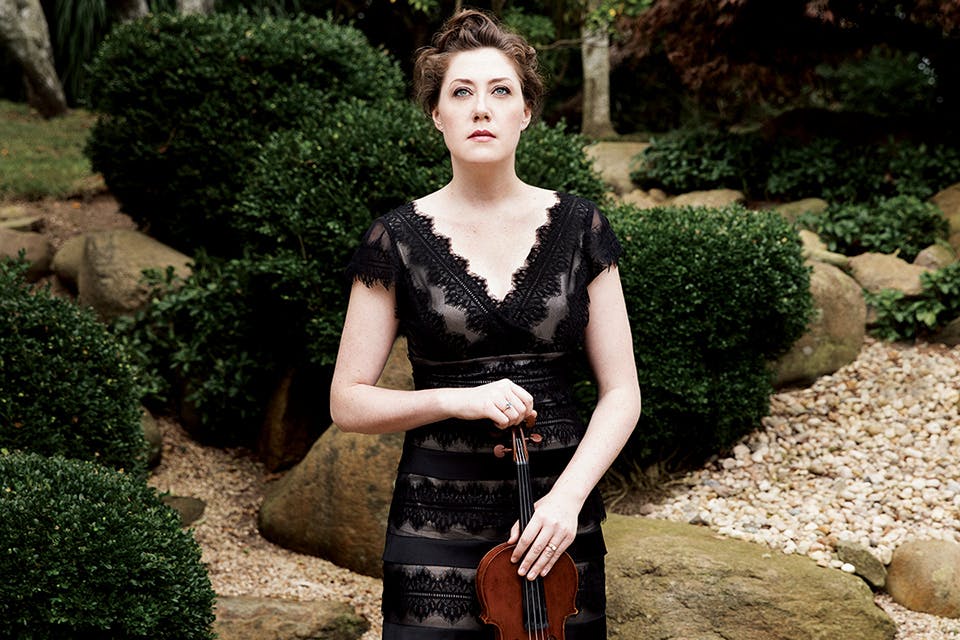
April Gornik laughs lightly when she admits that she knew, as a young art student aspiring to be important and cutting edge, that painting landscapes really wasn't very cool. That didn't stop her from doing them, though.
You probably couldn't get Stephanie Wiles to say anything bad at all about landscape paintings, but you don't have to nudge her very hard to get her to tell you how happy she is to show them. Gornik's, especially.
It's nice, then, that the two of them got together - in an accidental, but pleasantly balanced geographical switcheroo whose pure coincidence might not have meant much unless you could apply to it a scenario like this: art museum director encounters artist's work, is struck epiphany-like by the soaring beauty of it, pursues her quarry and lands a big show of said work at her art museum.
Which is pretty much how it all happened - along with the fact that Ohio is at the center of the whole thing.
Start with Gornik. The 52-year-old artist, one of the pre-eminent realist painters working in the United States today, was born and raised in the Cleveland suburbs - Mayfield Heights, to be exact - and remembers the days in the 1970s when she cut her aesthetic teeth at the Cleveland Institute of Art (she also studied at the Nova Scotia College of Art and Design), and in the corridors of the Cleveland Museum of Art.
"I passed up the landscape sections," she says with a chuckle. "I mean, I knew that wasn't cool."
She wanted to make conceptual art, the stuff that was hot in the New York art world that she felt beckoning, and to which she eventually moved. From abstraction she eventually began exploring ways of capturing light, and recalls thinking up "a landscape image I desperately wanted to paint." She did, and realized soon enough that "landscapes were where my soul lived."
Now Gornik makes quite more than a living letting the scenes she sees in dreams and vivid imaginings loose upon massive canvases that hang in galleries and art museums around the world.
Which is where Wiles comes in. While Gornik moved from northeast Ohio to settle in New York, the 46-year-old art administrator moved from New York and Connecticut in 2004 to northeast Ohio, where she became director of the Allen Memorial Art Museum in Oberlin.
She had seen Gornik's paintings before, but oddly enough felt she didn't understand them until she moved to Ohio.
"There is this power in her paintings, but I felt I had an incredible understanding of her work only after I lived in Ohio - I realized as I was out driving around in the country with my kids, that what I saw in her paintings was exactly what I was seeing in the passing fields in Ohio, the wonderful light and the weather.
"Then I flashed on her being from Cleveland," Wiles says - and a connection was made. Gornik had already worked with the Neuberger Museum of Art in New York to put together what she calls a "mini-retrospective" of her work, and Wiles arranged to bring it to her museum in Oberlin.
"April Gornik: Paintings and Drawings" is at the Allen Memorial Art Museum until June 4, and includes more than 20 works that range from her very large paintings, such as the soaring clouds-and-seascape view in "Sun, Storm, Cloud" from 2004, to minutely detailed, moody charcoal drawings like "Winding Trees," from 2005. Gornik says the works on display convey the sense she tries to establish for a viewer of floating within the scene, and of capturing a certain psychological state as much as a particular view. "Landscape is really an excuse for portraying this other state," she says. "But it's an awfully elaborate excuse."
"I'm really happy," Wiles says of Gornik's first museum exhibition in her native state. "April is a great artist, and she deserves to be seen."
Gornik's work isn't all to see at the Oberlin College-owned museum, one of the state's lesser-known artistic gems. Housed in a gorgeous Italianate building near downtown that was designed by the renowned architect Cass Gilbert and founded in 1917, the museum is comparatively small, but has a lauded, complex collection of more than 12,000 items that range across the whole of art history. It's particularly strong in Renaissance and late medieval art, 19th-century landscapes, Asian prints, decorative arts and early modernist work.
It also brings in a steady stream of visiting exhibitions. In addition to the Gornik show, the museum is now displaying a variety of works on loan from the Cleveland Museum of Art while it undergoes renovation.
"I love this museum," says Wiles, now in her second year as director. "I'd left a big, urban museum looking for something different, and when I saw the Allen I thought it was great. It's one of those classic small museums, with an incredibly idiosyncratic collection that's also deep." l - Ron Rollins
Be the first to leave a comment.