



August 2012 Issue
August 2012 Digest
A new theater presents canal history, a preserve protects swamp life, and a community garden brings people together.
Bygone Days
What better location for a play about the Ohio and Erie Canal than in a theater near the banks of the old waterway? The Lantern Theatre ensemble is using that ambiance as the backdrop for its debut production, Singin’ on the Ohio.
Producer Bill Hoffman presents the two-actor play in what locals call “The Big Red Barn” at Canal Corners Farm and Market in Valley View. Once known as the Gleeson Farm, the property is leased from the Cuyahoga Valley National Park as part of the Countryside Initiative farm conservation project. Since a portion of the former dairy barn still stores straw bales for the working farm, the setting makes the ideal rustic environment for the kinds of productions Hoffman envisions for the troupe.
Set in 1845, Singin’ on the Ohio is written by Cleveland playwright Eric Schmiedl, who also portrays Timothy Egan, an Irish-American immigrant who pilots the Annabeline, a canal boat traveling from Cleveland to Portsmouth. The only passenger on board: Bit Mullers, a 15-year-old African American orphan portrayed by Andrea Belser, who’s traveling to join relatives in the Queen City.
“In the mid-19th century, the canal was like the dot-com companies of today,” says Schmiedl. “If you had enough money to buy a boat, you could go into business. You might not be sure if you could make it, but you could try.”
The characters face several challenges on their journey south. They navigate through 158 locks, including Lock 3 in Akron. When a raging storm destroys the aqueduct that allows their passage, the pair spends five days outside of Coshocton. Other referenced communities include Adams Mills, Frazeysburg, Newark, Walnut Creek, Groveport and Columbus. Before their journey ends in Portsmouth, the two characters come face to face with the racial climate of the day.
“Along the way, Bit teaches Timothy to read and he teaches a shy girl to sing,” says Hoffman, a former producer for Cleveland Play House Children’s Theatre.
“It’s also the story,” he adds, “of finding your calling in life.”
And, like life along the canal in its heyday, theater accommodations are not luxurious. The barn has no heat, air conditioning or running water. But don’t worry. Porta-Potties are on-site and large barn doors and windows allow a comfortable breeze to circulate. —
Jill Sell
Canal Corners Farm and Market is located at 7243 Canal Rd., Valley View 44125. Performances are at 1 p.m. and 3 p.m. Saturdays and Sundays through Sept. 16. Tickets are $10. For more information, call 216/401-5131.
Back to Nature
Replace the new Horseshoe Casino in Cleveland with waist-high cinnamon ferns. Imagine wood frogs and spotted turtles in shallow ponds where the Rock and Roll Hall of Fame and Museum now stands. Forget Cleveland Browns Stadium. Think acres of buttonbush shrubs and wild blueberries, cushiony sphagnum moss hugging the ground and stately tupelo and yellow birch trees.
If that land-of-the-lost, Cleveland-before-settlement scenario is hard to picture, the Geneva Swamp Preserve in Ashtabula County is the helpful visual to make it appear before your eyes. Owned by the Cleveland Museum of Natural History and protected by its Natural Areas Program, the preserve is part of the largest remaining high-quality swamp forest on the eastern Lake Erie Lake Plain. It is indeed Cleveland untouched.
The museum, which began acquiring the preserve through donations and purchases in 2008, owns 242 acres of West Geneva Swamp and 101 acres of East Geneva Swamp. Plans are under way to acquire additional acreage.
“The museum protects more than 5,000 acres of natural habitats, says botanist Jim Bissell, the museum’s coordinator for natural areas and director of conservation. “But we didn’t have this unique type. It is an amazing urban preserve. It’s what was missing.”
Located approximately one mile apart in Geneva and Geneva Township, both sections of the preserve are filled with rare plant and animal life, highlighted by black-spotted orange beetles and log ferns. Listen closely and the sound of Bess beetles, conversing with each other using 14 different tones, can be detected. The swamp is also the museum’s only preserve that’s home to the airy and beautiful water horsetail perennial.
Museum staff and volunteers have replaced much of the phragmites, tall invasive grasses, with native plants. Several seasonal vernal pools also have been deepened to encourage amphibian populations.
Bissell talks excitedly about the potential the East Geneva Swamp — located near Geneva Platt R. Spencer Elementary School — has of becoming a land lab for students. The curator envisions the creation of bridges and paths that will offer students direct access to the clear running stream, massive colonies of feathery New York ferns, songbirds and “frogs that croak as loud as chickens.”
It will be the perfect place, Bissell says, for students in junior and senior high school to study water quality and conservation issues. The museum hosts special events there throughout the year. Although Geneva Swamp is not open to the public, field trips can be arranged through the museum’s Natural Areas division. —
JS
For more information, call 216/231-4600 or visit cmnh.org.
From Vacant to Vibrant
Cynda Kash is never one to ignore a good idea. So, when she looked at the empty lot behind her Middletown home and thought it should be a community garden, she hit the ground running and pursued her vision until it bloomed into a community garden.
As a member of a preservation committee in Butler County, Kash helps restore buildings and protect landmarks. She knew her passion for gardening was one that could be shared, and that a community plot would add vitality to an area that could use it. Middletown city officials supported Kash’s idea and leased the property for $1 a year to the nearby United Methodist Church.
“A community garden,” Kash says, “has the power of bringing people together, and erases the stigma of a vacant lot.”
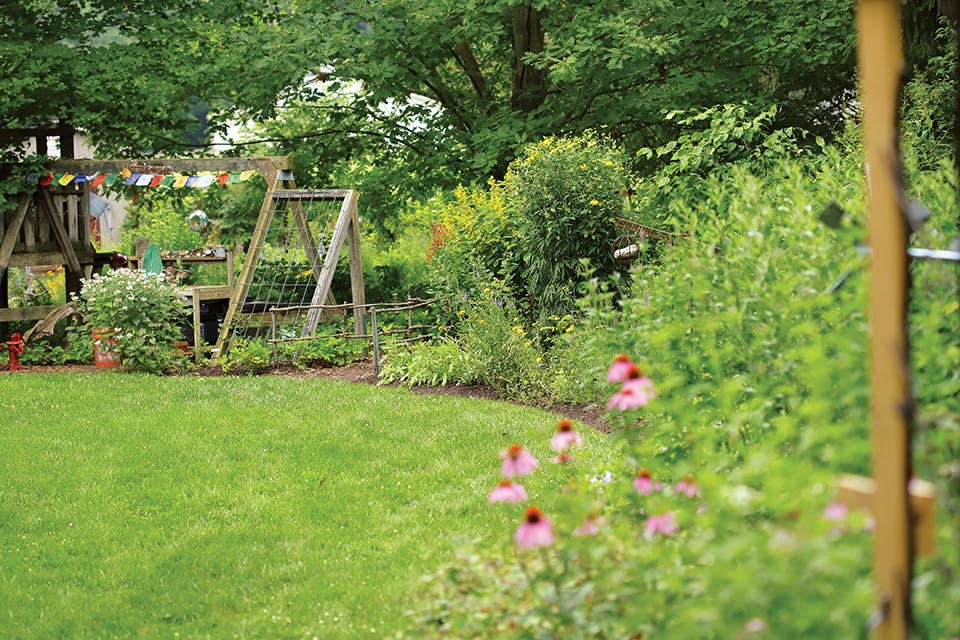
With the help of local clergy — including Pastor Carrie Jena of the Gathering Church, a mission of the United Methodist Church — and parishioners, Kash and her team were able to transform the former parking lot into an environmentally friendly destination consisting of 24 beds planted with seasonal foods. Noah Rogers, an Eagle Scout candidate, built a rain drum, a deck with a platform and a pathway for the garden. Residents of all ages banded together to cultivate the bounty and collect it for local families in need.
After such a positive, successful experience, Kash says communities hoping to build their own gardens shouldn’t be afraid to contact local government.
“Approach the city, because you don’t know [what they’ll say] until you talk with them,” she advises.
—
Kaitrin McCoy
Be the first to leave a comment.